

What if the most important tool for your move isn't the van or the tape, but the humble medium-sized box? We've all been there, staring at a growing stack of belongings and wondering how to fit it all in without the bottom falling out. It's frustrating when a box becomes a lead weight that nobody can lift safely, or worse, when your favourite kitchenware rattles around and breaks because the container is too large for the contents.
Knowing exactly what to pack in medium moving boxes is the secret to a smooth, injury-free moving day. We understand that you want your transition to a new home to be as calm and efficient as possible. This 2026 guide is designed to take the guesswork out of your preparations by providing a clear, room-by-room list of items that belong in these versatile workhorses. We'll explain the "Goldilocks" rule for weight and show you how to use professional-grade materials to ensure everything from small appliances to heavy books stays secure. By the time you've finished reading, you'll have a practical plan for a damage-free move that keeps your removal team happy and your treasures safe.
Key Takeaways
- Learn why the 45cm cube is the "versatile workhorse" for items that are too awkward for small boxes but too heavy for large ones.
- Discover exactly what to pack in medium moving boxes, including small kitchen appliances like kettles and toasters, to keep your home essentials organised.
- Follow the 20kg weight limit to ensure every box is safe to lift and won't buckle under pressure during transit.
- Identify the best ways to pack living room decor and bedroom items like shoes and handbags to maximise space without risking damage.
- Understand the importance of using professional-grade, double-walled cardboard to provide a sturdy foundation for your most valued possessions.
The Versatile All-Rounder: Understanding the Medium Moving Box
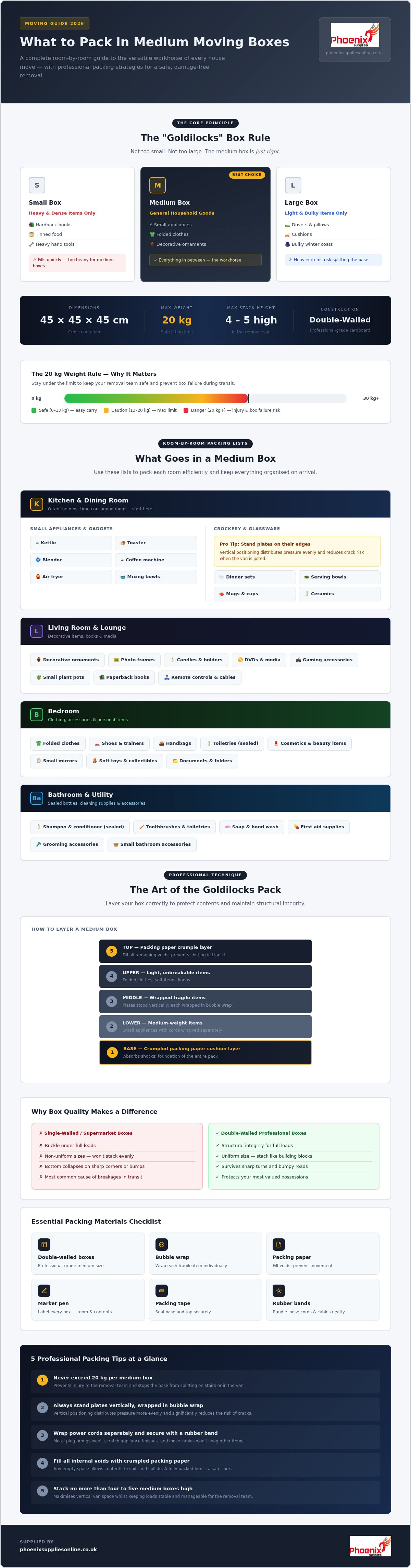
The medium box is often the unsung hero of a successful house move. Measuring approximately 45x45x45cm, this cubic container offers a balanced volume that fits far more than a standard book box without becoming an unliftable anchor. When homeowners ask what to pack in medium moving boxes, the answer usually involves those everyday items that don't quite fit the extremes of your inventory. It is the "Goldilocks" of packaging; it's not too small to be inefficient, yet not so large that it becomes a hazard to your lower back.
Strength is just as vital as size. Professional-grade medium boxes use double-walled cardboard, which provides the structural integrity needed to survive a journey in a removal van. Whilst cheaper, single-walled alternatives might look similar on the surface, they often buckle under the weight of a full load. A sturdy double-walled box ensures your belongings aren't crushed when the van navigates a sharp turn or a bumpy country lane. This extra layer of protection is what allows you to stack your life securely from one home to the next.
Why Size and Strength Matter for Your Van Load
Efficiency in a removal van relies on a modular approach. Because professional medium boxes are often uniform in size, they stack together like building blocks. This creates a stable "wall" of inventory that doesn't shift or slide during transit. We recommend stacking these double-walled boxes no more than four or five high. This height maximises vertical space whilst keeping the load manageable for the removal team. Using high-quality supplies rather than flimsy supermarket cast-offs prevents the boxes at the bottom from collapsing, which is one of the most common causes of breakages during a move.
Medium vs. Small and Large: The Quick Distinction
Understanding exactly where each box fits in your strategy makes the packing process much faster and more organised. It's best to think of your boxes as a hierarchy of weight and volume:
- Small Boxes: These are reserved for heavy, dense items. Think of hardback books, tinned food, or heavy hand tools. If you try to fill a medium box with these, it will quickly exceed a safe lifting weight.
- Large Boxes: These are best for light, voluminous items. Use them for duvets, pillows, cushions, and bulky winter coats. Filling these with anything heavier risks the bottom splitting.
- Medium Boxes: This is the home for everything in between. It's the perfect size for small kitchen appliances, folded clothes, and various decorative ornaments.
By using the medium box as your primary container for general household goods, you'll find the van is easier to pack and your items are far better protected.
Packing the Heart of the Home: Kitchen and Dining Room Essentials
The kitchen is often the most time-consuming room to tackle during a relocation. It is filled with an awkward mix of heavy gadgets, sharp utensils, and delicate ceramics. When you are deciding what to pack in medium moving boxes, your kitchen cupboards should be your primary focus. These containers provide the necessary depth for mixing bowls and small appliances whilst remaining manageable enough to carry through narrow doorways. Using a consistent box size for your kitchen essentials also makes it much easier to organise your new pantry once you arrive. If you want to keep snacks fresh for your family during the transition, you can check out Coolpod for their patented freezable pouches, which are ideal for use whilst on the move.
Most British kitchens revolve around the kettle and toaster. These daily essentials are the perfect fit for a medium-sized container. We recommend wrapping power cords separately and securing them with a rubber band; this prevents the metal prongs of the plug from scratching the appliance's finish. For gadgets like toasters or blenders, fill any internal gaps with a small amount of clean packing paper to stop loose parts from shifting. Modern kitchen must-haves like air fryers and coffee machines also sit securely in these boxes. If you're preparing for a larger move, ordering your medium moving boxes in bulk ensures you have a uniform stack that fits perfectly in the removal van.
Crockery and Glassware Strategies
While heavy stacks of plates might seem like a job for a smaller box, your everyday dinner sets actually thrive in a medium container when packed correctly. The secret is to avoid stacking plates flat on top of each other. Instead, wrap each individual piece in bubble wrap for moving house and stand them on their edges. This vertical positioning distributes pressure more evenly and significantly reduces the risk of pressure cracks if the box is jolted.
You should also use this space for your nesting mixing bowls and Tupperware sets. Place a layer of protective wrap between each bowl to prevent them from wedging together. Once the main items are in, check for any "rattle" by gently shaking the box. If you hear movement, fill the voids with crumpled paper or even clean tea towels. A box that feels solid and silent is far more likely to survive the journey without a single breakage. By focusing on these medium-sized essentials, you'll find the most fragile room in your house becomes the easiest to manage.
Beyond the Kitchen: Living Room, Bedroom, and Bathroom Items
Beyond the kitchen, the medium box continues to prove its worth as the ultimate relocation all-rounder. It's the ideal size for those items that are too large for a small "heavy" box but too substantial to be tossed into a large "light" box. When you're deciding what to pack in medium moving boxes in the living room, start with your media collections and tabletop decor. Board games, DVDs, and small table lamps fit perfectly into these dimensions, allowing you to keep sets together without wasting space.
Decorative Items and Soft Furnishings
For high-value tech and media equipment that requires more specialised care than standard household decor, you can discover ALEON to see how aerospace-grade aluminium cases compare to other protective options.
Vases, picture frames, and delicate ornaments need careful handling to survive the journey. Instead of using excessive amounts of paper, you can use soft furnishings like cushions and throws to act as natural padding for fragile decor. Placing a small, wrapped vase in the centre of a medium box and surrounding it with sofa cushions provides excellent protection. This method also saves space in your larger boxes that would otherwise be filled with light, bulky items. For board game enthusiasts, these boxes are deep enough to stack several games vertically. This prevents the lids of the bottom games from bowing under pressure during the move.
Clothing and Linens
While wardrobe boxes for moving are the best choice for suits, coats, and delicate dresses, medium boxes are perfect for the rest of your wardrobe. They're the right size for folded t-shirts, jeans, and heavy knitwear. We recommend using tight folding techniques to maximise space without making the box too heavy to lift. It's much easier to organise a chest of drawers when the contents are already grouped in manageable containers.
Bathroom and bedroom linens also find a natural home here. Towels and bed sheets make fantastic "top-fillers" for your packing strategy. If you have a box that's nearly full of heavier items, adding a layer of towels at the top prevents the contents from rattling whilst keeping the overall weight manageable. Hair styling tools, like hair dryers and straighteners, should be placed in the middle of these boxes, ideally wrapped in a hand towel for extra cushioning. Managing miscellaneous items like children's toys or hobby supplies is also simpler with this box size. It's much easier to carry one medium box of toys into a new playroom than it is to struggle with an oversized, overfilled container that might split.
The Art of the 'Goldilocks' Pack: Weight, Volume, and Protection
Achieving the perfect pack is about more than just filling space; it is about structural integrity and physical safety. Deciding what to pack in medium moving boxes requires a bit of strategy to ensure the weight remains manageable whilst the contents stay secure. If a box is too heavy, it risks injury to you or your removal team. If it is too light or half-empty, it becomes a structural liability that can collapse when other items are stacked on top of it in the van.
Weight Distribution and Safety
As a general rule, no single box should exceed 20kg. This is often considered the maximum safe lifting weight for a single person in a domestic moving context. To stay within this limit, always place your heaviest items at the bottom of the box to maintain a low centre of gravity. This makes the container much more stable when it is being carried or moved on a sack truck.
While it's tempting to fill every corner with your library, you should never pack a medium box entirely with books. These are much better suited for small moving boxes for books, which keep the weight dense but the container small enough to carry safely. Instead, use your medium boxes for a mix of item weights. Before you apply the final strips of tape, give the box a test lift. If you find yourself straining, it's a clear sign that you need to redistribute the contents into two separate containers.
Void Filling and Cushioning
The biggest enemy of a safe move is movement inside the box. Any "rattle" suggests that items could collide and break during transit. We recommend using bubble wrap to protect the sharp corners of appliances or the edges of picture frames. Once your main items are positioned, fill any remaining gaps with scrunched-up packing paper or clean newsprint. This creates a solid internal structure that supports the lid from beneath.
For larger or more delicate items within the box, such as a heavy kitchen mixer or a collection of framed photos, wrapping them in removal blankets provides a thick, cushioned barrier that prevents scratches. Ensure the lid of the box is perfectly flat before sealing. A bulging lid prevents safe stacking, whilst a sunken lid suggests the box is under-filled and prone to crushing.
To give your boxes the best chance of survival, use the H-taping method. This involves sealing the main centre seam and then running tape along the two side edges of the flaps, creating a letter 'H' shape. It reinforces the corners and ensures the bottom won't burst under pressure. If you are starting a full house relocation, you can find professional-grade medium moving boxes designed specifically for this type of heavy-duty stacking.
Why Quality Matters: Choosing Reliable Medium Boxes for Your Move
The success of your relocation depends entirely on the foundation of your packaging. While it is tempting to collect free containers from local supermarkets, these are rarely designed for the rigours of a house move. When you have carefully planned what to pack in medium moving boxes, the last thing you want is for the cardboard to fail under the weight of your kitchen appliances or favourite decor. Choosing professional-grade materials ensures that your planning isn't wasted by a structural collapse during transit.
As a family-run business, we take pride in providing the kind of personal service that larger e-commerce sites often lack. We understand that you aren't just moving "stuff"; you're moving your life. This is why we focus on high-quality, double-walled cardboard that offers the strength needed for stacking and protection. Investing in proper house moving boxes in kits can save significant stress and money by preventing damage to expensive items like coffee machines or designer handbags.
Professional Grade vs. Free Boxes
Structural integrity is the main difference between a professional removal box and a second-hand one. Cardboard is a natural fibre that weakens every time it is folded, dampened, or subjected to weight. Supermarket boxes have often been stored in humid environments or have already reached their structural limit. They lack the consistent, standardised dimensions of professional supplies, which makes loading a van much more difficult. Using uniform medium boxes allows for a modular, stable stack that won't shift when the van is in motion. This provides the peace of mind that comes from knowing your possessions are cradled in a sturdy, reliable shell.
Next Steps for Your Move
Before you begin, it's helpful to calculate exactly how many containers you'll need. For a typical three-bedroom house, we generally recommend between 20 and 30 medium boxes to handle the bulk of your kitchen, bedroom, and living room items. It's always better to have a few spares than to run out on the final night of packing.
You should also ensure you have everything on your packing materials list, from high-quality tape to protective bubble wrap. If you're unsure about the right quantities for your specific project, the Phoenix Supplies team is always within reach to provide bespoke advice. Once you have your supplies ready, use this final checklist to start your move on the right foot:
- Check the base: Ensure the bottom is sealed with the H-taping method.
- Weight check: Keep each box under the 20kg limit for safe lifting.
- Label clearly: Mark the room and a brief summary of the contents on the side of the box.
- No rattles: Fill all voids with packing paper to prevent movement.
By following these steps and using the right materials, you'll ensure your move is managed with the care and reliability your home deserves.
Mastering Your Packing Strategy for a Stress-Free Move
Mastering your packing strategy doesn't have to be an overwhelming task. By understanding exactly what to pack in medium moving boxes, from your daily kitchen kettles to bedroom linens, you can create a move that's organised and safe. Remember to stick to the 20kg weight limit and use the H-taping method to keep your double-walled containers secure. These simple steps prevent the common frustrations of split boxes and broken items whilst making the loading process much more efficient.
Choosing the right materials is just as important as the technique itself. At Phoenix Supplies UK, we're a family-run business with over 20 years of expertise in helping people relocate. We provide high-strength double-wall cardboard as standard to ensure your belongings are protected throughout their journey. With free national delivery included on all orders, you can get professional-grade supplies delivered straight to your door without any hidden costs.
Browse our range of heavy-duty Medium Moving Boxes at Phoenix Supplies UK and take the first step towards a manageable relocation. We're here to help you move with confidence. Happy packing!
Frequently Asked Questions
How many medium moving boxes do I need for a standard house move?
A typical three-bedroom house usually requires between 20 and 30 medium moving boxes to handle the majority of household items. This size is the most versatile, making it the primary choice for kitchens, living rooms, and bedrooms. If you have a larger home or a significant amount of kitchenware, you might need up to 40. We suggest ordering a few extra to avoid the stress of running out mid-pack during your move.
Is it better to use medium or large boxes for kitchen items?
Medium boxes are almost always better for kitchen items because they prevent the load from becoming too heavy to lift safely. Large boxes should be reserved for light, bulky items like duvets or pillows. When you consider what to pack in medium moving boxes in the kitchen, focus on small appliances, mixing bowls, and everyday dinner sets. These items are dense; filling a large box with them would likely cause the bottom to split.
What weight can a double-wall medium moving box actually hold?
A professional-grade, double-walled medium box can technically hold up to 25kg or 30kg, but we strongly recommend keeping the total weight under 20kg. This limit ensures that the box remains manageable for a single person to lift without risking injury. The double-wall construction provides the structural strength needed to stack boxes four or five high in a removal van without the bottom containers buckling or collapsing under the pressure of the load.
Can I pack books in a medium moving box?
You shouldn't pack a medium moving box entirely with books as it will quickly exceed a safe lifting weight. Books are dense and heavy, so they are much better suited to small moving boxes designed specifically for heavy loads. If you must use a medium box for books, only fill the bottom third with them and use the remaining space for lighter items like cushions, towels, or soft toys to keep the weight balanced.
How do I stop items from moving around inside a medium box?
To stop items from shifting, you should fill all empty spaces with void-filling materials like scrunched-up packing paper or clean newsprint. Ensuring there is no "rattle" is essential for a damage-free move. Wrap individual items in bubble wrap or removal blankets first, then pack them tightly together. If you find gaps at the top, a folded towel or small cushion makes an excellent final layer to keep everything secure during the journey.
Should I tape the bottom of the box differently for heavy items?
Yes, we recommend using the H-taping method for all boxes, especially those containing heavier items. This involves sealing the middle seam and then applying tape across the side edges of the flaps. This reinforces the corners and prevents the bottom from bursting open during transit. Always use high-quality packing tape rather than standard stationery tape, as it provides the necessary adhesive strength to bond with the cardboard fibres securely and reliably.
What items should never be packed in a medium moving box?
You should never pack hazardous materials, such as flammable liquids, gas canisters, or corrosive chemicals, in any moving box. Very heavy items like weights or large toolsets are also unsuitable for medium boxes and should go in smaller, reinforced containers. Additionally, avoid packing extremely bulky items like large pillows or duvets here; these are better suited for large moving boxes to ensure you aren't wasting the structural strength of your medium-sized containers.


