

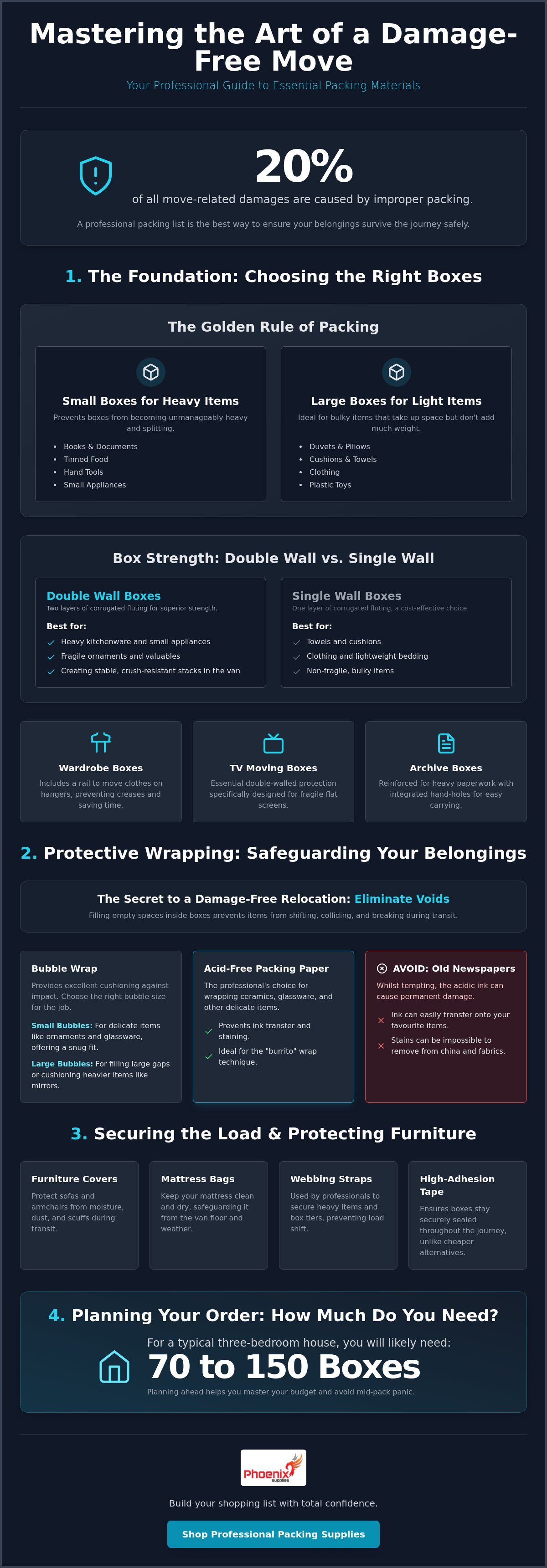
Did you know that improper packing is responsible for 20% of all move-related damages? It’s a sobering thought when you’re standing amongst your life’s possessions, wondering if a few rolls of tape and some old newspapers will really keep everything safe. You aren’t alone. If you feel a flash of anxiety about fragile items or confusion over which box strengths you actually need, we can help. Having a clear, professional packing materials list for moving is the best way to quiet that inner worry and ensure your belongings survive the van journey.
We believe that moving house should be a milestone to celebrate, not a logistical nightmare. That’s why we’ve put together this expert guide to help you master the art of a damage-free relocation. You’ll learn exactly why a typical three-bedroom house requires between 70 and 150 boxes, and how the right protective layers can save your heaviest furniture. This article previews every essential item required for a successful UK house move, from wardrobe boxes to removal blankets, so you can build your shopping list with total confidence.
Key Takeaways
- Learn how to stack a removal van safely by using uniform box sizes and following the rule of placing heavy items in small boxes to prevent structural collapses.
- Discover why acid-free packing paper is essential for your delicate items to avoid the permanent ink staining often caused by using old newspapers.
- Find out how to safeguard your sofas and beds from moisture and dust using specific mattress and furniture covers designed for the transit environment.
- Understand the importance of using professional webbing straps and high-adhesion tape to keep your load stable and silent throughout the journey.
- Master your budget and avoid mid-pack panic by using our comprehensive packing materials list for moving to accurately estimate exactly how many supplies your home requires.
The Foundation: Choosing the Right Cardboard Moving Boxes
Boxes are the literal building blocks of your move. When you start building your packing materials list for moving, the quality and shape of your cardboard containers will dictate how smoothly your moving day goes. Professional movers always aim to create "tiers" in the van; these are solid walls of boxes stacked from floor to ceiling. To achieve this, you need uniform box sizes. If you use a random assortment of mismatched containers, the stack becomes unstable and prone to shifting when the van turns a corner. A stable tier ensures that the weight is distributed evenly, preventing the boxes at the bottom from being crushed under the pressure of the load above.
The golden rule for any relocation is "Small for Heavy, Large for Light." It sounds simple, but it's the most common mistake people make. Small Moving Boxes are designed for dense items like books, tinned food, or hand tools. If you put these in a Large Moving Box, the weight quickly becomes unmanageable and the bottom is likely to split. Conversely, Large Moving Boxes are perfect for pillows, duvets, and light plastic toys. Following this logic protects your belongings and, just as importantly, protects your back from unnecessary strain during the lifting process.
Double Wall vs. Single Wall: Which Do You Need?
Understanding the structural difference between box types is vital for a damage-free move. Double wall boxes feature two layers of corrugated fluting, providing significantly higher crush resistance and stacking strength. You should choose these for heavy kitchenware, small appliances, and fragile ornaments that require extra rigidity. They are the industry standard for protecting valuables during transit. Single wall boxes are a cost-effective choice for lighter items like towels, cushions, and clothing. Even with the strongest boxes, you should still use protective cushioning materials to fill any internal gaps. This prevents items from rattling and absorbing shocks whilst the van is in motion.
Specialised Boxes for Wardrobes and Electronics
Standard boxes aren't always the best fit for every item in your home. Wardrobe Boxes are a lifesaver for your bedroom; they include a sturdy rail that allows you to move clothes directly from your cupboard without taking them off the hangers. This prevents creasing and saves you hours of ironing and re-hanging at your new address. For your living room, an Extra Large TV Moving Box is essential. Modern flat screens are incredibly fragile, and a dedicated double-walled box provides the specific depth and protection needed to keep the screen safe. Finally, don't overlook Archive Boxes for your home office. These are designed with integrated hand-holes and reinforced bases, making them the perfect solution for organising heavy paperwork and files in a way that's easy to carry.
Protective Wrapping: Safeguarding Your Belongings Against Impact
A sturdy box is only half the battle. To ensure your belongings survive the transit, you must address the space between the item and the cardboard walls. This is where your packing materials list for moving becomes truly essential. The primary goal is to eliminate "voids", those empty pockets of air that allow items to shift, collide, and break whilst the van is in motion. Professional packers refer to this as "void fill", and it is the secret to a damage-free relocation.
For ceramics and glassware, the "burrito" technique is a professional favourite. Place your item on the corner of a sheet of packing paper, roll it halfway, tuck in the sides, and continue rolling until it's fully encased. This creates a thick, multi-layered cushion that absorbs vibrations. If you're looking to stock up on these essentials, you can find high-quality protective wrapping supplies to suit any home size, ensuring every fragile piece is properly cushioned.
Bubble Wrap for Fragile and Delicate Items
Choosing the right bubble size is more important than most people realise. Small-cell bubble wrap is the go-to for delicate ornaments and intricate glassware. The smaller bubbles provide a precise, snug fit around odd shapes, offering excellent surface protection. Large-cell bubble wrap is better suited for filling significant gaps in boxes or providing a heavy-duty cushion for larger, weightier items like mirrors or electronics. Always place the bubbles facing inwards against the item for maximum protection.
Packing Paper and Acid-Free Tissue
While it's tempting to use old newspapers, the acidic ink can leave permanent stains on your favourite plates and mugs. Clean packing paper is a much safer alternative for lining boxes and wrapping everyday kitchenware. It's unprinted, recyclable, and provides a clean layer of protection. For high-value items like silverware or delicate fabrics, acid-free tissue paper is vital to prevent tarnishing and chemical reactions over time.
Before you place anything in a box, scrunch up several sheets of paper to create a shock-absorbing base layer. This "nest" acts as a suspension system, protecting the contents from the jolts of the road. You should also use scrunched paper to fill any remaining gaps at the top of the box before sealing it. If the contents don't move when you give the box a gentle shake, you've achieved a professional-standard pack.
Furniture and Mattress Protection: Beyond the Box
Whilst boxes protect your smaller possessions, your furniture and bedding require a completely different approach. Any professional-standard packing materials list for moving must extend beyond cardboard to account for the bulky, awkward, and expensive items that define your home. From king-size mattresses to velvet armchairs, these pieces are vulnerable to more than just impact. They face constant risks from dust, moisture, and the abrasive rub damage caused by the natural vibrations of a removal van.
Heavy-duty stretch wrap is a vital tool for this stage of the process. Unlike adhesive tape, which can leave a ruinous, sticky residue on wood or leather finishes, stretch wrap only sticks to itself. It's the ideal solution for securing chest-of-drawers so the units don't slide open during transit, or for keeping protective blankets tightly bound to a dining table. It also provides a clean, secondary layer of protection against light rain or splashes whilst you are loading the van on a typical British afternoon.
Mattress and Furniture Covers for Hygiene
A mattress is one of the most expensive items you own, yet it's often the least protected during a move. Polythene Mattress Covers are essential for maintaining hygiene. They provide a waterproof and dustproof barrier that prevents your sleeping surface from becoming soiled in the van or during the carry. It's important to select the correct size, whether you're protecting a Single, Double, or King-size mattress. Once the cover is on, tape the opening shut and secure any loose plastic. This prevents the material from snagging or slipping whilst being moved through narrow hallways or up tight staircases. Similarly, fabric-specific furniture covers for your sofas and armchairs will ensure that light-coloured upholstery stays pristine throughout the journey.
Removal Blankets: The Professional’s Secret
For wooden furniture, antiques, and polished surfaces, old duvets simply don't offer enough protection. They are often too thin and tend to slip off at the worst possible moment. This is why professional movers rely on removal blankets UK. These thick, textile blankets are designed to absorb shocks and prevent deep scratches. You should wrap them around table legs, sideboards, and wardrobes, securing them in place with webbing straps. Beyond surface protection, blankets are incredibly useful for padding the gaps between large items in the van. This ensures that nothing can shift or knock together during the journey. Using these blankets alongside your plastic covers ensures that both fabric and wood finishes remain in showroom condition.
Securing the Load: Essential Tools for a Stable Van
You've chosen the right boxes and wrapped your fragile items with care. Now comes the stage that many DIY movers overlook: structural integrity inside the removal van. Even the best-packed box can't survive a tumble if the entire stack shifts during a sharp turn. This is why a professional packing materials list for moving must include tools for load security. While some online forums suggest using old ropes or bungee cords, these are often unreliable or even dangerous. Bungee cords lack the necessary tension for heavy furniture, and knots in rope can slip under pressure.
To keep your belongings immobile, you need professional-grade equipment. You can find high-quality webbing straps and heavy-duty tape designed specifically for the rigours of a UK house move. These tools ensure that your furniture stays exactly where you put it, preventing the "domino effect" that leads to transit damage.
Using Webbing Straps to Prevent Shifting
Webbing straps are the industry standard for a reason. They allow you to apply significant tension without damaging the items you're securing. Follow these steps for a stable load:
- Step 1: Identify the anchor rails or lashing points located along the internal walls of your removal van.
- Step 2: Thread the webbing through the buckle, making sure there are no twists in the strap that could weaken the material.
- Step 3: Tension the strap until the furniture is immobile. You want it firm, but be careful not to crush delicate edges or finishes.
- Step 4: Perform a "shake test" by trying to move the item with your hands. If it doesn't budge, your load integrity is verified.
Sealing Boxes for Structural Strength
The tape you choose is just as important as the box itself. Cheap, thin tape often peels away from cardboard, especially in damp or cold UK weather. Investing in heavy-duty, high-adhesion tape ensures that your Double Wall boxes maintain their shape under heavy loads. Low-noise tape is particularly helpful if you're packing late into the evening, as it avoids that piercing screech every time you pull the roll. For a professional seal, use the "H-Taping" method. This involves sealing the middle seam and then taping across both end seams, forming a capital 'H'. This technique reinforces the box's corners and prevents it from bursting open.
A tape dispenser is another essential tool. It speeds up the process significantly and reduces the frustration of losing the tape's end. Once sealed, use colour-coded markers to organise your boxes by room. Adding "Fragile" tape to specific containers acts as a clear visual cue for whoever is carrying the load, ensuring your most delicate items are handled with the respect they deserve at both ends of the journey.
Planning Your Order: How Much Material Do You Actually Need?
Getting your quantities right is often the most stressful part of the preparation process. If you order too little, you face a mid-pack panic. Order too much, and you're left with a mountain of excess cardboard. A useful starting point is to declutter before you even look at a packing materials list for moving. Industry data suggests that a thorough clear-out can reduce your total move volume by up to 30%, which significantly lowers the number of containers you need to buy and the time you spend packing them.
For a standard three-bedroom house in the UK, you should expect to use between 70 and 150 boxes. This wide range accounts for the difference between a minimalist home and one with a loft or garage full of possessions. At Phoenix Supplies UK, we manage everything from individual bundles to large-scale pallet deliveries. For those larger family moves, our pallet service ensures that your entire order arrives in one organised shipment, ready for you to begin the process systematically without waiting for multiple deliveries.
A Room-by-Room Materials Estimate
While every home is unique, you can use these general guidelines to plan your initial order. We recommend a mix of Small, Medium, and Large boxes to handle everything from heavy books to light bedding. Having a variety of sizes ensures you don't overfill large boxes with heavy items, which protects both the box and your back.
- 1-Bedroom Flat: Typically requires 20 to 40 boxes, along with 2 wardrobe boxes and 1 roll of bubble wrap.
- 2-Bedroom House: Usually needs 40 to 70 boxes, 4 wardrobe boxes, and 2 rolls of bubble wrap.
- 4-Bedroom Family Home: Often requires upwards of 120 boxes, 8 wardrobe boxes, and multiple rolls of protective materials.
Don't forget the "Day One" box. This is an essentials kit containing toiletries, medications, a change of clothes, and basic tools. Keep this separate from the main van load so it's the first thing you can access at your new address. For your kitchen, plan for at least one full roll of bubble wrap specifically for your glassware and crockery, as these items take up more protective material than you might expect when wrapped individually.
Why Sourcing Quality Materials Online Saves Time
The "Tape Rule" is a simple piece of advice from our years in the industry: always order one more roll than you think you need. Running out of tape whilst sealing your final few boxes is a common frustration that is easily avoided with a little foresight. Sourcing your supplies online allows you to see the full breadth of professional-grade materials available, from specialised mattress covers to heavy-duty webbing straps. Having these items delivered directly to your door saves you multiple trips to local shops and ensures you have the right tools for the job from the very start. View our complete range of moving boxes and packing supplies to get your relocation off to an organised and efficient start.
Ready to Organise Your Perfect UK Move?
Moving house is a significant life event, and having the right tools makes all the difference to your peace of mind. You now know that a stable van load starts with uniform double-walled boxes and ends with professional webbing straps to keep your furniture immobile. By following a structured packing materials list for moving, you can avoid the common pitfalls of transit damage and the stress of running out of supplies mid-pack.
At Phoenix Supplies UK, we take pride in being a family-run business that offers more than just cardboard. We provide the same professional-grade materials used by removal experts, backed by personalised support to help you get your order quantities exactly right. To make your transition even easier, we include free delivery on all orders across the UK. Our goal is to be your dependable partner during this busy time, ensuring your belongings arrive at your new front door in the same condition they left the old one.
Browse our range of heavy-duty moving boxes and packing materials
You’ve done the hard work of planning; now it’s time to get packing with confidence. We’re here to help you every step of the way. Good luck with your move.
Frequently Asked Questions
Can I reuse old boxes from the supermarket for my move?
We generally advise against using supermarket boxes because they lack the structural integrity required for a safe house move. These boxes are often made of thin, single-wall cardboard that has already been weakened by moisture or heavy use. Because they come in inconsistent sizes, they are also very difficult to stack safely in a van, which increases the risk of your packing materials list for moving failing when you need it most.
How many rolls of tape do I need for a 3-bedroom house?
For a typical three-bedroom home requiring around 70 to 150 boxes, you should plan for at least 6 to 10 rolls of heavy-duty packing tape. This estimate accounts for the "H-taping" method on both the top and bottom of every box. It’s always a sensible idea to follow the "one extra roll" rule to ensure you don't run out during the final stages of your pack.
What is the difference between single wall and double wall boxes?
The main difference lies in the thickness and crush resistance of the cardboard. Single wall boxes have one layer of corrugated fluting and are suitable for light items like bedding or towels. Double wall boxes feature two layers of fluting, making them the industry standard for heavy books, kitchenware, and any items you plan to stack at the bottom of the removal van.
Do I really need mattress covers if I am using a professional van?
Yes, mattress covers are essential for hygiene regardless of how clean the removal van appears. Even in a professional vehicle, mattresses are vulnerable to dust, moisture, and "rub damage" as they are carried through hallways or shifted during transit. A polythene cover ensures your sleeping surface remains pristine and dry from the moment it leaves your bedroom until it reaches the new house.
Is bubble wrap or packing paper better for protecting plates?
Clean packing paper is usually the better choice for everyday plates because it is cost-effective and allows you to stack items more tightly. Bubble wrap is superior for highly delicate or irregularly shaped ornaments where impact protection is the priority. When you use packing materials list for moving essentials like acid-free paper, you also avoid the permanent ink stains that old newspapers can leave on your crockery.
How do I stop my furniture from sliding around in the van?
To keep your furniture stationary, you should use professional webbing straps to secure larger items to the van's internal lashing points. It is also vital to use removal blankets between items to act as a buffer. This combination of physical restraint and soft padding prevents the vibrations of the road from causing scratches or structural damage to your wooden and upholstered pieces.
What are wardrobe boxes and are they worth the extra cost?
Wardrobe boxes are tall, reinforced containers that feature an integrated metal rail for hanging clothes. They are definitely worth the investment because they allow you to move your garments directly from the cupboard without removing them from their hangers. This saves you hours of folding and ironing at your new home, whilst keeping your suits and dresses completely crease-free during the move.
How should I pack a large flat-screen TV without the original box?
The safest way to transport a screen without its original packaging is to use a dedicated Extra Large TV Moving Box. You should first wrap the screen in several layers of bubble wrap or a thick removal blanket to provide a soft primary layer. Once inside the double-walled box, fill any remaining gaps with scrunched packing paper to ensure the TV cannot move at all during transit.


