

What if the only thing standing between your favourite dinner set and a heap of ceramic shards is a few millimetres of corrugated paper? It's a stressful thought, especially when you consider that the wrong choice can lead to boxes collapsing or precious items shifting during transit. We understand that you want your belongings to arrive at your new home in the same condition they left. If you are currently searching for the right moving boxes for kitchen appliances and glassware, you have probably noticed there is a lot more to consider than just size.
This guide will help you select the perfect cardboard protection to ensure your relocation is safe, organised, and entirely damage-free. We want to take the guesswork out of your packing process by explaining the practical differences between single and double-wall boxes. You will learn why certain sizes work better for heavy items and how to choose sustainable packaging that respects the environment. By the end, you will have a clear plan to pack with confidence and keep your most cherished belongings secure throughout the journey.
Key Takeaways
- Understand the vital difference between standard shipping cartons and dedicated removal boxes to ensure your stack remains stable in the van.
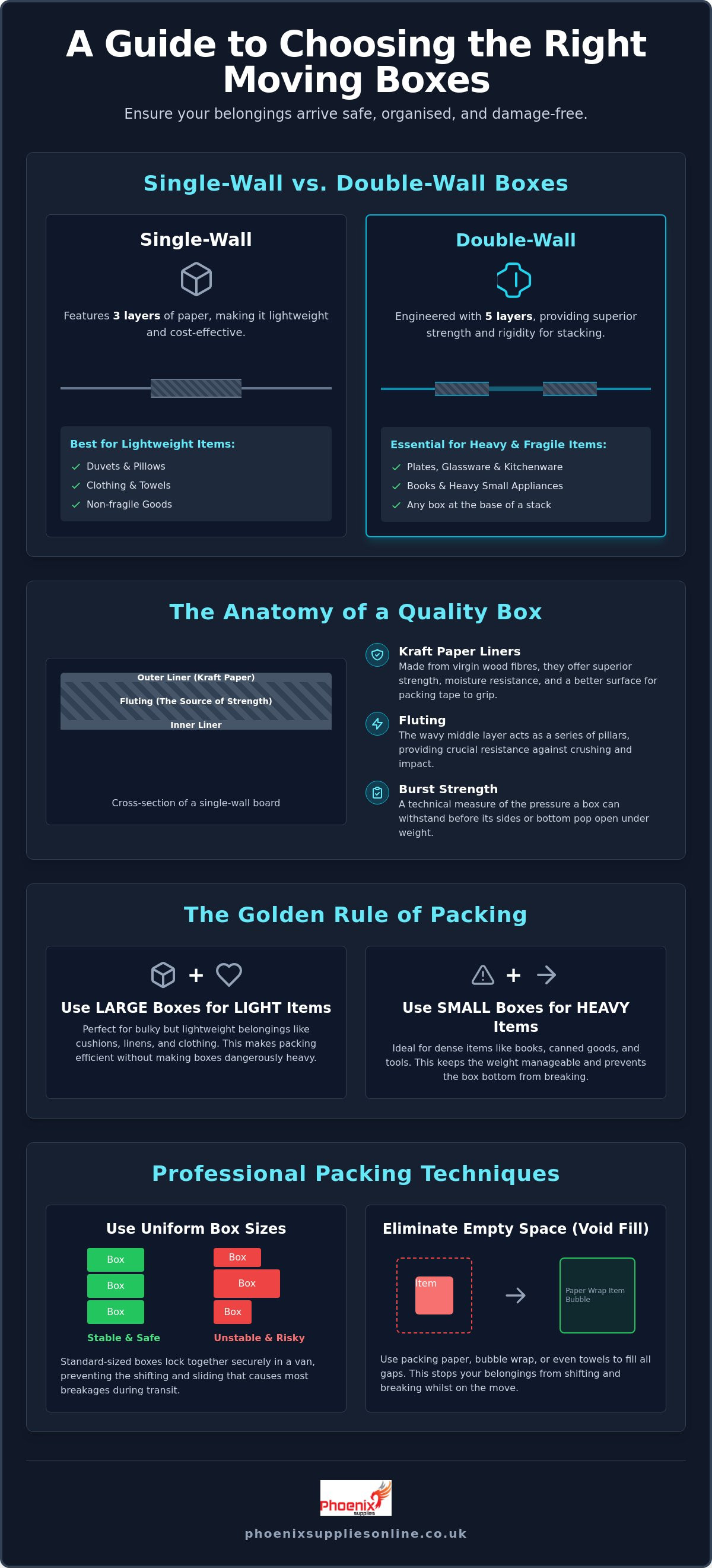
- Learn why double-wall cardboard is essential for heavier loads, providing five layers of protection compared to the standard three.
- Discover the best way to pick moving boxes for kitchen essentials, ensuring delicate plates and heavy small appliances are packed securely.
- Apply the "small for heavy, large for light" rule to prevent boxes from collapsing or becoming too difficult to carry safely.
- Master professional packing techniques like void filling to stop your belongings from shifting and breaking whilst on the move.
What Makes a Quality Cardboard Moving Box?
Selecting the right containers for your move is about more than just finding something to hold your belongings. Many people assume a box is just a box, but there is a significant difference between a standard shipping carton and a dedicated removal box. Shipping cartons are often designed for a single journey through a predictable courier network. In contrast, professional removal boxes are built to withstand the vertical pressure of being stacked high inside a moving van. If you are currently sourcing moving boxes for kitchen items, this structural integrity is the most important factor to consider. When a box at the bottom of a stack loses its shape, every item above it is at risk.
We've all seen those "free" boxes outside local supermarkets. While they might seem like a bargain, they often lead to more stress than they're worth. These boxes have usually been handled roughly, may have held damp produce, or might even carry traces of food or liquids that attract pests. High-quality boxes use kraft paper liners which offer far better moisture resistance than cheaper alternatives. This is vital in the UK, where a rainy moving day is always a possibility. A damp box is a weak box, and a weak box leads to damaged goods.
The Anatomy of a Moving Box
The strength of a box doesn't actually come from the flat paper on the outside; it comes from the "fluting" or the wavy layer sandwiched in the middle. This fluting acts like a series of structural pillars that resist crushing. There are different types of cardboard boxes used in various industries, but for removals, we focus on the quality of the liners. Kraft liners are made from virgin wood fibres, making them stronger and easier for packing tape to grip than "Test" liners, which are made from recycled material. You should also look for a high "burst strength," which is a technical term defining the amount of pressure a box can withstand before the bottom or sides literally pop open under the weight of your possessions.
Why Professional Grade Matters for Home Moves
Uniformity is your best friend during a relocation. When you use moving boxes for kitchen appliances and heavy plates that are all standard sizes, loading the van becomes much faster and safer. Uniform boxes lock together securely, preventing the shifting and sliding that causes most breakages. Using professional-grade supplies also gives you a level of hygiene you won't get with second-hand packaging. You won't have to worry about old detergent smells or food residue transferring onto your clean dinnerware. Ultimately, it's about peace of mind; knowing your box won't collapse gives you one less thing to worry about during an already busy day.
Single Wall vs Double Wall Cardboard: Which Do You Need?
Understanding the physical construction of your packaging is the best way to prevent a moving day disaster. Cardboard boxes aren't just simple sheets of paper; they are engineered structures. A single wall box consists of three distinct layers: an outer liner, a wavy middle layer known as fluting, and an inner liner. While these are lightweight and easy to handle, they lack the rigidity required for heavy loads. In contrast, double wall boxes feature five layers, including two separate layers of fluting. This extra "sandwich" of material provides a significant leap in strength. When selecting moving boxes for kitchen items, this distinction becomes a matter of safety for your most fragile possessions.
The choice usually comes down to weight and stacking. Double wall boxes are the industry standard for removals because they can support much heavier contents without the bottom falling out. They also possess the vertical strength needed to sit at the base of a tall stack in a removal van. If you use single wall boxes for everything, the weight of the boxes on top will eventually crush those at the bottom. Mixing both types is often the most cost-effective strategy for a standard home move. Once your move is finished, knowing how to recycle your moving boxes properly ensures that these valuable materials can be processed and reused responsibly.
When to Choose Single Wall Boxes
Single wall boxes are perfectly suited for bulky but lightweight items. Think about things like duvets, pillows, towels, and clothing. These items take up a lot of space but don't put much strain on the cardboard structure. They are also a great choice if you are transporting items yourself in a car, where you won't be stacking boxes five or six high. For temporary storage of non-fragile goods in a loft or cupboard, these boxes offer a budget-friendly solution that still keeps your items clean and tidy.
The Necessity of Double Wall Boxes
For everything else, double wall is a necessity. You'll need these for books, heavy ornaments, and especially for moving boxes for kitchen equipment like dinner plates and small appliances. The five-layer construction provides superior puncture resistance, which is vital if a box happens to rub against the sharp corner of a table or bed frame during transit. Because they don't flex as much as single wall alternatives, they keep your fragile glassware much more stable. You can find a range of double wall moving boxes designed specifically to handle these heavier requirements with ease.
Matching the Right Box Size to Your Belongings
One of the most common mistakes people make during a move is choosing a box that is far too large for the weight of its contents. To avoid this, you should follow the "small for heavy, large for light" golden rule. This simple principle ensures that your boxes remain manageable and structurally sound. Small boxes are designed to carry dense weight, whilst larger boxes are meant for bulky items that don't weigh much. When you are selecting moving boxes for kitchen items, remember that a medium-sized box is usually the limit for heavy ceramic plates or stacks of bowls. If you go larger, the box becomes a safety hazard for whoever has to lift it.
Over-packing a large box with heavy items is a recipe for a "bottom-out" disaster. Even the strongest cardboard has its limits when subjected to concentrated weight. Beyond the risk of breakage, over-packed boxes lead to physical strain and injury. To get your planning right, a good rule of thumb is to estimate about 15 to 20 boxes per room, though you should always allow extra for the kitchen and garage. For more detailed house packing tips, it's often helpful to look at how professional removal teams categorise their supplies to keep a move flowing smoothly.
Small, Medium, and Large Moving Boxes
- Small Moving Boxes: These are the perfect choice for heavy books, CDs, and tinned goods from the pantry. Their compact size prevents you from making them too heavy to carry.
- Medium Moving Boxes: This is your versatile "all-rounder" for the majority of your home. They are ideal for toys, small kitchen appliances, and general cupboard items that aren't excessively heavy.
- Large Moving Boxes: You should reserve these exclusively for lightweight, bulky items. They are best for pillows, duvets, cushions, and lightweight plastic items that take up space without adding significant weight.
Specialist Solutions: Wardrobe and TV Boxes
Sometimes, standard dimensions simply won't do. Wardrobe Boxes are a fantastic investment because they include an integrated hanging rail. This allows you to move your clothes directly from the cupboard onto the rail, saving you hours of folding and ironing at your new home. For your electronics, Extra Large TV Moving Boxes are essential. Most people don't keep their original packaging, and these double-wall containers provide the specific protection needed for large, fragile screens. Finally, if you're clearing out a home office, Archive Boxes offer a professional way to keep your documents organised and protected during the transition.
How to Organise and Pack Your Boxes Like a Professional
Packing for a move is often a race against time, but skipping the details can lead to heartache later. Having the right moving boxes for kitchen items is only half the battle; you also need a toolkit of essential supplies. High-quality packing tape, generous amounts of bubble wrap, and thick removal blankets are your best defence against the bumps of the road. These materials work together to create a protective barrier around your most prized possessions, ensuring they survive the journey to your new home.
A critical technique that professionals use is "void filling." If you leave gaps inside a box, the contents will rattle and collide. This movement is what causes most breakages during transit. Use crumpled packing paper or bubble wrap to fill every nook and cranny until nothing moves when you give the box a gentle shake. It feels like extra work, but it's the difference between opening a box of intact wine glasses or a pile of shards. To ensure you have all the tools for the job, you can find everything you need amongst our range of professional packing supplies.
Before you even start filling a box, you must ensure the base is secure. The weight of your belongings relies entirely on the strength of the tape at the bottom. We recommend using the "H" taping method. This involves running one strip along the centre seam and two more along the side edges. It creates a reinforced seal that prevents the flaps from bowing or popping open under pressure. This is especially vital when you are packing heavy ceramics or small kitchen appliances that put extra strain on the cardboard structure.
The Step-by-Step Packing Process
Start by reinforcing the base of your box with at least three strips of high-quality tape. Once the box is built, place a thick layer of crumpled paper or bubble wrap at the bottom to act as a shock absorber. This cushion protects your items from the vibrations of the van. Always place your heaviest items at the very bottom. You can then nestle lighter items amongst them at the top to keep the weight balanced and the box easy to carry without it becoming top-heavy.
Labelling for an Organised Move
Organisation starts with clear labelling. Write the destination room on at least two sides of every box so the information is visible even when they are stacked. If a box contains something breakable, mark it as "Fragile" on every side in large, bold letters. Finally, don't forget to pack an "Essentials Box" for the first 24 hours. This should contain your kettle, tea bags, snacks, and basic toiletries. Having this box easily accessible means you won't have to hunt through dozens of containers just to make a cup of tea on your first night.
Sourcing Your Moving Supplies from Phoenix Supplies UK
Finding a supplier who understands the practical realities of a house move makes all the difference. At Phoenix Supplies UK, we've built our reputation on being a reliable, family-run specialist that treats every customer as an individual rather than just a reference number. We provide national delivery across the UK, bringing professional-grade materials directly to your doorstep. This convenience saves you from multiple trips to local shops and ensures you have a consistent set of high-quality tools from day one. Whether you are looking for specific moving boxes for kitchen dinnerware or a comprehensive kit for a large family home, we have the stock and the expertise to support you. We take the stress out of the logistics so you can focus on the move itself.
Why Choose a Family-Run Specialist?
Our commitment to quality stems from the pride we take in helping families transition to their new homes. We don't believe in automated barriers; our office team is always available to offer personalised advice based on your specific needs. If you aren't sure how many boxes you need or which strength is best for your heavier appliances, a quick chat with us can provide the clarity you need. We work hard to keep our pricing competitive, but we never compromise on the structural integrity of our cardboard. You get the peace of mind that comes with professional-standard supplies at a price that respects your moving budget. It's this neighbourly approach that sets us apart from the cold, sterile experience of large-scale e-commerce retailers.
Building Your Complete Moving Kit
A successful move requires more than just containers. To truly protect your investment, we offer a versatile range of accessories designed for every stage of the process. This includes everything from removal blankets and webbing straps for your larger furniture to specialised mattress and furniture covers that guard against dust and moisture. Using these professional tools ensures that your upholstered items stay clean and your polished surfaces remain free from scratches during the loading and transit process. We also provide bubble wrap and high-quality tape to complement our moving boxes for kitchen items, giving you a complete, one-stop solution for your packing needs. By sourcing everything in one place, you ensure that your packing system is cohesive, sturdy, and ready for the road ahead.
Explore our full range of cardboard moving boxes and supplies and let us help you make your next move your most organised one yet.
Pack for a Stress-Free Move
Your relocation is a major milestone, and having the right supplies ensures it starts on a positive note. We've explored how the structural integrity of double-wall cardboard protects your most fragile items from being crushed. By following the "small for heavy, large for light" rule and mastering professional techniques like void filling, you can prevent shift-related breakages. When you are selecting moving boxes for kitchen equipment and heavy appliances, choosing quality over "free" second-hand alternatives is the best insurance policy for your belongings. Once you arrive, if you find the decor in your new home needs a refresh, a professional kitchen unit respray UK by SKR Specialists is an excellent way to revitalise the heart of the home after you've unpacked.
As a family-run business, we take pride in offering personal service that helps you feel supported throughout your journey. We provide high-quality double-wall options for maximum protection and include free national delivery to simplify your preparations. Our team is always here to offer advice and ensure you have exactly what you need for a smooth transition. Shop our range of heavy-duty cardboard moving boxes today and take the first step toward a damage-free move. We wish you the very best of luck in your new home.
Frequently Asked Questions
Can I reuse old cardboard boxes for moving house?
You can reuse old boxes, but it isn't always advisable for your most valuable or heavy items. Cardboard fibres weaken every time they are folded, stacked, or subjected to humidity. If a box feels soft or has visible damage to the corners, it won't provide the stacking strength needed to protect your belongings inside a removal van.
How many cardboard moving boxes do I need for a 3-bedroom house?
For a standard 3-bedroom house, you should expect to need between 60 and 80 boxes in a variety of sizes. It's often helpful to allow for at least 15 to 20 moving boxes for kitchen items alone. This room tends to have the highest density of fragile and heavy belongings, requiring more specialised protection than other areas of the home.
What is the difference between a shipping box and a moving box?
The main difference lies in the structural design and vertical crush resistance. Shipping boxes are often made of thinner, single-wall cardboard intended for one-way courier trips. Professional moving boxes are built with stacking in mind, allowing them to be placed several high in a van without the bottom boxes collapsing under the weight of those above.
How do I stop the bottom of my moving boxes from falling out?
You can prevent the bottom from falling out by using high-quality packing tape and the "H" taping method. Instead of just one strip down the middle, apply tape across the centre seam and then along the two side edges of the flaps. This reinforces the entire base and ensures the weight of your possessions is distributed across the tape's adhesive surface.
Should I buy new or used cardboard boxes for my move?
Buying new boxes is the safest choice for your most valuable, heavy, or fragile possessions. New cardboard has maximum structural integrity and is guaranteed to be clean and free from pests. Used boxes can be a cost-effective alternative for lightweight items like bedding or towels, provided they haven't been stored in damp conditions.
What is the best way to pack fragile items in cardboard boxes?
The best way to pack fragile items is to wrap each piece individually in bubble wrap or packing paper before placing it in the box. Use a thick layer of cushioning at the bottom and fill any remaining gaps with crumpled paper to prevent movement. This "void filling" technique ensures that your items don't collide whilst the van is in motion.
Are cardboard moving boxes recyclable after use?
Yes, cardboard moving boxes are fully recyclable and are one of the most environmentally friendly packaging options available. Most UK local authorities will collect flattened cardboard as part of their standard kerbside recycling service. You can also pass them on to friends or neighbours who are planning their own relocation to extend the material's lifespan.
How do I pack a flat-screen TV if I don't have the original box?
If you don't have the original packaging, you should use a specialist Extra Large TV Moving Box. These containers are specifically designed with heavy-duty double-wall cardboard to protect large, delicate screens. Wrap the TV in several layers of bubble wrap or a removal blanket before placing it inside the box to provide the necessary shock absorption.


