

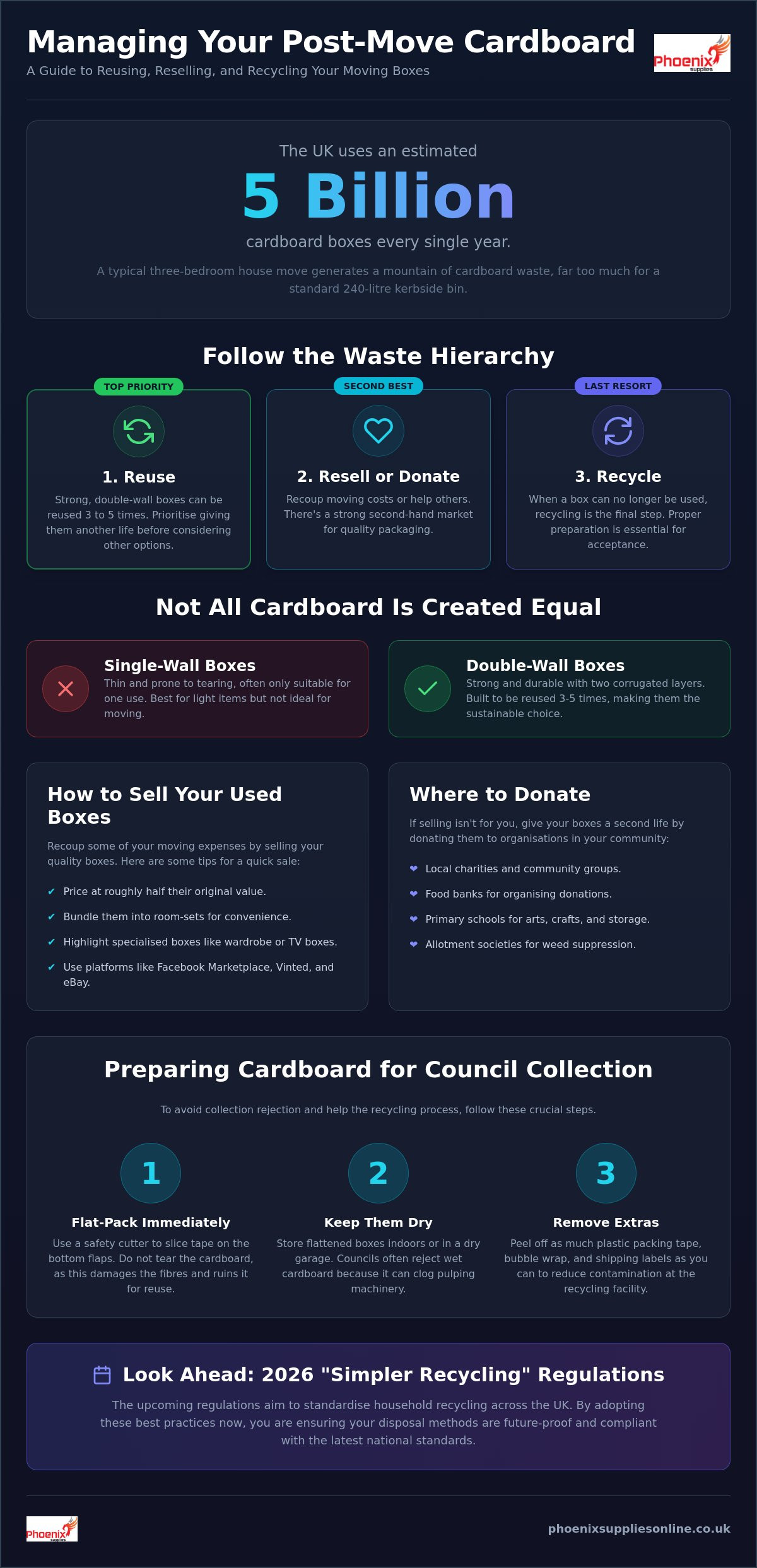
Did you know that the UK uses an estimated 5 billion cardboard boxes every year? It is a staggering figure that feels very personal when you are standing in your new living room surrounded by a literal mountain of empty packaging. You likely spent time sourcing strong moving boxes UK residents rely on for a safe transit, but now those same durable containers are taking up every square inch of your new space. It is a common frustration to find that your local council bin is far too small for the job, leaving you feeling stuck with the waste and a fair bit of environmental guilt.
We understand that you want your home back without causing a headache for the local recycling centre. This guide provides a clear, step by step plan to clear your post-move clutter whilst staying on the right side of the 2026 "Simpler Recycling" regulations. We will show you how to prep your cardboard for collection, where you can sell or donate your supplies to help others, and how to navigate the latest rules for a stress-free, eco-friendly tidy up.
Key Takeaways
- Learn how to manage your post-move mountain by choosing strong moving boxes UK families can easily resell or donate once the unpacking is finished.
- Discover the best online and local platforms for recouping your costs, including tips for listing your used supplies on Vinted or Facebook Marketplace.
- Understand the crucial preparation steps for recycling, such as why removing plastic tape and labels is essential to prevent council collection rejections.
- Get up to speed with the 2026 "Simpler Recycling" regulations to ensure your excess cardboard meets the latest national standards for household waste.
- Find out how to locate your nearest Household Waste Recycling Centre and why a reuse-first approach is more sustainable than immediate recycling.
The Post-Move Cardboard Mountain: Why Your Disposal Strategy Matters
Stepping into your new home is a milestone, but that feeling of achievement often fades when you realise you are sharing your hallway with fifty or sixty empty containers. A typical three-bedroom house move generates a significant volume of waste that simply cannot fit into a standard 240-litre kerbside recycling bin. If you have invested in strong moving boxes UK families trust for their durability, you are holding onto valuable material that deserves better than being jammed into a bin and left for the lid to pop open. Managing this volume requires a plan that respects both your space and the environment.
The environmental cost of producing new corrugated fibreboard is surprisingly high. While the UK has a strong track record for paper recovery, with corrugated cardboard seeing a recovery rate of around 91.4%, the energy required to pulp and reform new sheets is considerable. Following the principles of Recycling in the United Kingdom, we should always look at the waste hierarchy. This means prioritising reuse over recycling. At Phoenix Supplies UK, we provide heavy-duty options like our double-wall Large and Medium Moving Boxes specifically because they are built to survive more than just a single trip from A to B.
The Life Cycle of a Heavy-Duty Moving Box
Not all cardboard is created equal. Single-wall boxes are often thin and prone to tearing after one use. In contrast, strong moving boxes UK suppliers provide are usually double-walled, meaning they have two layers of corrugated fluting. This structural integrity allows a high-quality box to be reused three to five times before the corners soften or the flaps lose their grip. Eventually, the cellulose fibres become too short to be reformed into sturdy boxes. At this stage, they are typically recycled into lower-grade products like newspaper, egg cartons, or industrial paper towels.
Organising Your Empty Boxes for Disposal
Unpacking is tiring, but taking ten minutes to organise your boxes as you go will save you hours of frustration later. You can keep your new home tidy by following these simple steps:
- Flat-pack immediately: Use a safety cutter to slice through the tape on the bottom flaps. Do not "pop" the tape by force, as this tears the liners and ruins the box for the next person.
- Keep them dry: Store your flattened stack inside or in a dry garage. Councils often reject "wet-strength" cardboard because it clogs pulping machinery.
- Remove the extras: Pull off as much plastic packing tape and shipping labels as possible. This reduces contamination and makes the recycling process much more efficient for your local facility.
Beyond the Bin: Smart Ways to Reuse and Resell Moving Boxes
Once you have finished the marathon of unpacking, you're left with a valuable resource. If you invested in strong moving boxes UK families use for their most precious belongings, there's plenty of life left in those containers. Instead of viewing them as waste, think of them as an asset that can help you recoup some of your moving costs or support a neighbour in need. High-quality, strong moving boxes UK sellers provide are in high demand because they offer a level of security that standard supermarket boxes simply cannot match.
The second-hand market for quality packaging is thriving. Platforms like Facebook Marketplace, Vinted, and eBay are excellent for finding people in the middle of their own move. Because new boxes are a significant expense, many people are happy to pay a fair price for a pre-owned set that's still structurally sound. This "Pay it Forward" model keeps cardboard in circulation longer, reducing the demand for new materials and saving energy.
Where to Sell Your Used Moving Boxes
To get the best price, be specific in your listings. Mentioning if you have specialised items like wardrobe boxes or extra-large TV boxes is helpful, as these are often the most sought-after pieces. Pricing them at roughly half their original value usually ensures a quick sale. Creating a complete room-set bundle is often more effective than selling individual pieces; it saves the buyer multiple trips and clears your hallway in one go.
The Ethics of Giving Away Packaging
If you prefer to donate, there are many community options. Local charities, food banks, and even primary schools are often in need of sturdy containers for storage or creative projects. Always ensure the boxes are clean and free from any food residue or dampness before passing them on. You can connect directly with people in your immediate area by donating boxes on Freecycle, which is a fantastic way to ensure your supplies go to a good home.
Please avoid the "pavement dump" where boxes are left outside with a "free" sign. In the UK, this can be considered fly-tipping by some local councils. More importantly, a single rain shower will ruin the cardboard, turning a helpful gesture into a soggy mess that's almost impossible to recycle properly. If you can't find a taker, it's better to keep them dry until you can visit a recycling centre.
For any boxes that are too battered for resale, consider upcycling. Large sheets of cardboard are perfect for "no-dig" gardening as a mulch layer to suppress weeds. Alternatively, a few extra-large boxes can become an afternoon's entertainment for children, transforming into castles or spaceships before they finally head to the recycling centre.
Busting the Myths of Cardboard Recycling in the UK
Recycling seems straightforward, but there is a lot of misinformation that leads to perfectly good material being rejected at the facility. Many people assume that cardboard can be recycled an infinite number of times. This is a common misconception. In reality, every time cardboard is pulped, the wood fibres become shorter and weaker. When you buy strong moving boxes UK suppliers provide, you are often starting with high-quality virgin fibres that have the best chance of a long life. However, after five to seven cycles, these fibres become too stubby to bond together, eventually ending up as low-grade items like egg cartons or animal bedding.
Another persistent myth is that plastic tape and shipping labels don't matter because the recycling plant "filters them out." While it is true that some industrial processes can remove minor contaminants, heavy amounts of plastic tape cause significant issues. Large clumps of adhesive can gum up the pulping machinery or leave "stickies" in the new paper, which lowers the quality of the final product. Similarly, there is a belief that wet cardboard is perfectly fine to recycle. This is incorrect. Once cardboard becomes rain-soaked, the fibres begin to break down and the "wet strength" of the material is lost. Most UK councils will send wet cardboard straight to landfill because it is too difficult to process and can clog sorting sensors.
Finally, don't worry about being a perfectionist with staples or every tiny bit of paper glue. Modern recycling centres are equipped to handle small metal staples and common adhesives. The goal is to find a practical balance; remove the bulk of the plastic and keep the material dry without spending hours picking at a single label.
The Great Tape Debate: Sellotape vs. Paper Tape
Traditional plastic tape is a major headache for the recycling industry. It doesn't dissolve in the pulping tanks and often has to be manually skimmed off the top. Switching to gummed paper tape is a much better choice for the environment. Paper tape bonds directly to the box fibres and can be recycled alongside the cardboard without any extra effort. It is also vital to remember that removing heavy-duty webbing straps is essential for recycling safety as these non-paper materials can easily tangle in industrial processing equipment.
Dealing with Contaminants: Grease, Food, and Ink
Grease is the ultimate enemy of the recycling bin. A single pizza box saturated with oil can ruin an entire batch of pulp because the oil prevents the paper fibres from bonding. You should also watch out for poly-coated cardboard, which has a thin layer of plastic to make it shiny or water-resistant. If a box has been stored in a damp shed or garage and has developed a musty smell or visible mould, it's safer to dispose of it in your general waste. Mould is a biological contaminant that can spoil the clean stream of strong moving boxes UK facilities are trying to process.
Council Collections and Household Waste Recycling Centres (HWRC)
Your kerbside bin is your first line of defence, but it's rarely enough for a full house move. Since the 2026 "Simpler Recycling" regulations came into force, local councils across England are now required to collect paper and cardboard as a distinct waste stream. This is great news for those with strong moving boxes UK households need to shift, as it standardises what is accepted. However, "standardised" does not mean "unlimited." If you leave a pile of loose boxes on the pavement, they will likely be ignored by the collection crew.
When the kerbside isn't an option, the Household Waste Recycling Centre (HWRC), often just called "the tip", is your best bet. You can find your nearest site using the official Gov.uk search tool. It's vital to check your local council website before you set off; many centres have maintained the appointment-only booking systems introduced in 2020. Turning up without a slot or proof of residency often results in a wasted trip.
A Pro-Bundling Guide for Kerbside Collection
If your council allows "side waste" for recycling, you must present it correctly to ensure it's taken. Crews are on a tight schedule and won't stop to pick up scattered sheets. Follow these steps for a successful collection:
- Step 1: Flatten every single item. This includes everything from Small Moving Boxes and archive boxes to those cumbersome Extra Large TV Moving Boxes.
- Step 2: Create manageable bundles. Use natural jute twine or garden string to tie them together. Avoid plastic cord or webbing, as these can cause issues at the sorting facility.
- Step 3: Keep bundles compact. A good rule of thumb is to ensure each bundle is no wider than your standard recycling bin and light enough to be lifted easily with one hand.
Vehicle Logistics for the Tip Run
If you are taking a carload to the HWRC, volume is your biggest enemy. Even a large estate car will fill up instantly if boxes aren't flat-packed. Stack your flattened cardboard horizontally to keep your rear-view mirror clear; an obscured view can lead to a fine before you even reach the gates. If you are using a van or a large trailer, you will almost certainly need a specific permit. These are usually free for residents but must be applied for in advance. Always bring a form of ID and a recent utility bill to prove you live within the council's catchment area, as many sites now use number plate recognition to track usage.
Before you head out, double-check that you have removed all non-paper materials. While you might have used strong moving boxes UK residents trust for their durability, the internal packaging like bubble wrap or mattress covers must be disposed of in different containers at the site. Separating these at home makes the process much quicker once you arrive.
Closing the Loop: Choosing Eco-Friendly Moving Boxes for the Future
The journey of a cardboard box doesn't have to end in a recycling skip. True sustainability starts long before you pack your first roll of tape. By choosing strong moving boxes UK families can rely on, you are already participating in a circular economy. High-quality materials are designed to be used, shared, and eventually transformed into new products without unnecessary waste. It's about making a choice today that respects tomorrow, ensuring that your move has the smallest possible footprint on our local environment.
Sourcing high-quality materials from the start simplifies the entire disposal process. When you choose strong moving boxes UK residents trust for their durability, you aren't just buying cardboard; you are investing in a resource that can be reused multiple times. This longevity is what makes professional-grade packaging more eco-friendly than the thin, single-use alternatives often found for free. A sturdy box stays in the "reuse" tier of the waste hierarchy for much longer, delaying the energy-intensive recycling process.
Sourcing Responsibly with Phoenix Supplies
We take our role as your helpful neighbour seriously. That's why we're committed to providing moving packs that feature FSC-certified materials or high levels of recycled content. Our goal isn't just to sell you a box, but to provide a solution that lasts. For example, our Wardrobe Boxes are frequently kept by customers for years after their move to serve as dust-proof seasonal storage for winter coats or formal wear. Our team is always on hand to help you calculate exactly what you need, which prevents over-ordering and ensures no material goes to waste.
The Future of Sustainable Packaging
The industry is moving away from traditional plastics. We are seeing a rise in biodegradable protective wraps and furniture covers that offer the same protection as standard versions but break down naturally. Whilst it might be tempting to scavenge for used boxes at the local supermarket, these often lack the structural integrity needed for a safe move and are frequently contaminated with food residue. Buying from a specialist ensures your packaging is clean, strong, and ready for a second life in someone else's home. If you're planning your next move, you can View our range of durable, recyclable moving boxes to get started on the right foot.
To help you achieve a zero-waste move, we've put together this final checklist:
- Buy Quality: Choose double-wall boxes that can survive multiple trips.
- Pack Smart: Use paper-based tape to make recycling easier for your local plant.
- Flat-Pack Early: Slice tape carefully to keep the box flaps intact for the next user.
- Prioritise Reuse: List your boxes on local community groups before heading to the tip.
- Stay Dry: Keep your cardboard mountain under cover to prevent wet-strength degradation.
Start Your Next Chapter with a Clear Home
Reclaiming your space after a move is a rewarding final step in your journey. By prioritising reuse through local donations or reselling, and following the 2026 recycling standards for whatever is left, you can clear your cardboard mountain with a clear conscience. The key is to handle your materials with care from the start, ensuring they remain dry and structurally sound for their next purpose. It's much easier to manage your waste when you aren't fighting with soggy or torn cardboard.
If you're planning a future move, we're here to help you get it right from day one. We're a family-run business that prides itself on personalised customer service and a commitment to quality. Our high-quality double-wall strong moving boxes UK are designed for maximum reuse potential, and we include free delivery on all our moving packs to keep your costs down. Order your high-quality, recyclable moving boxes from Phoenix Supplies UK today and enjoy the peace of mind that comes with dependable, eco-friendly supplies. You've done the hard work of moving; now it's time to enjoy your new home.
Frequently Asked Questions
Can I put moving boxes in my blue recycling bin in the UK?
Yes, you can put cardboard in your blue recycling bin, but it must be flattened so the lid can close properly. Since the 2026 "Simpler Recycling" rules began, local councils are required to collect cardboard as a separate stream. If you have a large volume after a move, you may need to bundle them neatly beside the bin or visit a local recycling centre.
Do I really need to remove all the sellotape from my cardboard boxes?
You should remove as much plastic tape as possible because it is a major contaminant in the recycling process. While modern plants can filter out tiny fragments, large strips of adhesive can gum up machinery and lower the quality of the recycled pulp. Taking a moment to peel off the tape ensures your strong moving boxes UK are processed into high-quality new paper products.
What should I do if my moving boxes got wet in the rain?
You should let damp boxes dry out completely before recycling them, but heavily soaked cardboard must go in the general waste. Most UK councils reject wet cardboard because the fibres have already begun to break down, making them difficult to pulp. If your boxes are only slightly damp, stand them up in a dry garage or hallway until they are crisp again before flat-packing.
Are wardrobe boxes recyclable along with standard cardboard?
Yes, Wardrobe Boxes are fully recyclable once you have removed the internal hanging rail. These are made from heavy-duty corrugated board that is highly valued by recycling centres for its strong fibres. We always recommend offering these for reuse first, as their size and durability make them very popular for people planning their own move or for seasonal clothes storage in the attic.
Can I take moving boxes to the local tip without an appointment?
It is unlikely you can turn up without a booking, as many UK Household Waste Recycling Centres still operate an appointment-only system. This practice became common across most counties after 2020 to prevent long queues and manage site safety. You should check your local council's website to book a slot and ensure you have your proof of residency ready for the site marshals.
How do I dispose of the bubble wrap and packing peanuts inside the boxes?
Bubble wrap should be taken to soft plastic collection points at larger supermarkets rather than your kerbside bin. For packing peanuts, check if they are starch-based by seeing if they dissolve in water; if they do, they can go on your compost heap. Polystyrene peanuts cannot be recycled and must go in your general waste bin, though we always suggest offering bubble wrap to neighbours for reuse.
Is it better to compost moving boxes or recycle them?
Recycling is generally the best option for large quantities because it keeps the wood fibres within the manufacturing loop for longer. Composting is a fantastic way to dispose of small amounts of brown cardboard, especially if you have a garden that needs extra carbon material. However, for a full house move, the volume of cardboard is usually too large for a domestic compost bin to handle effectively.
Where can I donate moving boxes to charity in the UK?
You can donate your boxes to local charity shops, food banks, or community projects that often need sturdy storage for their inventory. Platforms like Freecycle and local Facebook community groups are also brilliant for finding people in your immediate area who are about to move. Donating your strong moving boxes UK is the most eco-friendly way to clear your space whilst helping someone else save on their moving costs.


