

The biggest mistake you can make when moving your library isn't using too few boxes; it's using boxes that are too large. It's a common sight during a house move: a giant carton filled to the brim with hardbacks, only for the bottom to split the moment it's lifted. We understand that your book collection is a labour of love, and seeing a favourite spine crushed or a rare edition damaged is heartbreaking. Most people believe that larger containers save time, but when it comes to heavy literature, that logic often leads to physical strain and broken belongings.
You deserve a move that's organised and, above all, safe for your library and your health. By choosing small moving boxes for books, you ensure each load remains manageable and every box stays structurally sound during transit. This guide reveals why small, double-walled boxes are the secret to moving your library safely whilst avoiding the common pitfalls of overpacking. We'll walk you through professional packing techniques, efficient van stacking, and the best ways to keep your most valuable stories protected from start to finish.
Key Takeaways
- Understand why using small moving boxes for books is an ergonomic necessity that prevents both physical strain and structural box failure.
- Learn how double-walled construction and high-quality materials provide the essential rigidity needed to protect heavy book collections during transit.
- Master the "shelf-to-box" rule to accurately estimate the number of cartons required for your library based on your current shelving.
- Discover professional packing techniques, such as the H-pattern taping method, to ensure the base of every box is fully reinforced.
- Find out how to group books by size to maximise space in the removal van whilst keeping your most valuable editions secure.
Why Small Moving Boxes are Vital for Your Personal Library
A "Book Box" isn't just a container; it's a reinforced, smaller carton specifically designed for high-density items. While a standard box might handle bulky clothes, books present a unique challenge because of their concentrated weight. This is why using small moving boxes for books is the standard for professional removal firms. By following established book preservation principles, you can prevent the structural failures that lead to torn pages or warped covers.
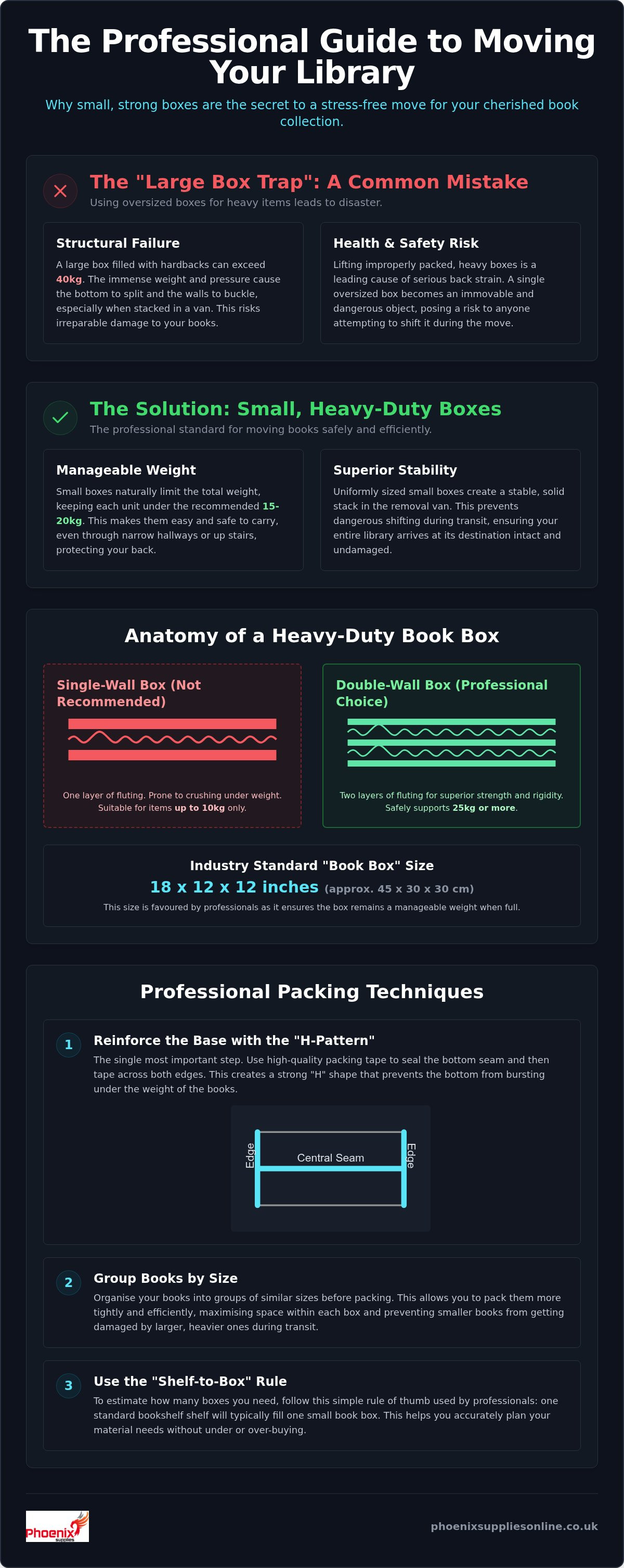
It's tempting to grab a large box and fill it to the top to save time. This is the "Large Box Trap." A large box filled with hardbacks can easily weigh over 40kg, which is far beyond what standard cardboard is designed to support. When you lift it, the bottom flaps are under immense stress, often leading to a total collapse that leaves your collection on the pavement. Even if the box stays intact, it becomes an immovable object that risks serious injury to anyone trying to shift it.
The Physics of Box Failure
In a removal van, boxes are stacked high to maximise space. Vertical pressure from the boxes above pushes down on the ones at the bottom. If you use a large box for books, the walls often buckle under this weight because the internal contents are too heavy to support the structure. Burst strength is the measure of force required to rupture the cardboard wall. For high-density items like books, you need a high burst strength that only professional-grade, double-walled small boxes can provide. Unlike bedding or pillows, books don't compress, so every bit of gravity works against the cardboard seams whilst you're in transit.
Protecting Your Health During the Move
Your safety is just as important as your library's security. Lifting overpacked large boxes is a leading cause of lower back strain during a house move. We recommend keeping the weight of each unit under 15-20kg for safe manual handling. Small boxes are naturally "lap-sized," which makes them much easier to carry through narrow hallways or up stairs. Because they are compact, they encourage you to keep the load close to your body, which is the gold standard for proper lifting form amongst DIY movers. You'll find that uniform small moving boxes for books also create a much more stable load in the van, preventing the dangerous shifting of cargo on the road.
The Anatomy of a Heavy-Duty Moving Box for Books
Not all cardboard is created equal. When you're choosing small moving boxes for books, the physical construction determines whether your library arrives safely or ends up in a heap. Professional-grade boxes rely on a specific architecture designed to withstand the high-density weight of paper, which is far heavier than standard domestic items.
Double-Wall vs Single-Wall Cardboard
The difference between these two types of construction is significant. A single-wall box consists of one layer of corrugated fluting between two liners, and it's generally rated for lighter items up to 10kg. In contrast, a double-wall box features two layers of fluting, which boosts the weight capacity to 25kg or more. When you stack boxes in a removals van, single-wall versions often bow or lose their shape under pressure. You can read more about making the right choice in our guide on Double wall vs Single wall: Choosing the Right Box.
Fluting and Structural Integrity
Fluting refers to the "arches" found between the cardboard layers. These arches act as vertical columns that provide strength and rigidity. For books, this vertical strength is vital because it prevents the box from crushing when another is placed on top. The quality of the paper also matters. Virgin kraft paper is often used for the outer liner because it offers better moisture resistance and a higher burst strength than materials with very high recycled content. This is especially important if you're moving during a damp British winter, as it helps keep your collection dry and secure.
The industry standard for a "book box" is typically around 18x12x12 inches (approx. 45x30x30cm). This size is a favourite amongst professionals because it limits the total weight once the box is full. Even the strongest box needs support, so using high-quality tape to secure the bottom in an H-pattern is essential. Following expert packing tips ensures you don't overstretch the material's limits whilst protecting your most valuable editions.
At Phoenix Supplies UK, our boxes are favoured for their consistent professional-grade thickness. If you're looking for peace of mind during your move, you can order our heavy-duty small moving boxes to ensure your books are protected by the same supplies trusted by removalists across the country.
Calculating Your Needs: How Many Boxes for Your Books?
Estimating how many small moving boxes for books you require shouldn't be a guessing game. It's a common frustration to find yourself three boxes short on moving day, or conversely, surrounded by a mountain of unused cardboard. We recommend using a methodical approach to ensure you have exactly what you need to protect your library without overspending on supplies.
Estimating by Collection Size
The most reliable way to calculate your needs is the "Shelf-to-Box" rule. Generally, one standard 3ft (90cm) bookshelf holds enough volumes to fill between 1 and 1.5 small boxes. If your collection consists mainly of dense academic hardbacks or thick biographies, you should lean towards the higher estimate. For those with extensive home libraries, purchasing in bulk packs of 10 or 20 is significantly more cost-effective than buying individual units. This approach also accounts for "Coffee Table" books; these oversized editions often require a slightly larger footprint and should be stacked flat to prevent spine damage.
Weight Limit Safety Guide
Understanding the difference in density between book types is vital for both box integrity and your physical safety. Hardbacks are significantly heavier and less flexible than paperbacks, meaning they put more focused pressure on the base of the carton. A standard small book box should ideally weigh no more than 15kg for a single-person lift. The following guide helps you visualise how many books fit into a professional-grade small box before it reaches a safe weight limit.
| Book Type | Est. Quantity per Box | Typical Weight Range |
|---|---|---|
| Standard Paperbacks | 35 to 45 books | 12kg to 15kg |
| Large Hardbacks | 20 to 25 books | 15kg to 18kg |
| Mixed Collections | 30 books | 14kg to 16kg |
Whilst filling your small moving boxes for books, we suggest using the "Two-Finger" test. Once the box is packed and on the floor, try to slide two fingers underneath the base. If you struggle to get any purchase, or the box feels like an immovable anchor, it's likely overpacked. You can balance the load by filling the bottom half with heavy books and topping the rest of the space with lighter items such as cushions or removal blankets. This prevents the box from becoming a health hazard whilst ensuring every inch of van space is used efficiently.
Professional Packing Techniques for Book Lovers
Packing a library requires more than just placing volumes into a carton. It's a methodical process that ensures your small moving boxes for books remain stable and your most cherished editions stay pristine. By following a few professional steps, you can prevent the shifting that leads to dog-eared pages and cracked bindings.
The first step is always to reinforce the base. Even with heavy-duty cardboard, the weight of a dozen hardbacks creates significant pressure. Use the H-pattern taping method, where you apply tape along the centre seam and across both side edges. This simple technique creates a secure foundation that won't give way when you lift the box. Once the base is solid, group your books by size. This keeps the load balanced and minimises wasted space, which is essential for a rattle-free pack.
Spine-Up, Flat, or Upright?
How you position your books matters immensely for their long-term health. For most standard collections, you have three choices. Packing books flat, stacked on top of each other, is the safest way to protect the structure of larger hardbacks. Alternatively, you can pack them upright, just as they sit on a shelf. If you choose this method, ensure they are snug but not squeezed. We strongly advise against packing books with the "pages down" or "spine up." This orientation puts the entire weight of the paper on the binding, which inevitably ruins the spine tension over time. For rare or antique volumes, take the extra step of wrapping them individually in acid-free paper to prevent acid migration and scuffing. If you also collect TV or film-themed memorabilia alongside your library, you can learn more about Koolthings to discover items that might require similar care and attention during your relocation.
Empty space is the enemy of a safe move. If books can shift, they can be damaged. Use bubble wrap or packing paper to cushion valuable editions and fill every small gap. This prevents the "crush" effect, where the cardboard walls cave in because there's nothing solid behind them. A professional pack should feel like a single, solid unit with no internal movement when gently shaken.
Clear labelling is your final task. Don't just write "Books" on the top. We recommend marking them with specific instructions like "Heavy - Bottom of Stack" or "Living Room - Rare Editions." This helps you or your helpers understand exactly where each box should go in the removal van. For a complete list of what you'll need, check our guide on The Ultimate Packing Materials List for Moving House in 2026.
If you're ready to start your move, you can buy our professional-grade small moving boxes to give your library the best possible protection during transit.
Sourcing Reliable Small Moving Boxes from Phoenix Supplies UK
Phoenix Supplies UK understands that moving a library is a significant task that requires more than just generic cardboard. We provide small moving boxes for books that are specifically engineered for the British removals market. Our products are the exact same ones trusted by professional removalists across the country. This means you get professional-grade strength with the convenience of national delivery, ensuring your collection is protected by materials designed for the job.
As a family-run business, we take immense pride in the personal connection we maintain with our customers. We don't believe in automated barriers or sterile transactions. If you're unsure about the quantity you need or the best way to secure a particular set of volumes, expert advice is just a phone call away. We're here to act as a steady guide, helping you choose the right supplies to make your move as straightforward and stress-free as possible.
Professional Grade vs High-Street Alternatives
It's often tempting to pick up "budget" boxes from local supermarkets or high-street shops. However, these containers are usually designed for light grocery items and frequently fail under the concentrated weight of a library. A box splitting at the bottom isn't just an inconvenience; it can lead to permanent damage to your books. Investing in professional-grade cardboard offers far better long-term value. Our heavy-duty boxes are robust enough to be reused for future moves or for long-term storage in your new home. For more tips on selecting the right supplies, you can read our guide on How to Buy Moving Boxes Online in the UK.
Ordering Your Packing Kit
If you're organising a home office move, you can easily combine our small moving boxes for books with our specialised archive boxes. This creates a complete system for both your personal reading collection and important professional documents. Our commitment to sustainability means that whilst our cardboard is high-strength, it's also fully recyclable, helping you move in an eco-friendly way.
When you order from us, you can expect a fast, reliable service that keeps your moving timeline on track. All our supplies arrive flat-packed and ready for quick assembly, allowing you to start packing immediately. We handle the logistics so you can focus on the move itself. Browse our range of heavy-duty small moving boxes today and discover the difference that professional-grade supplies can make to your library's safety.
Securing Your Library for the Journey Ahead
Moving a book collection is about more than just transport; it's about preserving years of curated stories and knowledge. We have explored how double-wall construction provides the vital rigidity needed to prevent buckling and split seams whilst in transit. By applying the shelf-to-box rule and professional H-pattern taping, you can ensure every load remains manageable and structurally sound throughout your move.
Choosing small moving boxes for books is the most practical step you can take to avoid physical strain and the risk of crushed spines. Safety comes first. As a family-run UK business, we take pride in providing the same professional-grade double-walled cardboard trusted by removals experts. Order Your Heavy-Duty Small Moving Boxes from Phoenix Supplies UK today and take advantage of free national delivery included with your purchase. You've spent years building your collection; we're here to help you move it with the care and reliability it deserves.
Frequently Asked Questions
Why are small boxes better for books than large ones?
Small boxes are superior because they limit the total weight of the package, making them safer for both you and the cardboard. A large box filled with books can easily exceed 40kg, which risks the bottom splitting and causes significant physical strain. By using smaller containers, you keep the load around 15kg. This ensures the box remains structurally sound and easy to carry through narrow doorways or up stairs.
Can I use single-wall boxes for my book collection?
We don't recommend using single-wall boxes for a book collection. These boxes only have one layer of corrugated fluting, which often bows or collapses under the heavy, concentrated weight of paper. Double-walled cardboard provides two layers of protection, offering the vertical strength needed for stacking in a removal van. This professional-grade construction is essential for preventing your favourite editions from being crushed or damaged during the move.
How many books can I fit in a standard small moving box?
You can typically fit between 20 and 45 books in a standard small moving box. If you're packing large hardbacks, the capacity is usually around 20 to 25 volumes to keep the weight manageable. For smaller paperbacks, you might fit up to 45. It's best to aim for a total weight of roughly 15kg per unit to ensure each box is safe for a single-person lift without risking injury.
Should I pack books vertically or horizontally?
You can pack books either flat or upright, but you must avoid placing them with the pages facing downwards. Packing books flat in stacks is often the safest choice for heavy hardbacks as it protects the binding from stretching. If you prefer to pack them upright like they sit on a shelf, make sure they're snug. Never pack them with the spine facing up, as this ruins the spine tension over time.
How do I stop books from moving around inside the box?
The best way to prevent movement is to fill every empty space with packing paper or bubble wrap. A "rattle-free" box ensures that books don't shift and scuff against each other whilst the van is in motion. These fillers also act as internal pillars, providing extra support that helps the box maintain its shape when other heavy items are stacked on top of it during the journey.
Is it worth buying professional moving boxes instead of using free ones?
Investing in professional small moving boxes for books is definitely worth it for the added security they provide. Free boxes from shops are usually single-walled and may have hidden structural damage or dampness from previous use. Professional-grade boxes are engineered specifically for heavy loads and can often be reused for future storage. They provide a consistent size and strength that makes stacking in the removal van much safer.
What is the best tape to use for heavy book boxes?
We recommend using professional-grade packing tape applied in an H-pattern for the best results. This technique involves securing the middle seam and both side edges of the box base. It creates a reinforced foundation that can support the high-density weight of a library. Cheap tape often peels away under stress, so choosing a high-tack variety is essential for ensuring your boxes remain sealed throughout the move.
How do I protect the corners of my expensive coffee table books?
You should wrap each oversized or expensive volume individually in bubble wrap or thick packing paper. Place these books flat at the bottom of the box to create a stable base and distribute the weight evenly. This protects the corners from being bumped or bent during transit. For particularly valuable or antique editions, wrapping them in acid-free paper before adding the outer cushioning will prevent any chemical damage to the covers.


