

Imagine the moment you lift your heaviest kitchen appliances or a stack of hardback books, only to hear the sickening sound of cardboard tearing. It's a common nightmare during UK moves, but using the right heavy duty packing boxes ensures it won't be your reality. We understand that your belongings aren't just items; they're the foundation of your home, and seeing them tumble through a split base is heartbreaking.
You're right to worry about boxes splitting under pressure or stacks collapsing in the removal van. It's a stressful enough time without the added fear of broken valuables. This guide will help you identify, choose, and use heavy-duty containers to keep your heaviest belongings secure from start to finish. We'll explain why double-wall construction is the gold standard for strength, clarify the 20 to 30kg weight limits for safe manual handling, and show you how to pack for a truly stress-free move. We'll also cover ways to make lifting easier so you don't have to struggle with awkward, heavy loads. By the end, you'll have the confidence to get your home packed up safely and efficiently.
Key Takeaways
- Recognise that genuine heavy duty packing boxes are defined by double-wall corrugated layers and Kraft paper for maximum puncture and moisture resistance.
- Master the "Golden Rule" of packing by using smaller boxes for your heaviest items to ensure they remain manageable and structurally sound.
- Understand the importance of Uniformly Distributed Load (UDL) limits to prevent your valuables from shifting or causing the base of a box to fail.
- Learn how professional taping techniques and vertical stacking can prevent your boxes from collapsing during transit in the removal van.
- Discover why double-wall construction is the essential standard for protecting fragile and heavy belongings throughout the entirety of your move.
What Defines Genuine Heavy Duty Packing Boxes?
When you're preparing for a house move, it's easy to assume that any cardboard box will do the job. However, true heavy duty packing boxes are engineered specifically to handle the rigours of being lifted, stacked, and shifted. Unlike the thin boxes you might find at a local supermarket, these are built with multiple layers of corrugated material. This construction provides high puncture resistance. It's vital for when a sharp corner of a furniture piece or a stray tool presses against the side of the box during transit.
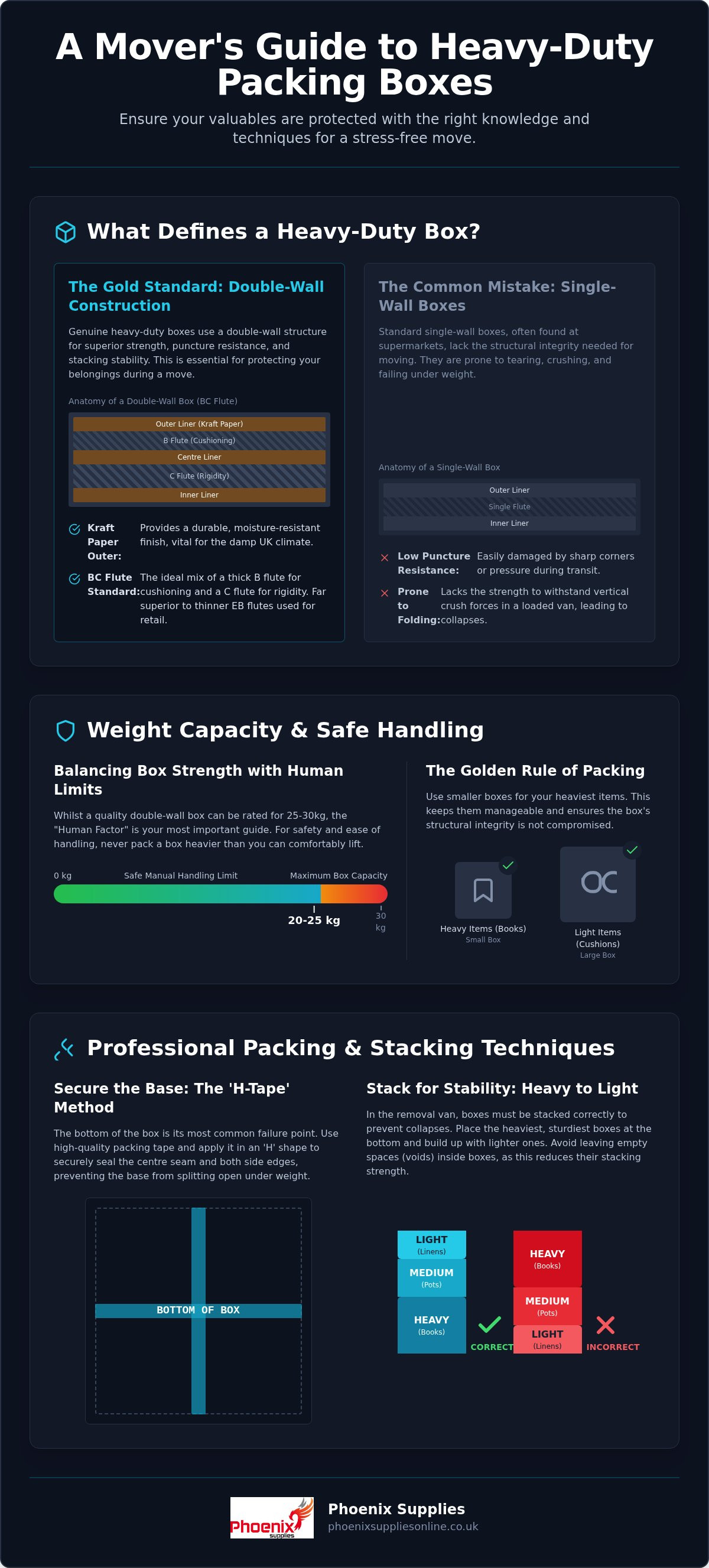
The outer skin of a quality box usually features Kraft paper. This isn't just about appearance; Kraft paper is a high-grade material that offers a durable, moisture-resistant finish. In the damp UK climate, this extra layer of protection is essential to keep the cardboard from softening whilst it's being moved between the house and the removal van. Standard single-wall boxes often fail because they lack this structural integrity. They're prone to folding under the weight of other items, whereas heavy-duty versions are designed to withstand the vertical crush forces found in a fully loaded van.
The Anatomy of a Double Wall Box
To understand why these boxes are so sturdy, you need to look at what's happening between the layers of cardboard. A double-wall box consists of two layers of fluting, which are the wavy bits, sandwiched between three liners. These corrugated box design principles are what give the material its impressive strength-to-weight ratio. For most domestic moves, a BC flute combination is the standard. This mixes a thicker B flute with a C flute to provide both cushioning and rigidity. It's much more reliable than an EB flute, which is thinner and often used for retail packaging rather than heavy removals.
Double Wall vs Triple Wall: Which Do You Need?
While triple-wall boxes exist, they're often overkill for a standard house move. Triple-wall is incredibly heavy and usually reserved for international shipping or moving industrial machinery. For your crockery, kitchen appliances, and heavy books, a high-quality double-wall box is the perfect middle ground. It provides the security you need without the unnecessary bulk or cost of industrial-grade crates. At Phoenix Supplies, we focus on providing these dependable double-wall options because they offer the best protection for your home's most precious contents during a move.
Weight Capacity and Load Limits for Heavy Duty Boxes
When you're choosing heavy duty packing boxes, understanding how much weight they can actually support is vital for a safe move. Manufacturers often refer to UDL, or Uniformly Distributed Load. This means the weight is spread evenly across the base rather than pressing down on one single point. While a high-quality double-walled box is technically rated to carry up to 25-30kg, you've got to consider the practical reality of lifting it. If the weight isn't balanced, even the strongest cardboard can struggle.
We always recommend the "Human Factor" as your primary guide. Regardless of the box's structural strength, you should rarely pack a single container beyond 20-25kg. This protects your back and ensures that whoever is helping with the move can lift the items safely. If you're unsure if you've overpacked, try the "thumb test". Press your thumb firmly against the side or top of the sealed box. If the cardboard gives way easily or feels soft, it's a sign that there are too many empty gaps inside or the contents are too heavy for the structure.
Calculating the Safe Working Load
The bottom of the box is almost always the first point of failure. This usually happens because the weight of the contents overcomes the strength of the adhesive tape or the cardboard flaps. To prevent this, use high-quality packing tape and avoid leaving "voids" or empty spaces. When a box has gaps, the sides can bow inwards, significantly reducing its ability to support weight from boxes stacked on top. Professional removal teams have to stay mindful of UK vehicle weight limits to keep their lorries safe, and your careful packing helps them manage the total load effectively.
Specialist Boxes for Heavy or Awkward Items
Standard boxes aren't always the best fit for everything in your home. For example, using wardrobe boxes UK is the best way to transport heavy coats and suits without them becoming a crushed mess at the bottom of a standard carton. Similarly, expensive electronics like flat-screens need large TV moving boxes that feature reinforced double-wall protection. For those moving a home office, heavy-duty archive boxes are essential for dense document storage as they feature integrated handles that won't tear under the weight of paper. If you're planning your move now, you can view our full range of moving supplies to find the right containers for your heaviest belongings.
What to Pack in Heavy Duty Boxes: Room-by-Room Guide
A common mistake people make during a move is choosing the largest container for their heaviest items. It seems logical to fit everything in at once, but it's actually the opposite of what you should do. The "Golden Rule" of removals is simple: the heavier the item, the smaller the box should be. By using smaller heavy duty packing boxes for dense items, you ensure the weight remains manageable for one person to lift. This approach also prevents the box from losing its shape or the bottom giving way, which is a frequent issue when people try to pack an entire library into a single large carton.
Packing the Kitchen and Dining Room
Kitchens are often the most challenging rooms to pack because they contain a mix of heavy, dense items and extremely fragile ones. For your cast-iron pans and heavy ceramic plates, layering is essential. Place the heaviest items at the bottom, using plenty of bubble wrap or packing paper between each layer to absorb shocks. If you're packing expensive china or glassware, you need crush-resistant double-wall boxes. These provide a rigid shell that protects the delicate contents from the pressure of other items in the removal van. Always fill any gaps with scrunched-up paper to stop the contents from shifting during the journey.
Packing the Home Office and Library
Books are deceptively heavy. A standard shelf of hardbacks can easily exceed the safe lifting limit of a large box. This is why books and vinyl records must always go into small moving boxes for books. When packing them, stack books flat or with the spine facing the side of the box. Never pack them with the spine facing upwards, as the weight of the pages can pull the binding away from the cover. For home offices with plenty of paperwork, using archive boxes is much more efficient than using standard cartons. These are designed to hold the specific weight of dense files and often feature reinforced handles. For your computer towers and printers, stick to reinforced double-wall cartons to provide the necessary puncture resistance for delicate internal components.
The garage and shed often contain the densest items in the entire house. Tools, tinned paints, and garden equipment are not only heavy but can also be oily or sharp. Using heavy duty packing boxes in these areas is a must to prevent tools from poking through the sides of the cardboard. Ensure paint tins are sealed tightly and kept upright to avoid leaks that could ruin other boxes nearby. Taking the time to organise these heavier zones room-by-room makes the eventual unpacking process much smoother and protects your most rugged equipment from damage.
How to Secure and Stack Your Heavy Duty Packing Boxes
You can buy the best cardboard in the world, but if you don't seal it correctly, the box remains a weak link in your move. Securing your heavy duty packing boxes is about more than just a single strip of tape across the top. It's about creating a structural seal that supports the weight from within whilst resisting the pressure of other boxes stacked on top. Proper sealing ensures that the flaps don't shift and the base doesn't "belly" out when you lift it. This is especially important for items like kitchen small appliances or dense toolkits that put significant stress on the bottom seams.
The Professional "H-Taping" Method
Professional removal teams don't just tape the middle; they use the "H-Taping" method to reinforce every potential point of failure. This technique creates a rigid frame on both the top and bottom of your heavy duty packing boxes. Follow these three steps for every heavy load:
- Step 1: Seal the centre seam where the two flaps meet with a long strip of high-quality packing tape, extending it at least 10cm down the sides.
- Step 2: Seal the two edge seams where the flaps meet the box walls. This creates the "H" shape and prevents air from getting in or the flaps from snagging.
- Step 3: Never interlock the flaps. It's a common habit, but interlocking actually weakens the cardboard fibres and makes the box more likely to collapse under pressure.
Safe Stacking in the Removal Van
Once your boxes are sealed, the way you arrange them in the van determines whether they survive the journey. The physics of a moving vehicle means that items shift and vibrate. Always place your heaviest boxes directly on the floor of the van. This lowers the centre of gravity for the entire load, making the vehicle more stable and preventing heavy items from crushing lighter ones. You should align these boxes vertically so the corners sit directly on top of each other. The corners are the strongest part of a double-wall box, acting like pillars that can support a surprising amount of weight.
To prevent friction damage, use packing materials like removal blankets between your stacks. These blankets act as a buffer, stopping the boxes from rubbing against each other and weakening the cardboard during transit. Finally, always label your heavy boxes clearly on at least two sides with a "HEAVY" warning. This isn't just for your own organisation; it's a vital safety measure for anyone helping you lift. If you're ready to start your packing, you can buy our professional-grade tape and heavy-duty boxes to ensure everything stays exactly where it should.
Why Source Your Boxes from Phoenix Supplies UK?
Choosing the right heavy duty packing boxes is a major step towards a successful move, but who you buy them from matters just as much. As a family-run business, we don't see our customers as just another order number in a database. We understand the stress that comes with moving house because we've been there ourselves. We treat your move with the same care and attention we'd give our own family, ensuring you have the right tools to protect your most precious belongings. Our team takes pride in being a dependable partner you can rely on from the moment you start browsing until the last box is unpacked.
We've carefully curated our range to include only the highest quality double-wall boxes. These are the exact same containers we'd use for our own moves, so you can be sure they're up to the task of protecting heavy kitchenware or fragile electronics. We offer a national reach with a personal touch, meaning you get the efficiency of a large supplier with the accessibility of a local specialist. If you're unsure about how many boxes you need or which sizes are best, you can speak directly to our office team for honest, straightforward advice.
Our Commitment to Quality and Service
Our double-wall boxes are the preferred choice for removals across the UK because they offer a consistent level of protection that single-wall alternatives simply can't match. We've made the process of buying moving boxes online as simple as possible, with door-to-door delivery that saves you a trip to the shops. Our house moving kits even include free delivery, so there are no hidden costs at the checkout. Whether you're an individual moving a few streets away or a large organisation requiring pallet quantities, we provide personalised support to help you get exactly what you need without any fuss.
Complete Your Packing Kit
While heavy duty packing boxes are the foundation of your move, you'll likely need a few extras to get the job done properly. You can browse our full range of protective wraps, high-tack tapes, and furniture covers to ensure every item is shielded from dust and scratches. Combining different box sizes is a smart way to stay organised; use our small boxes for your library and medium or large boxes for lighter, bulkier items. If you have a particularly large project or need something specific, please contact our friendly team for a bespoke packing quote. We're always here to help you move with confidence.
Prepare for a Smooth and Secure Move
Moving house is a major milestone, and the security of your possessions shouldn't be a source of anxiety. By selecting genuine heavy duty packing boxes, you're ensuring that your most cherished items are protected from the inevitable knocks and bumps of transit. We've explored how the combination of double-wall construction and the "Golden Rule" of packing, which involves keeping heavy items in smaller containers, creates a much safer environment for your valuables and your back. These simple steps, along with the professional H-taping method, make a world of difference when the removal van is in motion.
Our family-run team is dedicated to providing the expert guidance and reliable supplies you need for a smooth transition. With high-quality double-wall strength as our standard and free UK delivery included on all our moving packs, we make it easy to get organised without any hidden surprises. Browse our range of Heavy Duty Packing Boxes at Phoenix Supplies UK to find exactly what you need for your upcoming move. You've now got the professional techniques required to pack with total confidence; we wish you the very best of luck in your new home.
Frequently Asked Questions
How can I tell if a box is truly heavy duty?
Check the thickness of the cardboard and look for double-wall construction. A genuine heavy-duty box will have two layers of fluting, which is the wavy part, sandwiched between three layers of liner. You can see this clearly by looking at the edge of the box flap. If it's only a few millimetres thick and has just one layer of fluting, it's a standard single-wall box and won't provide the same puncture resistance.
Is it worth buying double wall boxes for a local move?
Yes, because the risk of damage isn't just about distance; it's about the lifting and stacking process. Even on a short ten-minute journey, boxes at the bottom of a stack in the removal van must support the weight of everything above them. Using double-wall heavy duty packing boxes prevents the lower containers from buckling or collapsing when the vehicle goes over speed bumps or takes corners, keeping your valuables safe regardless of the mileage.
How much weight can a standard heavy duty moving box hold?
Most high-quality double-wall boxes are rated to hold between 20kg and 30kg of weight safely. While the cardboard itself might be structurally capable of supporting more, this range is the limit for safe manual handling by one person. Industry best practices suggest keeping boxes under 25kg to prevent injury and to ensure the adhesive tape doesn't fail under the pressure. Always use smaller boxes for your densest items to stay within these limits.
Can I reuse heavy duty packing boxes after my move?
You certainly can, provided the cardboard hasn't been exposed to moisture or suffered significant structural damage. High-quality heavy duty packing boxes are designed for durability, making them ideal for long-term loft storage or for passing on to a friend who is moving. To store them, carefully slice the tape rather than tearing it, then flatten the boxes and keep them in a dry place. This ensures the corrugated fibres remain strong for their next use.
Should I use bubble wrap or packing paper for heavy items?
A combination of both usually provides the best protection for heavy belongings. Use bubble wrap for items with delicate surfaces or protruding parts that need cushioning against impact. Packing paper is excellent for wrapping individual pieces of crockery or filling empty "voids" inside the box to stop items from shifting. For very heavy items like cast-iron pans, thick layers of scrunched-up paper at the bottom of the box act as an effective shock absorber.
How many heavy duty boxes do I need for a 3-bedroom house?
A typical 3-bedroom house usually requires between 60 and 80 boxes in total, with at least half of these being heavy-duty versions for kitchens, books, and garages. You'll generally need more small and medium containers than large ones to keep weight manageable. Every home is different, so it's often best to order a comprehensive house moving kit that includes a mix of sizes along with protective wraps and tape to get you started on the right foot.
What is the best tape to use with heavy duty cardboard?
You should use a high-tack polypropylene or vinyl packing tape that is at least 48mm wide. Standard office tape or masking tape won't provide the necessary grip to secure heavy flaps. For heavy-duty cardboard, a "hot melt" adhesive tape is often the most effective because it bonds quickly and deeply with the Kraft paper fibres. This ensures that the H-taping method remains secure even when the box is under significant internal pressure during the move.
Can heavy duty boxes be recycled in the UK?
Yes, all corrugated cardboard boxes are fully recyclable through standard UK household recycling collections or local recycling centres. Before recycling, you should remove as much packing tape and any plastic bubble wrap as possible. Under the UK's Extended Producer Responsibility scheme, the industry is moving towards a circular economy where these materials are reused to create new packaging. Recycling your boxes helps reduce waste and supports more sustainable manufacturing processes across the country.


