

Imagine it's 11 PM on the night before your move, you've just reached for the last roll of tape, and you realise there are still three cupboards full of kitchenware left to pack. We've all been there, and we know that sinking feeling when the supplies run dry mid-pack. Moving house is a massive undertaking, and it's easy to feel overwhelmed by the sheer volume of items you need to organise. Using a reliable moving box estimator is the simplest way to replace that guesswork with genuine confidence.
Our comprehensive guide will help you calculate exactly how many boxes and packing supplies your UK relocation requires in 2026. You'll learn how to match box sizes to your specific belongings, from heavy-duty small boxes for books to wardrobe boxes for your favourite clothes. We'll provide a clear breakdown of everything you need, including bubble wrap and removal blankets, giving you a streamlined shopping list. This approach ensures your fragile items stay protected whilst helping you avoid the cost of unnecessary extras, leading to a much smoother moving day.
Key Takeaways
- Discover how to use a moving box estimator to move beyond simple room counts and accurately calculate the total volume of cardboard your 2026 relocation requires.
- Learn how to adjust your supply list based on your lifestyle, whether you need to reduce estimates for minimalist homes or increase them for long-term residences.
- Master the specific ratios for specialised items, including how to measure your wardrobe rail to determine the exact number of wardrobe boxes needed.
- Identify the essential extras you'll need, such as the correct amount of bubble wrap for your kitchen and the "Two-Roll Rule" for packing tape.
- Understand the structural differences between single and double-wall boxes to ensure your heavier or more fragile items have professional-grade protection.
The Fundamentals of a Moving Box Estimator: Room-by-Room Logic
A reliable moving box estimator does more than just count doors; it calculates the total volume of cardboard your life requires based on square footage and room density. Whilst a bedroom count provides a helpful baseline, it's really just the starting point for a successful move. To get the numbers right, you need to look at the actual contents of each room. Understanding the complexities involved in the moving process helps you appreciate why a manual audit is so vital for a stress-free experience.
Digital calculators are fantastic for a quick overview, but they can't see inside your cupboards. A manual room-by-room audit allows you to verify those digital results. Walk through your home with a notepad and count how many shelves of books or stacks of plates you actually have. This extra step transforms a generic guess into a definitive shopping list. It's much better to spend twenty minutes measuring now than two hours driving to find more supplies on moving day.
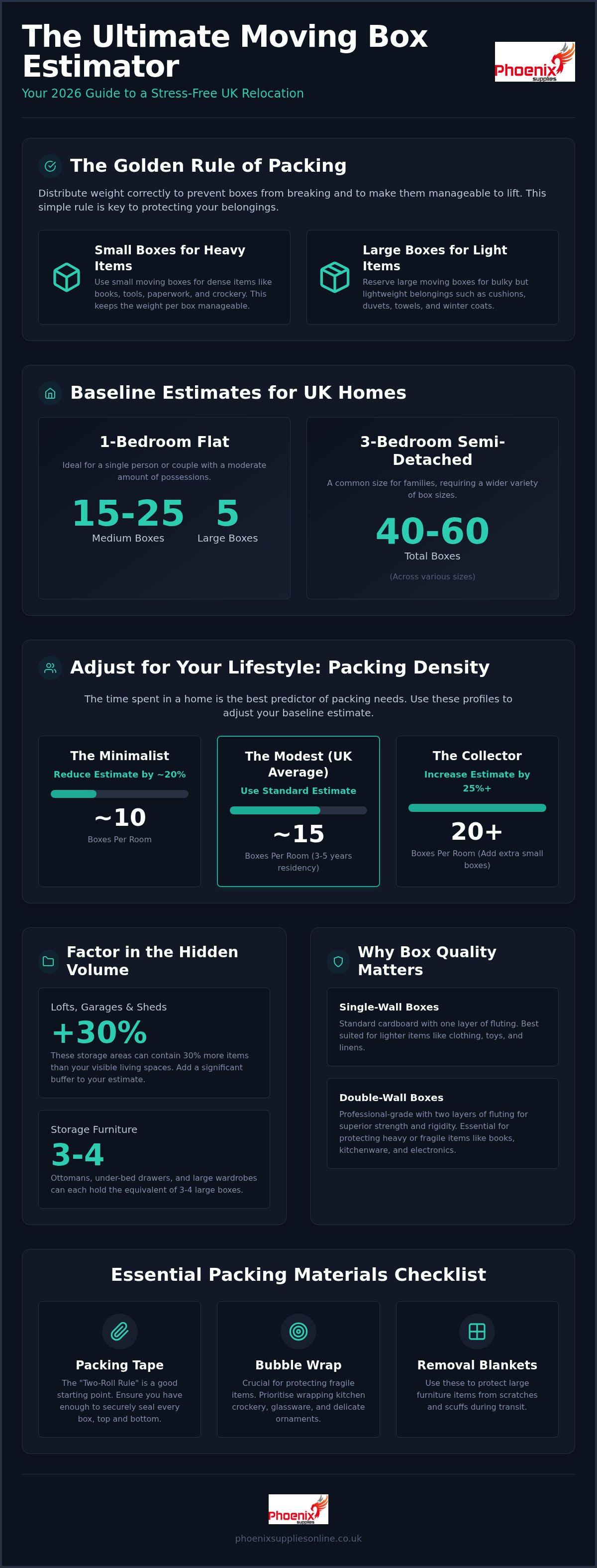
When you use a moving box estimator, remember that volume isn't the same as weight. A Large Moving Box full of books is almost impossible to lift and likely to split at the seams. We suggest a "Small for Heavy, Large for Light" rule. Use Small Moving Boxes for your library and Archive Boxes for your paperwork. Reserve the larger sizes for bulky, airy items like cushions, towels, and winter coats. This keeps your boxes manageable and protects your belongings from damage caused by overloading.
Standard Estimates for UK House Sizes
Every home is unique, but we can look at common averages across the UK to give you a head start. These figures assume a moderate level of possessions and include the necessary variety of sizes:
- 1-Bedroom Flat: Typically requires 15-25 medium boxes and 5 large boxes.
- 3-Bedroom Semi-Detached: Usually needs 40-60 boxes across various sizes.
Don't overlook communal areas. The kitchen usually requires the most packing material due to fragile crockery, whilst hallways and bathroom cupboards often hold more than we realise. Ensure you've accounted for every cupboard and under-stairs nook to avoid running short at the last minute.
The Loft and Garage Factor
Storage areas often contain 30% more items than visible living spaces because we tend to tuck things away and forget about them. These rooms often house awkward or heavy items that require specific care. You'll need heavy-duty Small Moving Boxes for heavy tools and garden equipment to ensure they are manageable and secure. The Loft Variable is the most common cause of underestimating box counts. If you haven't cleared your loft in years, it's wise to add a significant buffer to your initial estimate to account for the hidden volume found in the rafters.
Adjusting Your Estimate: Minimalism vs. The "Pack Rat" Reality
The length of time you've spent in your current home is often the most accurate predictor of your packing needs. If you've been in the same property for over five or ten years, you've likely accumulated a significant amount of "hidden" belongings that a generic moving box estimator might miss. We recommend looking honestly at your cupboards, shelves, and storage nooks before you commit to an order. Your lifestyle habits directly influence whether you'll need a standard set of supplies or a more substantial collection of Medium Moving Boxes.
Lifestyle Density Comparison
To help you categorise your home, we've identified three common types of "packing density" that we see across the UK. Identifying your category early helps prevent the frustration of running out of tape or boxes on your final night:
- Minimalist: Roughly 10 boxes per room. If you regularly declutter and keep surfaces clear, you can safely reduce your initial estimate by about 20%.
- Modest: Roughly 15 boxes per room. This is the standard UK average for families who have lived in a home for three to five years.
- Collector: 20+ boxes per room. If you own extensive libraries, hobby equipment, or sentimental collections, you should add at least 25% more Small Moving Boxes to your total.
Don't forget to account for furniture that doubles as storage. Ottomans, under-bed drawers, and large wardrobes often hold the equivalent of three or four Large Moving Boxes each. If you aren't sure which category fits your home, our Bulk Moving Packs offer a versatile starting point that suits most household densities.
Packing Intricacy and Protection
The way you pack also changes how many supplies you'll use. If you follow a "Professional Style" approach, you'll use more wrapping and padding to keep items safe, which naturally increases the number of boxes you'll fill. Delicate items like glassware and ceramics require plenty of bubble wrap for moving house and should be placed in smaller, sturdier boxes to prevent crushing. Consulting official consumer moving resources can provide extra peace of mind regarding the protection of your high-value belongings.
Professional organisers often suggest adding a 10% safety margin to every order. This buffer handles those last-minute items we all forget, like the contents of the "junk drawer" or the cleaning supplies under the sink. Having a few spare boxes is always better than a late-night dash for more cardboard. Using a moving box estimator with this built-in buffer ensures you won't be left short when the pressure is on.
Estimating Specialised Boxes: Wardrobes, Archives, and Electronics
A standard moving box estimator often focuses on total volume, but the shape and weight of your most prized possessions dictate which specialised containers you'll need. Standard boxes are the workhorses of any move, yet certain items require a more tailored approach to ensure they arrive safely. By identifying these specialised needs early, you can avoid the frustration of trying to squeeze a flat-screen TV into a standard carton or watching a box of paperwork collapse under its own weight. We've found that getting these specific counts right is what truly separates an organised move from a chaotic one.
Clothing and Wardrobe Estimation
Packing clothes is often more time-consuming than people realise. Using wardrobe boxes for moving is the most efficient way to transfer your garments directly from the rail to the box without the need for folding. We suggest a simple rule of thumb: estimate one wardrobe box for every 0.5 metres of hanging rail. This prevents overstuffing and keeps your clothes crease-free, making the unpacking process at your new home much faster.
- Seasonal Wear: Don't forget the bulky winter coats tucked away in the under-stairs cupboard or the loft. These often require an extra box or two beyond your main wardrobe count.
- Bedding and Linens: Whilst hanging clothes need wardrobe boxes, use Large Moving Boxes for duvets, pillows, and towels. These items are light but take up significant space, so they don't need the reinforced strength of smaller containers.
Electronics and Fragile Tech
Your television is likely one of the most fragile items in your house. Selecting the best TV moving box UK depends entirely on your screen size. These bespoke containers use double-walled protection to shield delicate screens from pressure and impact. For other home entertainment systems and desktop computers, we recommend using heavy-duty alternatives if the original packaging is no longer available. You can use removal blankets and webbing straps to provide an extra layer of security for larger tech setups during transit.
Home offices present a different challenge. Paper is deceptively heavy, and a standard medium box filled with files can quickly become unmanageable or even split. This is where archive boxes become essential. They're designed with reinforced handles and a specific size that prevents you from making the box too heavy to carry. Using the right moving box estimator logic for your office ensures your documents stay organised and your physical health is protected throughout the move.
The Essential Packing Materials Checklist: Beyond the Box
Cardboard is only half the battle when you're preparing for a relocation. Whilst a moving box estimator provides the foundation for your order, the accessories you choose are what keep your belongings safe during transit. Cardboard alone can't protect a fragile vase or prevent a chest of drawers from scratching against the van wall. Getting the quantities of these extras right is just as important as the box count itself. We've seen many moves delayed because someone ran out of tape at midnight, so we always suggest following proven rules of thumb for your supplies.
One of the most reliable methods is the "Two-Roll Rule" for packing tape. You should estimate one roll of high-quality tape for every 15 to 20 boxes. This accounts for double-taping the bottoms of heavy Medium Moving Boxes and securing the tops firmly. Using a low-quality tape often leads to boxes popping open, which is a risk no one wants to take on moving day. It's a small detail that makes a huge difference to the structural integrity of your stacks.
Calculating Protective Wrapping
For a standard UK kitchen, you'll generally need between 25 and 50 metres of bubble wrap to safely cushion your crockery and glassware. This allows for individual wrapping of plates and plenty of padding for delicate wine glasses. If you have a larger kitchen or a collection of fine china, aim for the higher end of that scale to ensure everything has a thick enough layer of protection. Don't try to save money by skimping on wrap, as one broken set of dishes will cost far more than an extra roll of plastic.
When it comes to larger items, removal blankets UK are essential for preventing dents and scratches. We recommend having at least 10 blankets for every van load. These thick, quilted layers are perfect for wrapping wooden furniture or protecting the edges of mirrors. To maintain hygiene and stop moisture from affecting your beds, always include mattress covers in your checklist. They're a simple investment that keeps your sleeping surfaces clean and dry throughout the journey.
Securing the Load
Even the best-packed boxes can suffer damage if they shift whilst the van is moving. Webbing straps are the best tool for preventing "box tumble" inside the removal vehicle. These straps secure your stacks to the side rails of the van, keeping everything in place even on winding roads. For a standard 3.5-tonne Luton van, you'll typically need four to six straps to secure the load effectively. This keeps the heaviest items from sliding into your more fragile boxes.
Sofas and armchairs also need specific care during the move. Using dedicated furniture covers protects the fabric from dust, rain, and accidental snags during the carry. If you're ready to get started, you can order your full range of packing supplies to ensure you have everything needed for a secure relocation. Taking these extra steps ensures your moving box estimator results lead to a truly professional-grade move where everything arrives in the same condition it left.
Ordering Your Supplies: Why Quality Beats Price Every Time
Once you've used a moving box estimator to determine your needs, the next step is choosing where to source your supplies. It's tempting to hunt for free boxes behind local supermarkets or use old delivery cartons, but this is often a false economy. Used cardboard can harbour hidden damp, pests, or structural weaknesses that aren't visible at a glance. A single collapsed box containing your favourite dinner service costs far more than the price of professional-grade supplies. High-quality materials provide the peace of mind you need when your entire life is packed into the back of a van.
Choosing the Right Box Strength
Cardboard isn't all the same, and the strength of a box is determined by its construction. For heavy items like books, tinned food, or kitchen appliances, you should always use small, double-walled boxes. These provide the necessary vertical support when stacked and won't buckle under pressure. You can identify professional-grade cardboard by checking the "fluting" thickness between the layers; a thicker, more rigid wave indicates a box that can handle a heavier load.
- Kitchen and Books: Small, double-walled boxes are essential for weight support.
- Bedding and Toys: Large, single-walled boxes are perfectly sufficient for these lightweight, high-volume items.
- Fragile Items: Medium boxes with double walls offer the best balance of space and protection for ornaments.
Streamlining the Delivery
The convenience of buying moving boxes online UK cannot be overstated. It saves you the hassle of trying to transport bulky, flat-packed bundles in a standard car, which is often impossible for larger moves. Many people find that moving house packing kits UK simplify the process even further. These kits are designed based on typical house sizes, providing a pre-calculated mix of box sizes alongside essential tape and bubble wrap. Before you click "order", do a final check of your moving box estimator results to ensure you've accounted for those "hidden" storage areas like the loft or garage.
As a family-run business, Phoenix Supplies UK takes pride in offering a personalised service that large e-commerce giants simply can't match. We understand that moving house is a significant life event, and we're here to act as your steady guide. Whether you need a single extra-large TV box or a full suite of supplies for a four-bedroom home, our commitment is to provide professional-grade protection with a friendly, human touch. We're always within reach to offer expert advice, ensuring you have exactly what you need for a smooth transition to your new home.
Start Your Next Chapter with Confidence
Mastering your relocation starts with moving beyond simple guesswork. By using a reliable moving box estimator, you've already taken the most important step towards an organised, stress-free move. You now understand that accurate packing is a balance of room-by-room logic and lifestyle density, whether you're a minimalist or a lifelong collector. From selecting double-walled protection for your kitchenware to measuring your hanging rails for wardrobe boxes, these details ensure your belongings stay safe from your old front door to your new one.
As a family-run business, we take immense pride in being a dependable partner for your journey. We offer a comprehensive range of supplies, from specialised TV boxes to removal blankets and webbing straps, all designed to provide professional-grade protection. Our team is here to provide the personalised support you need to choose the right packing kits for your specific home. Browse our range of heavy-duty moving boxes and packing kits today to get started. With the right supplies in hand, you can focus on the excitement of your new home whilst we help you protect the things that matter most. Happy moving!
Frequently Asked Questions
How many boxes do I need for a 3-bedroom house in the UK?
For a typical 3-bedroom semi-detached home, you'll generally require between 40 and 60 boxes. This estimate assumes a standard level of possessions and includes a mix of small, medium, and large sizes. If you've lived in your property for more than five years, you should lean towards the higher end of this scale. A reliable moving box estimator helps you account for these variables, ensuring you don't run short on moving day.
Is it better to have too many boxes or too few when moving?
It's always better to have a small surplus of supplies than to run out mid-pack. We recommend adding a 10% safety margin to your final order to handle those last-minute items from the "junk drawer" or garden shed. Having a few spare boxes reduces the stress of your final night and provides extra protection for items you might have overlooked during your initial audit. It's a simple way to keep the process moving smoothly.
What size moving box is best for heavy books?
Small, double-walled boxes are the best choice for heavy books and dense paperwork. Large boxes filled with books become impossibly heavy to lift and are prone to splitting at the seams. By using smaller containers, you keep the weight manageable for yourself and your helpers. These heavy-duty options provide the structural strength needed to support the weight of a private library without the risk of the bottom falling out during transit.
How much bubble wrap do I need for a standard kitchen?
A standard UK kitchen typically requires between 25 and 50 metres of bubble wrap. This allows you to wrap dinner plates individually and provide ample cushioning for fragile glassware and ceramics. If you have a particularly large collection of fine china or decorative ornaments, it's wise to order a larger roll. Protecting your breakables with enough padding is far cheaper than replacing a sentimental set of dishes that wasn't properly secured.
Can I reuse old supermarket boxes for my house move?
Whilst it's possible to find free boxes at supermarkets, it's often a false economy for a full house move. These boxes are frequently single-walled and may have been weakened by damp or heavy use. They also carry a risk of bringing pests into your new home. Investing in professional-grade, double-walled cardboard ensures your belongings are supported by clean, structurally sound materials that won't collapse when stacked in the removal van.
How many rolls of packing tape should I buy?
You should aim to buy one roll of high-quality packing tape for every 15 to 20 boxes in your order. This "Two-Roll Rule" ensures you have enough to secure both the top and bottom seams firmly. We always suggest using a professional-grade tape that adheres well to cardboard. Running out of tape at midnight is a common moving headache that's easily avoided with a bit of forward planning and a slight surplus.
Do I really need specialised wardrobe boxes for my clothes?
Wardrobe boxes are essential for any hanging garments that you want to keep crease-free. They allow you to transfer clothes directly from your rail to the box, which significantly speeds up both packing and unpacking. For non-hanging items like t-shirts, knitwear, and bedding, standard large boxes are perfectly suitable. Using a moving box estimator helps you determine exactly how many of these specialised containers you'll need based on the width of your current wardrobe.
What happens if I underestimate my box count mid-move?
Underestimating your box count often leads to last-minute packing delays and increased stress. If you find yourself short, you may have to resort to using unsuitable containers or making a frantic dash for more supplies. This is why we emphasise the importance of a thorough room-by-room audit before ordering. If an emergency does happen, look for suppliers offering next-day delivery to get your packing process back on track as quickly as possible.


