

What if the biggest box you can find is actually your worst enemy on moving day? Many people instinctively reach for the largest containers they can find, hoping to speed up the process. However, overfilling a massive carton with heavy books is a recipe for a split base and a very sore back. Understanding exactly what size boxes for moving are required for different items is the first step toward a successful, injury-free transition to your new home.
It's frustrating to watch a stack of flimsy, single-walled boxes buckle under pressure whilst they are being loaded into a van. You deserve the confidence that your favourite dinner service and heavy kitchen gadgets are properly protected. Our guide helps you master box selection by covering essential dimensions, weight limits, and room-specific strategies. We'll provide a clear shopping list tailored to your specific house size, ensuring you have the right double-walled protection for every fragile item. By the end, you'll have an organised packing system that professional movers will truly appreciate.
Key Takeaways
- Learn how to match item density to box volume to prevent the common mistake of overfilling large containers with heavy items.
- Discover exactly what size boxes for moving you need for each room, ensuring your belongings stay safe and manageable for lifting.
- Understand the importance of using specialist wardrobe and TV boxes to provide structural protection for your most valuable possessions.
- Identify why professional-grade, double-walled boxes are the only reliable choice for secure stacking and transit in a removal van.
- Gain a clear, room-by-room packing strategy that helps you stay organised and makes the job much easier for your moving team.
Understanding Moving Box Sizes: The Fundamentals of Selection
Selecting the right containers is the foundation of a smooth relocation. In the UK, the industry follows a standard hierarchy consisting of Small, Medium, Large, and Extra Large options. Deciding what size boxes for moving are best for your belongings involves more than just picking the biggest one you can find. You need to apply the "Goldilocks" principle; each box must be just right for its specific contents. If a box is too large for heavy items, it becomes dangerous to lift. If it's too small for bulky items, you'll end up with protruding edges that make stacking impossible. To stay on track, it helps to organise your move with a detailed list of your inventory before you start buying supplies.
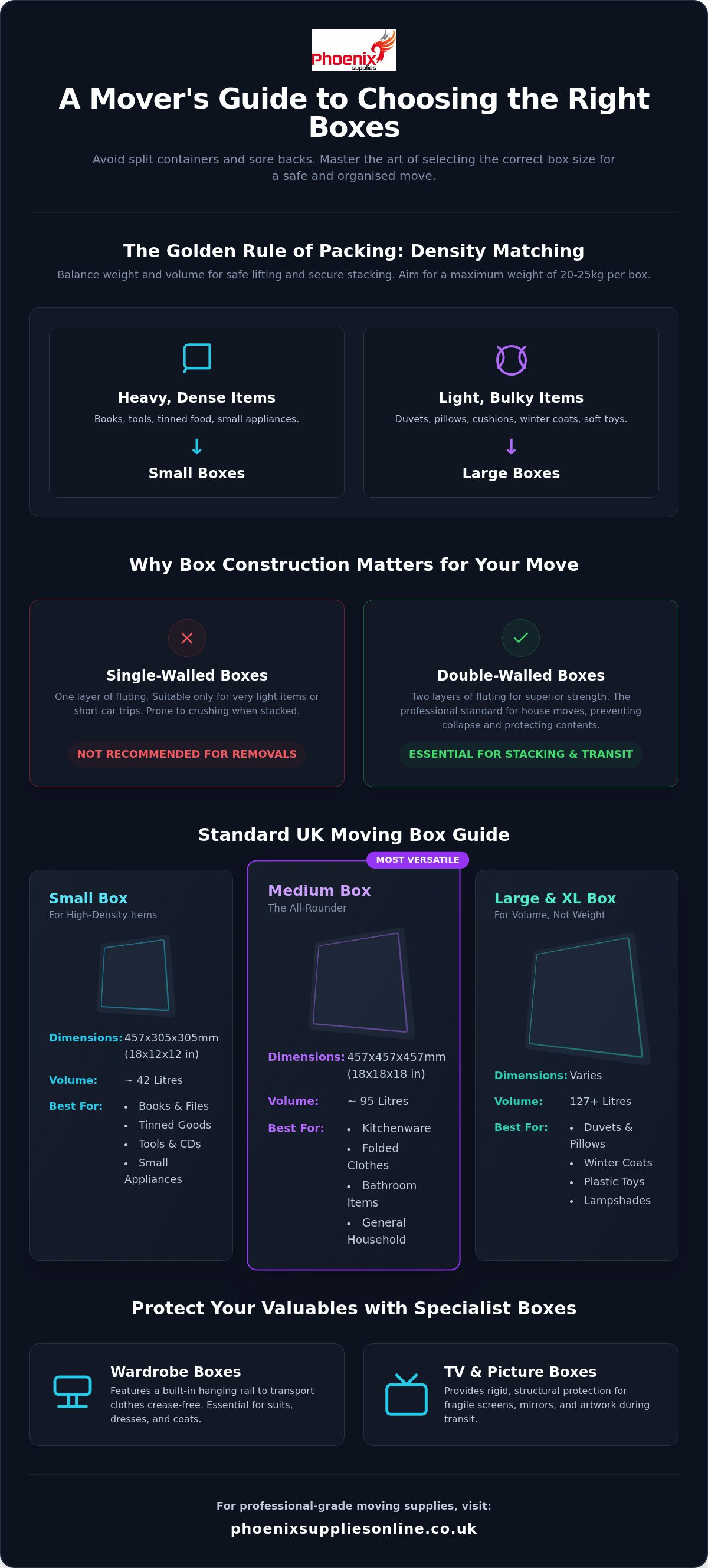
Professional packers rely on a technique called density matching. This involves placing high-density items, such as books, tools, or tinned food, into Small Moving Boxes. Conversely, low-density but voluminous items like duvets, pillows, or cushions belong in Large or Extra Large boxes. This balance ensures every package stays within a safe weight limit, generally between 20kg and 25kg, whilst protecting the structural integrity of the container. It prevents the bottom of the box from falling out and keeps the load manageable for whoever is carrying it.
The Difference Between Single and Double-Walled Boxes
When understanding cardboard materials, the distinction between single and double-wall construction is vital for safety. Single-walled boxes consist of one layer of fluted paper between two flat liners. They're suitable for lightweight items or short trips in a car. However, for a proper house move involving a removal van, double-walled boxes are the national standard. These feature two layers of fluting, providing significantly more vertical strength. This extra layer prevents the "crush effect," where boxes at the bottom of a stack buckle under the weight of those placed on top of them during transit.
Standard Dimensions Used by UK Removal Companies
UK removal firms prefer standard sizes because they allow for efficient "tiering" in the van. A Small Moving Box is roughly 457 x 305 x 305mm (18 x 12 x 12 inches), holding about 42 litres. A Medium Moving Box often measures 457 x 457 x 457mm (18 x 18 x 18 inches) with a 95-litre capacity. Large boxes can reach 127 litres or more. Using these consistent dimensions helps loaders maximise every inch of the vehicle. Knowing what size boxes for moving are standard helps you estimate exactly how many you'll need for your specific house size, reducing wasted space and ensuring a more stable load.
Small vs Medium vs Large: Comparing Dimensions and Weight Limits
Determining what size boxes for moving you need depends entirely on the weight and volume of your possessions. A common mistake is using large boxes for everything, which often leads to heavy, unmanageable loads that are difficult to carry. Instead, follow a structured room-by-room breakdown to allocate the correct container for each item type. This approach keeps your move organised and protects your physical health.
Small Boxes: For Your Heaviest Belongings
Small boxes, typically measuring around 18x12x12 inches, are designed specifically for items with high density. Because the base area is smaller, the weight is concentrated over a tighter surface. This makes the box much harder to split at the bottom. Using small moving boxes for books is essential to prevent back injuries and ensure the contents remain secure. They're also the best choice for canned goods, CDs, heavy tools, and small kitchen appliances like blenders or kettles.
The Medium Moving Box, measuring roughly 18x18x18 inches, is the versatile all-rounder of any UK relocation. It offers a generous 95-litre capacity, which is perfect for kitchenware, folded clothes, or bathroom essentials. It's the standard size that fits most household items whilst remaining easy to carry through narrow hallways. If you're unsure about what size boxes for moving to buy first, a pack of medium containers is usually the most practical starting point.
Large and XL Boxes: For Volume, Not Weight
Large and Extra Large boxes are built for volume, not weight. These are the best options for duvets, pillows, winter coats, and plastic toys. If you pack a large box with heavy items like crockery or files, it will lose its shape almost immediately. This makes stacking in the removal van dangerous because the box can't support the weight of others on top of it.
To keep your move safe, don't exceed the 20-25kg limit for any single box. Whilst this is the maximum for health and safety, keeping your boxes between 15-20kg makes the day much easier for everyone involved. If you're struggling to lift it comfortably, it's probably too heavy. For those starting their packing journey, choosing heavy-duty Medium Moving Boxes provides the strength you need for everyday items.
Specialist Box Sizes: Beyond the Standard Square
While standard sizes handle most of the house, certain items require a more tailored approach. Deciding what size boxes for moving are right for your wardrobe or home office isn't just about volume; it's about structural support. Specialist boxes are designed to mirror the shape of your items, which actually reduces the amount of bubble wrap you need. This makes packing more efficient and significantly safer for your most valuable belongings.
Using the correct container also addresses a common gap in many moving guides: manual handling safety. Standard boxes are often awkward to grip when they contain oddly shaped items. Specialist containers usually include reinforced hand-holds and dimensions that allow you to keep the weight closer to your centre of gravity. This is vital for navigating narrow British hallways and stairs without risking a back injury or dropping a fragile screen.
Wardrobe Boxes and Hanging Rails
These tall, upright containers are essential for anyone who wants to avoid hours of ironing after the move. Height is the critical factor here; a standard wardrobe box is tall enough to accommodate long dresses and heavy winter coats without them bunching at the bottom. When you learn how to pack clothes for moving in boxes using these specialist units, you simply transfer items directly from your wardrobe onto the integrated hanging rail. It's a massive time-saver that keeps your clothes crease-free and ready to wear the moment you arrive.
The Importance of TV and Mirror Boxes
Modern flat-screens are incredibly delicate and prone to pressure damage. Many people assume the original manufacturer's box is the best choice, but these are often designed for palletised shipping rather than the individual handling of a domestic move. A professional best TV moving box UK specialists recommend features heavy-duty double-walled protection and adjustable inserts. This rigid outer layer absorbs side impacts that would otherwise shatter a panel or crack a mirror during transit.
For those with a home office, Archive Boxes are the gold standard for document organisation. They feature a lift-off lid and reinforced handles, making them easy to stack and access without needing to cut through tape every time you need a file. Choosing what size boxes for moving are appropriate for your paperwork ensures you don't create a "dead weight" that is impossible to move safely. By using these specialist designs, you ensure every item in your home has a secure, purpose-built space for the journey ahead.
A Room-by-Room Guide to Box Selection
Every room in a British home has its own unique packing requirements. Understanding what size boxes for moving work best for each space prevents you from over-ordering or running out of supplies mid-pack. A systematic approach ensures that heavy items stay in manageable containers whilst bulky, lightweight goods are grouped together efficiently. This strategy isn't just about organisation; it's about making sure your moving team can load the van safely and quickly.
Kitchen and Dining Room Strategy
The kitchen is often the most demanding room to pack due to the high volume of fragile and heavy items. Medium boxes are the "sweet spot" for plates, bowls, and glassware. They are also ideal for pet essentials; if you need to replace your cat's dishes for the new home, petsandfriends.co.uk offers a range of durable feeding bowls. These boxes provide enough space for protective wrapping without becoming too heavy to lift. For spice jars, tinned food, and the heavy contents of your "junk drawer," small boxes are a much safer choice. Always leave roughly two inches of space at the top of these boxes for extra bubble wrap or packing paper to cushion the contents against vibrations during the journey.
When deciding what size boxes for moving you need for the bedrooms, focus on volume. You'll generally need one wardrobe box for every 0.5 to 1 metre of hanging rail space in your closet. These tall containers keep your clothes clean and ready to wear. For bedding, extra-large boxes are the best way to keep duvets, pillows, and winter coats dust-free. To avoid squashing your favourite footwear or handbags, place them in the bottom of wardrobe boxes or in dedicated medium containers with plenty of padding.
Lounge and Entertainment Centres
Your living room contains a mix of delicate electronics and bulky furniture. Use medium boxes to keep gaming consoles, remote controls, and cables together. This prevents small parts from getting lost amongst larger items. If you are a collector of fragile miniatures, you can learn more about Darlington Diecast Models Limited to understand the value and delicacy of such items, which require careful individual wrapping in small, sturdy boxes. For the home office, paper is deceptively heavy once stacked. This is why using dedicated archive boxes is essential for weight distribution. In the garage or shed, stick to medium boxes for tools and cleaning supplies, as these items are often dense and require sturdy double-walled support.
Before you seal the lids, label every box by room and indicate if it's particularly heavy. This simple step helps loaders place items correctly in the van and ensures fragile kitchenware doesn't end up under a heavy crate of garage tools. If you're ready to start your packing journey, you can find everything you need in our complete range of professional moving boxes.
Sourcing Quality Boxes: Why Professional Grade Matters
Choosing what size boxes for moving is only half the battle; the quality of those containers determines whether your possessions arrive in one piece. Whilst it's tempting to source free boxes from local supermarkets, these often suffer from structural fatigue and hidden hygiene issues. Professional-grade, double-walled boxes are specifically engineered to withstand the vertical pressure of a removal van. They work in harmony with other essential supplies, such as removal blankets and webbing straps, to create a secure environment for your belongings. As a family-run specialist, we take pride in providing the reliable materials that turn a chaotic day into a manageable transition.
Buying in pre-calculated moving kits or bulk packs is almost always more cost-effective than picking up individual items. These kits are designed based on years of experience, providing a logical balance of small, medium, and large containers. This personalised approach ensures you aren't left with twenty extra-large boxes that are too heavy to lift, or a shortage of small boxes for your library. It's about having the right tool for the job, delivered directly to your door with the care you'd expect from a local partner.
The True Cost of Box Failure
The financial impact of a "bottom-drop" failure is often much higher than the price of a sturdy box. If a flimsy, single-walled carton splits whilst being carried, the damage to a laptop or a set of heirloom ceramics can be devastating. Professional boxes don't just protect your goods; they speed up the entire moving process. Hired removal crews can work much faster when they have uniform, sturdy shapes that stack perfectly. There is also an environmental benefit; high-quality cardboard is durable enough to be reused for storage or passed on to a friend, reducing the need for single-use alternatives.
How to Calculate Your Total Box Requirement
A general rule of thumb for a UK move is to allow for 10 to 15 boxes per room. For a typical two-bedroom house, you might require a mix of 40 to 60 boxes in total. It is always wise to order roughly 10% more than your initial estimate to account for those last-minute items found in the back of cupboards. If you want to streamline your shopping, you can learn how to buy moving boxes online in the UK through our efficient guide to packing kits. This ensures you have a professional-grade organised system that keeps your move on schedule and your fragile items safe.
Secure Your Belongings for a Successful Move
Packing your entire home is a significant task, but mastering the basics of box selection makes the process far more manageable. By matching the density of your items to the correct container size, you ensure that every load remains safe to lift and secure for transit. Remember that double-walled strength is the standard for a reason; it provides the structural integrity needed to stack your life safely into a removal van without the risk of collapse.
Now that you understand exactly what size boxes for moving you need for each room, you can focus on the journey ahead. As a family-run UK business, we're here to support you with professional-grade materials designed for durability. Our boxes offer heavy-duty protection for your most fragile items, helping you avoid the common pitfalls of flimsy supermarket alternatives. To get started, browse our range of heavy-duty double-walled moving boxes and enjoy free national delivery included with your order. You've done the hard work of planning; now it's time to pack with confidence and look forward to your new home.
Frequently Asked Questions
How many boxes do I need for a 3-bedroom house move?
A typical three-bedroom house move usually requires between 80 and 100 boxes. This estimate provides a balanced mix of small, medium, and large sizes to accommodate different item densities across the home. It is always a sensible idea to order a slightly higher quantity than you initially expect to avoid running out during the final stages of packing. Using pre-calculated moving kits can simplify this process by providing professional-grade containers for every room.
Is it better to have many small boxes or a few large ones?
It is much better to have a higher volume of small and medium boxes than a few overstuffed large ones. Small boxes are essential for heavy items like books and tinned food, as they keep the weight manageable and prevent the base from splitting. Large boxes should be reserved for lightweight, bulky items only. This approach ensures your move stays organised and significantly reduces the risk of injury for anyone lifting the containers.
What is the standard size of a medium moving box in the UK?
The standard medium moving box in the UK typically measures approximately 457mm x 457mm x 457mm, which is 18 inches cubed. This size offers a capacity of around 95 litres, making it the most versatile choice for general household items. It is large enough to hold a variety of goods whilst remaining compact enough to carry through narrow doorways. Sticking to these standard dimensions helps loaders maximise space and stability within the removal vehicle.
Can I use grocery store boxes for my house move?
Whilst grocery store boxes are often free, they aren't recommended for a full house move. These boxes are usually single-walled and may have already suffered structural fatigue or hygiene issues from previous use. Professional double-walled boxes are specifically engineered to be stacked in a van without collapsing. Investing in quality materials prevents the "bottom-drop" failures that lead to broken belongings. When considering what size boxes for moving you need, reliability is just as important as dimensions.
What should I pack in extra-large moving boxes?
Extra-large boxes should be used exclusively for lightweight, voluminous items that don't fit well elsewhere. Ideal contents include duvets, pillows, winter coats, and large plastic toys. You should never pack heavy items like books or kitchenware in these containers, as they will become impossible to lift and will likely lose their shape. Using these for soft furnishings keeps your bedding clean and dust-free during the transition to your new property.
How much weight can a double-walled moving box hold?
A high-quality double-walled moving box can physically support significant weight, but the recommended limit for safe manual handling is between 20kg and 25kg. This threshold is set to prevent back injuries and ensure the box handles remain intact during transit. Even if a box feels like it could hold more, keeping the weight within this range ensures that the stack remains stable in the removal van and is comfortable for movers to carry safely.
Do I need different size boxes for my kitchen items?
Yes, the kitchen requires a strategic mix of sizes to protect different types of contents properly. Small boxes are perfect for heavy items like tinned goods, spice jars, and cutlery drawers. Medium boxes are the "sweet spot" for plates and glassware because they provide enough room for protective bubble wrap without becoming too heavy to lift. Using specific sizes for your kitchenware helps you decide what size boxes for moving are necessary to keep your most fragile items secure.
Why are wardrobe boxes so much taller than standard boxes?
Wardrobe boxes are designed with extra height to accommodate an integrated hanging rail. This allows you to transfer clothes directly from your closet on their hangers, keeping long dresses, suits, and coats from bunching at the bottom. The upright design prevents permanent creases and saves you hours of ironing after you've moved. These specialist containers provide the structural support needed to protect your wardrobe whilst making the packing process significantly faster on moving day.


