

The most expensive part of your house move isn't the van hire or the fuel; it's the cost of replacing a mahogany sideboard that wasn't properly secured. You've spent years looking after your furniture, so the thought of it sliding across a van floor at the first roundabout is enough to keep anyone awake at night. It is completely normal to feel confused by the different types of equipment available. However, choosing the right webbing straps for moving is the single most effective way to ensure your belongings stay exactly where you put them.
We understand that you want your items to arrive without a single scratch or dent. This guide will show you how to select and use the correct straps to achieve professional-level security for everything from heavy washing machines to delicate wardrobes. You will discover how to get the job done right the first time, giving you the peace of mind that comes with a truly safe transit. We'll explore the differences between ratchet and cam systems, explain essential UK safety standards, and provide practical tips for securing your load like a seasoned specialist.
Key Takeaways
- Learn how heavy-duty polyester webbing straps for moving act as the "seatbelts" for your furniture, preventing expensive items from shifting during transit.
- Understand the specific roles of ratchets, cam buckles, and simple ties so you can choose the right level of tension for different appliances and furniture pieces.
- Avoid common equipment mistakes by distinguishing between forearm lifting straps for carrying and high-strength webbing for securing loads inside the van.
- Master the professional technique of loading from the bulkhead backwards and utilising internal tie-down points to create a stable, damage-free environment.
- Discover why choosing removal-grade materials over flimsy alternatives ensures your equipment won't fray or fail when you need it most.
What are Webbing Straps for Moving and Why Do You Need Them?
Webbing straps for moving are essentially the safety harnesses of the removals world. These heavy-duty bands, typically made from woven polyester or nylon, are designed to lash furniture and appliances securely to the interior of a vehicle. To understand What are Webbing Straps in a technical sense, it's helpful to see them as industrial-strength fabric engineered for high tensile strength and minimal stretch. Unlike the "lifting straps" you might see people wearing over their shoulders to carry a fridge, these are specifically for transit security.
Many people assume that if they drive slowly, their furniture will stay put. However, even a gentle turn at 15mph creates enough centrifugal force to tip a tall wardrobe or slide a heavy washing machine. This "van transit" problem is responsible for the majority of scuffs and broken legs during a move. When you include these in your packing materials list for moving, you're choosing a tool that outperforms traditional rope. Rope is thin and rounded, which often bites into wood or fabric under tension, leaving permanent "burn" marks. Webbing is flat and wide, allowing it to grip a larger surface area without causing damage.
The Science of Load Security
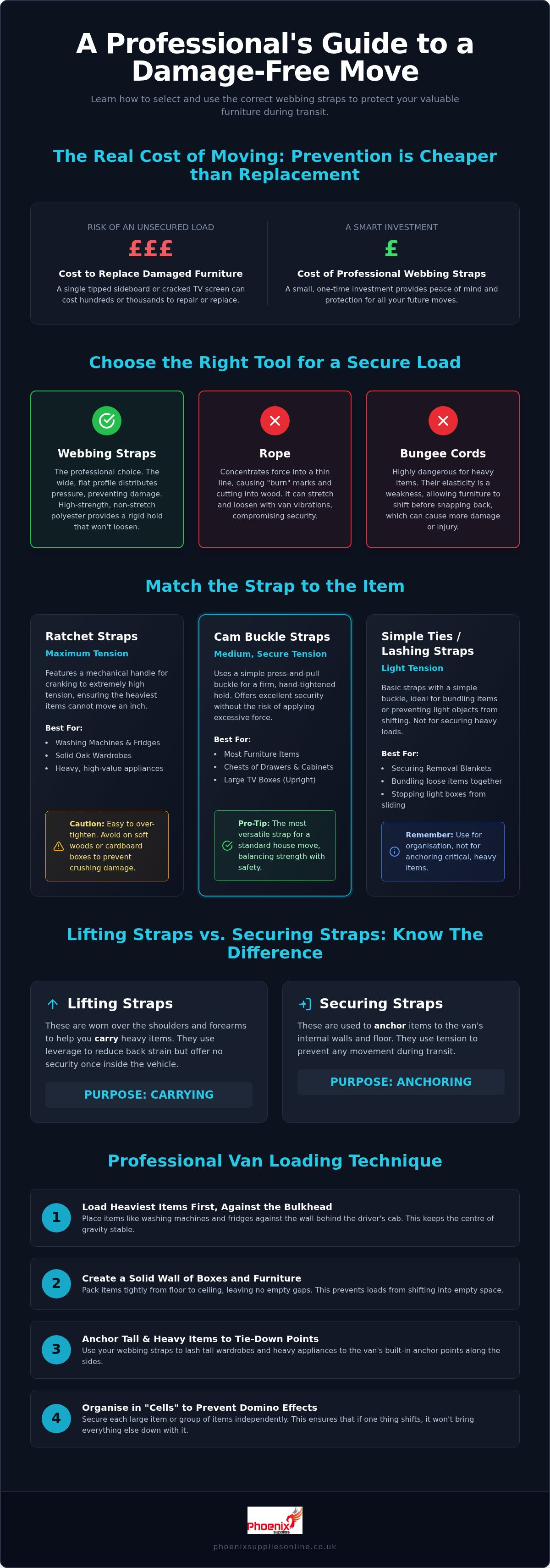
The effectiveness of webbing comes down to how it handles pressure. Because the strap is flat, it distributes the force of the tie-down across several inches of the furniture's surface rather than concentrating it in one sharp line. This distribution offers several benefits:
- Surface Protection: It prevents the strap from cutting into soft wood or upholstery.
- Friction Control: Pressing the furniture firmly against the van walls stops the base from "kicking out" during a sudden stop.
- Tension Stability: Unlike rope, the tight weave doesn't loosen as the vehicle vibrates on the road.
Avoid using bungee cords for heavy items. Their elasticity is their weakness; if a heavy oak table begins to tip, a bungee cord will simply stretch and then snap back, often causing more damage or even injury. Webbing provides the rigid, non-stretch hold required for heavy loads.
Protecting Your Favourite Belongings
A single unsecured item can cause a "domino effect" inside the van. If one heavy chest of drawers tips over, it can crush smaller boxes or puncture the side of another piece of furniture. Using webbing straps for moving allows you to create "cells" of security, where each large item is anchored independently to the van walls. This is particularly vital when you are transporting high-value items like electronics. For example, you should always use straps to keep large TV moving boxes in an upright position. If a TV box falls flat, the internal pressure can easily crack the screen, even with plenty of padding. Securing your load to a professional standard isn't just about safety; it's about the peace of mind you feel when you hear the van engine start, knowing everything is locked in place.
The Different Types of Removal Straps Explained
Choosing the right webbing straps for moving depends entirely on what you are trying to secure. Not every item in your home requires the same level of tension or the same locking mechanism. Using a heavy-duty strap on a light box might crush it, while using a light tie on a fridge could lead to a dangerous failure. Most people will find that a combination of three main categories; ratchets, cam buckles, and simple ties; provides the most comprehensive security for a standard house move.
Ratchet Straps: For the Heaviest Loads
Ratchet straps are the heavy hitters of the moving world. They feature a mechanical handle that allows you to crank the webbing to a high level of tension. This ensures that even the bulkiest items cannot shift during the journey. These are the best choice for securing fridges, washing machines, and solid oak wardrobes that have a high centre of gravity. When you need to safely move heavy furniture, the mechanical advantage of a ratchet gives you the confidence that the load is truly locked down.
A word of caution is necessary here. Because ratchets are so powerful, it is easy to over-tighten them. You should avoid using them on soft-wood furniture or cardboard boxes, as the pressure can easily crack the wood or collapse the box. Always check the tension by hand as you go. If you are looking for professional-grade reliability, you can find a variety of webbing straps and removal supplies that are built to withstand these high-pressure tasks.
Cam Buckle and Simple Ties: Quick and Versatile
Cam buckle straps use a much simpler "press-and-pull" mechanism. You thread the webbing through a spring-loaded buckle and pull it tight by hand. These are much faster to apply and remove than ratchets. They are the favourite choice for securing mattresses, sofas, and lighter stacks of boxes. If you are transporting a library, these straps are perfect for holding stacks of small moving boxes for books together so they don't slide around the van floor.
Simple webbing ties are the most basic option. These are manual-tension straps that often use a simple knot or a plastic slider. Whilst they aren't suitable for heavy furniture, they are excellent for bundling items together. You might use them to keep a set of garden tools in a tidy bunch or to stop a roll of carpet from unfurling. Using these varied webbing straps for moving allows you to create a stable "block" of items in the van, where everything supports everything else without the risk of over-tightening.
Lifting Straps vs Securing Straps: Which Do You Need?
It's a common mistake to assume all straps are the same. When you look for moving equipment, you'll likely see two distinct tools: lifting harnesses and securing webbing. Whilst they both help you move, they perform completely different jobs. We like to think of this in a "from-to" framework. You use lifting straps to get your sofa from the living room to the tail lift, but you use webbing straps for moving to keep it safe from the driveway to your new front door. Understanding this difference is the first step toward a damage-free move.
When to Use Lifting Harnesses
Lifting harnesses, often called forearm forklifts or shoulder dollies, are designed for human ergonomics. These help you carry heavy white goods or bulky wardrobes by redistributing the weight to your larger muscle groups. They're brilliant for protecting your back and helping you navigate tight corners or narrow hallways. However, they have clear limitations. You always need two people to use them, and their job ends the moment the furniture touches the van floor. They offer zero protection once the vehicle is in motion, as they lack the strength and tensioning mechanisms required to anchor a load.
Why Securing Straps are Non-Negotiable
This is where securing straps become essential. Every professional removal firm treats webbing ties as their primary tool for a reason. Once your items are inside the vehicle, they face forces they weren't built to withstand. Sudden braking or a sharp turn can cause a "load shift," where hundreds of kilograms of furniture slide at once. This is when most transit damage happens. You must properly to prevent this movement. High-quality webbing straps for moving are built to stay in the van, locking your belongings to the vehicle's internal rails so they don't move even a centimetre.
The risk of load shift is the most common cause of insurance claims during DIY moves. When a heavy appliance slides, it doesn't just damage itself; it can punch a hole through the side of the van or crush adjacent boxes. Using professional-standard webbing provides several benefits:
- They prevent lateral movement during cornering.
- They stop items from sliding forward during heavy braking.
- They allow you to stack items higher with confidence.
- They are non-elastic, ensuring the tension stays constant throughout the journey.
Without these straps, your furniture is just loose cargo waiting for a bumpy road to cause a disaster. Whilst lifting harnesses save your back, only webbing straps will save your furniture.
How to Organise and Secure Your Removal Van Load
Loading a removal van is about more than just fitting shapes together like a puzzle. It is about creating a structure that can withstand the vibrations and forces of the road. To do this properly, you must follow a logical sequence that starts at the "bulkhead", which is the interior wall directly behind the driver's cab. By loading your heaviest furniture here and working backwards, you ensure the weight is distributed safely across the vehicle's axles. This prevents the van from becoming unbalanced and makes the drive much smoother.
Once your furniture is in position, locate the internal tie-down rails or points built into the van walls. These are designed specifically for webbing straps for moving. The process involves a few key steps:
- Thread your strap through the rail and wrap it around the furniture.
- Employ the "blanket sandwich" technique by placing a folded removal blanket between the strap and the item.
- Tightened the strap until it is taut but not crushing the item.
- Tie off the excess webbing to prevent it from tangling or getting caught in the doors.
The Importance of Removal Blankets
You should never place a strap directly against a polished wooden surface or delicate fabric. The vibrations of a moving van can cause even the smoothest webbing to act like sandpaper, leaving marks that are impossible to remove. Blankets do more than just protect; they provide the necessary "grip" that allows the strap to hold the item firmly without slipping. This is even useful for lighter items. If you are securing hanging clothes moving boxes, a quick wrap with light webbing over a blanket ensures they stay upright and don't slide during transit.
The "Two-Finger" Tension Test
A common worry for DIY movers is knowing exactly how tight to pull the straps. You want the item to be immovable, but you don't want to hear the wood creak or see a cardboard box start to buckle. A simple way to check is the two-finger test. Once you have tightened the strap, try to slide two fingers between the webbing and the furniture. If they slide in with a bit of resistance, the tension is usually perfect. If you can't get your fingers under at all, it is too tight and could cause damage. If you can fit your whole hand, it is too loose. The item should not move when you give it a firm push, but the strap shouldn't be biting into the wood. To get started with the right gear, you can browse our range of professional removal supplies and webbing straps for national UK delivery.
Choosing High-Quality Webbing Straps from Phoenix Supplies UK
When you are preparing for a move, it is tempting to pick up the cheapest tie-downs from a DIY store or an anonymous online marketplace. However, these are often generic imports that lack the durability required for heavy furniture. As a family-run business with decades of experience, we take pride in providing professional-standard webbing straps for moving that you can actually trust. Our straps are made from high-quality polyester, which is specifically chosen for its resistance to fraying and UV damage. This means your equipment stays strong and reliable even after multiple trips in the van.
To make the process as straightforward as possible, we recommend combining your straps with our moving house packing kits. This gives you a complete solution, from the boxes themselves to the security equipment needed to keep them in place. If you are unsure how many straps you actually need for your specific inventory, our office team is always available to help you calculate the right amount based on the size of your van and the number of bulky items you have.
The Phoenix Supplies Difference
We believe that personal service is just as important as the quality of the webbing. When you call us, you won't be met with automated barriers or cold, sterile e-commerce systems. You'll speak to a helpful human being who understands the practical challenges of a house move. We offer national UK delivery, which includes free delivery on orders, ensuring your supplies arrive at your door well before the big day. Our commitment is to provide professional-grade webbing straps for moving at competitive prices, giving you the same tools used by commercial removal firms without the industrial price tag.
Ready to Secure Your Move?
Before you start loading, it is worth reviewing your inventory to decide on the mix of ratchets and cam buckles you'll need. If you are handling a commercial move or a large family home, buying in bulk can be a cost-effective way to ensure you never run out of ties mid-load. Remember that a complete kit involves more than just the straps. Ensure you have your final checklist ready:
- Heavy-duty webbing straps for the main furniture items.
- Removal blankets to prevent surface scratches.
- Correctly sized moving boxes to prevent over-stacking.
- Strong packing tape and bubble wrap for fragile items.
By choosing high-quality equipment and following the advice in this guide, you can approach your move with total confidence. We are here to act as your steady guide, providing the reliable materials you need for a safe, damage-free transition to your new home.
Secure Your Furniture for a Stress-Free Move
Moving house is a significant life event, and the safety of your belongings should never be left to chance. By now, you understand that the right webbing straps for moving are just as important as the boxes themselves. Whether you are using heavy-duty ratchets for white goods or versatile cam buckles for lighter furniture, the key is proper tension and surface protection. Remember to always use removal blankets as a buffer to prevent strap marks on polished wood or delicate fabrics.
As a family-run business, we take pride in offering expert advice alongside our high-tensile, removal-grade webbing. We want to ensure you have the professional tools needed to avoid the "load shift" that causes so much unnecessary damage. With free UK delivery on all orders, getting your supplies organised is simpler than ever. Browse our range of professional webbing straps and securing ties today and take the first step towards a safe, professional-standard house move. You've done the hard work of packing; let us help you keep it all secure.
Frequently Asked Questions
Can I use bungee cords instead of webbing straps for moving furniture?
No, you should avoid using bungee cords for securing heavy furniture. Bungee cords are elastic, which means they allow items to bounce and shift when the van turns a corner or hits a bump. This movement is the primary cause of transit damage. Professional webbing straps for moving are non-elastic and provide a rigid, reliable hold that keeps your belongings completely stationary throughout the entire journey.
How many webbing straps do I need for a 3-bedroom house move?
For a typical 3-bedroom home, we recommend having between 6 and 10 straps available. You will generally need two straps for each large appliance, such as a fridge or washing machine, and at least one or two for each tall wardrobe or sofa. It is always better to have a few spares in your kit rather than running out of security options halfway through loading the van.
What is the difference between a ratchet strap and a cam buckle strap?
The main difference lies in how they apply tension. A ratchet strap uses a mechanical handle to crank the webbing very tight, which is perfect for heavy white goods. A cam buckle strap uses a simple "press-and-pull" mechanism that relies on your manual strength. Use ratchets for your heaviest items and cam buckles for lighter furniture, mattresses, or securing stacks of boxes together.
Will webbing straps leave marks or "burn" my furniture during the journey?
Webbing straps are much safer than rope because their flat surface distributes pressure, but they can still leave friction marks on polished wood if used alone. To prevent this, you should always use the "blanket sandwich" technique mentioned earlier. Placing a thick removal blanket between the strap and your furniture provides a soft buffer that prevents any scuffs, burns, or indentations from appearing on your favourite pieces.
Do I need a specific type of van to use webbing straps correctly?
You don't need a specialist vehicle, but you should ensure your hire van has internal "tie-down" points or rails. Most standard Luton or panel vans used for removals come equipped with these metal loops or rails along the interior walls. These points are essential because they give you a secure place to anchor your webbing straps for moving, ensuring the load is tied to the vehicle itself.
What weight limit should I look for when buying webbing straps for appliances?
For standard domestic appliances like dishwashers or fridges, look for straps with a minimum lashing capacity of 250kg to 500kg. Most professional-grade 25mm or 50mm webbing is rated well above this. Always check the permanent label on the strap for the Break Strength and Load Limit. Using equipment rated for these weights ensures that even a sudden stop won't cause the strap to snap under the pressure.
How do I clean and store my webbing straps after the move is finished?
To maintain your straps, wipe the webbing with a damp cloth to remove any dust or grit and let them air dry completely. It is important to never store them whilst they are damp, as this can cause mildew to weaken the fabric. Roll them up neatly to prevent tangles and store them in a dry box or bag. This keeps the ratchets moving freely for your next project.
Can I use these straps to secure items on a roof rack or just inside a van?
Yes, these straps are highly versatile and can be used on roof racks for items like ladders or timber. However, you must be careful to tie off any excess webbing securely so it doesn't flap or become caught whilst driving. When using them outdoors, always check the tension after the first few miles of your trip, as wind resistance and road vibrations can sometimes cause the load to settle.


