

Imagine finally finishing a long, exhausting moving day, only to find your mattress covered in van grease or, worse, damp and dirty from the journey. It is a stressful scenario that many people face when they have not planned for the unique challenges of transporting bulky bedding. We understand that your mattress is more than just furniture; it is a significant investment in your health and comfort that deserves proper care. You want to be certain that once you reach your new home, your bed is as fresh and supportive as the day you bought it. Learning how to protect a mattress when moving is the best way to avoid the fear of pests, dirt, or permanent damage to internal foam and springs.
In this guide, we will share the expert methods used to keep mattresses structurally sound and hygienically sealed throughout any house move. You will discover why a dual-layer approach is essential for the best results, combining moisture protection with physical padding. We will walk you through a straightforward, cost-effective plan that uses professional-grade mattress covers and removal blankets to ensure your bed stays in perfect condition. From sealing out dust to securing the mattress safely in the van, we provide the practical steps you need to settle in comfortably on your very first night.
Key Takeaways
- Discover why a dual-layer system using polythene covers and removal blankets is the most effective way to guarantee a clean, damage-free mattress.
- Master the "Slide and Seal" technique to safely package heavy mattresses without risking injury or tearing your protective materials.
- Understand how to protect a mattress when moving by avoiding the common mistake of folding it, which can cause permanent damage to internal springs.
- Learn the correct loading sequence to ensure your mattress remains flat and supported throughout the journey to your new home.
- Follow our simple inspection process during unpacking to prevent any external dirt or moisture from reaching your clean bedding on the first night.
Why Protecting Your Mattress is Essential for a Successful Move
A mattress is likely one of the most expensive items in your home. It is also the most vulnerable during a house move. Whilst it may look sturdy, the outer fabric is a magnet for what we call "van grime." Removal vans are hardworking vehicles that transport everything from garden tools to oily bicycle chains. Even in a clean van, diesel particles and dust settle on every surface. When you consider how to protect a mattress when moving, you must look beyond simple surface covers. A standard cotton bedsheet is insufficient because it is porous. It allows moisture and microscopic allergens to pass straight through to the internal fillings. If you wouldn't sleep on a dirty van floor, you shouldn't let your mattress touch one without a proper barrier.
The cost-benefit of using professional supplies is clear. You can spend a small amount on a heavy-duty cover or face spending hundreds of pounds on a replacement bed. Many manufacturers are also very strict about their terms. It is common for a warranty to be voided if the mattress shows signs of being folded or heavily soiled. Using a dedicated Mattress protector or a specialist polythene moving bag is a simple insurance policy that preserves both your comfort and your consumer rights.
Hygiene and Health Considerations
Your bed should be the cleanest place in your home. During a move, however, it is exposed to the elements. Even a light drizzle during the walk from the front door to the van can lead to disaster. If moisture gets trapped inside the plastic wrapping, it can quickly develop into mould or mildew whilst in transit or storage. Using a clean, dry cover prevents the transfer of dust mites and allergens from the old house or the removal vehicle. This ensures that when you finally collapse into bed at the end of a long moving day, you are breathing in fresh air rather than road grit.
Structural Integrity and Longevity
Improper handling is the leading cause of "mattress death" during a move. Modern pocket springs and memory foam layers are engineered to support weight whilst lying flat. They are not designed to be twisted or bent. The specific vulnerability of heavy king-size or super-king mattresses means they can easily lose their shape if they are lugged around by the fabric handles, which are often only intended for positioning, not lifting. We always tell our customers that the fold is the enemy. Snapping an internal border wire or shifting the spring alignment can cause permanent lumps that no amount of flipping will fix. Keeping the mattress flat and supported is the only way to ensure it survives the journey intact.
Choosing the Right Supplies: Mattress Covers vs Removal Blankets
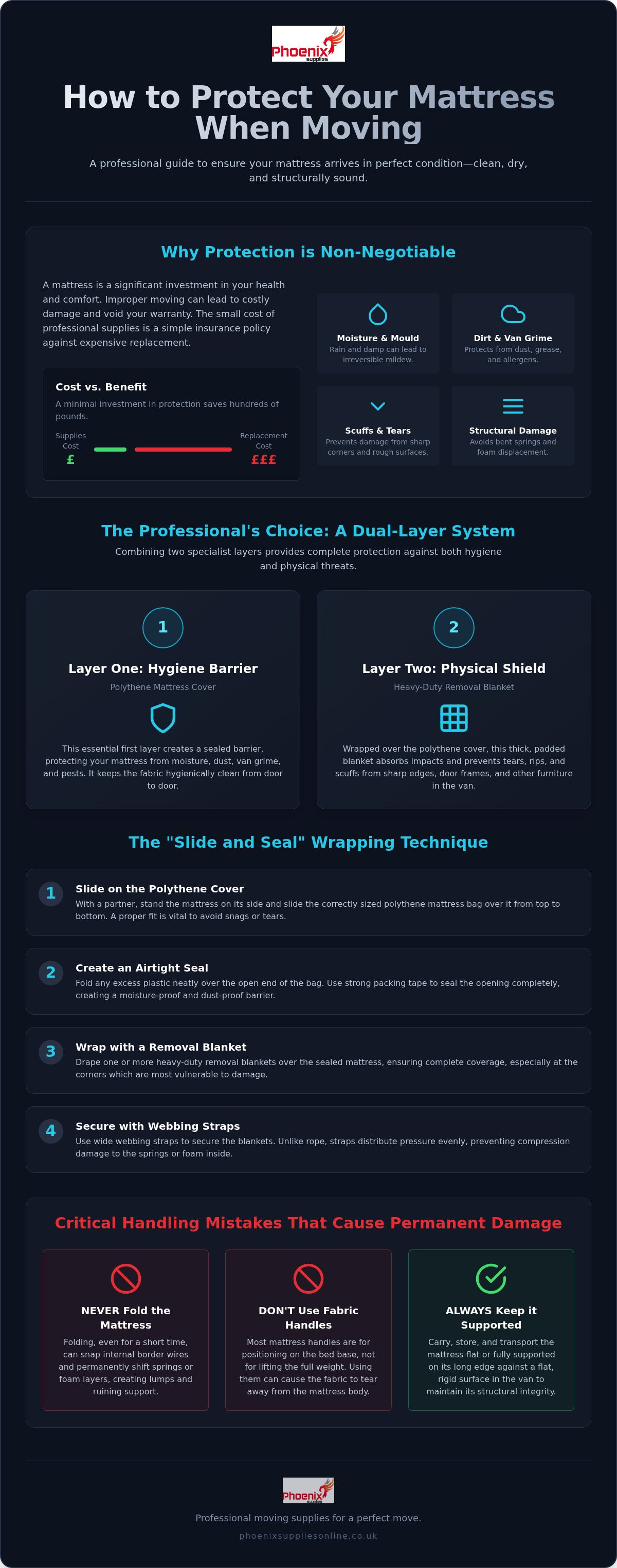
When you are planning how to protect a mattress when moving, the first decision involves choosing materials that actually stand up to the rigours of transit. Many people assume a thin plastic wrap is enough, but professional movers usually rely on a dual-layer approach. You need a primary barrier to keep the fabric clean and a secondary layer to prevent physical damage. Combining a polythene cover with a heavy-duty removal blanket creates a "belt and braces" system that guards against everything from road spray to sharp furniture corners.
You also need the right tools to keep these layers secure. Strong packing tape is essential for creating a moisture-proof seal on your bags. For the final secure, webbing straps are far superior to standard rope. Straps are wider and distribute pressure evenly across the mattress border, which prevents the springs from being compressed or the fabric from being pinched during the journey. If you are looking for professional-grade mattress and furniture covers, choosing removal-grade materials ensures your bed stays in showroom condition.
When to Use Polythene Mattress Covers
Polythene covers are your essential hygiene barrier. They are non-negotiable for any move involving a van or any period of outdoor transit. These bags are designed to fit specific UK bed sizes, from single and double up to king and super-king dimensions. A proper fit is vital; a bag that is too large will have loose "wings" of plastic that can snag or tear, whilst a bag that is too small will be impossible to seal. Standard polythene bags usually require taping at the ends, but they offer the most robust protection against damp and dust mites. If you want to know more about the logistics of the process, you can find expert advice on how to pack a mattress to ensure it remains sanitary.
The Role of Professional Removal Blankets
Whilst the plastic bag keeps the mattress clean, removal blankets keep it structurally safe. These thick, quilted textile wraps provide a cushioned layer that absorbs friction. During a long-distance move, items in the back of a van will naturally shift. Without a blanket, the polythene cover can rub against the van walls, causing "friction burns" or small punctures that let in dirt. Wrapping the corners and edges in blankets prevents the internal border wires from being crushed if other items are leaning against the bed. This combination is the gold standard for anyone who wants to be certain their mattress is ready to sleep on the moment they arrive at their new home.
A Step-by-Step Guide to Wrapping Your Mattress Safely
Once you have gathered your professional-grade supplies, it is time to start the physical work. Wrapping a mattress is a task that requires patience and, ideally, a second pair of hands. If you rush this stage, you risk trapping moisture or leaving gaps that allow dust to enter. Understanding how to protect a mattress when moving begins with the preparation stage, ensuring the fabric is in the best possible condition before it is sealed away for the journey.
Preparation and Cleaning
The first step is to strip all bedding, including sheets, pillows, and any detachable toppers. These items should be packed separately in medium moving boxes to keep them organised and away from the heavier mattress itself. It is vital that the mattress is bone-dry before you wrap it. You should allow the mattress to air out for exactly 60 minutes to ensure there is zero trapped humidity from overnight use. This simple pause prevents the growth of mould once the mattress is inside its airtight polythene skin.
After the airing period, give the surface a quick vacuum to remove any loose hair or skin cells. This prevents them from becoming ground into the fabric during the vibrations of the move. If you have any specific concerns about stains, treat them days in advance so the area is completely dry before moving day arrives.
The "Slide and Seal" method is the most efficient way to package the bed. With two people, stand the mattress on its long edge. One person holds the open end of the polythene bag whilst the other person slides the mattress inside, inch by inch. This prevents the bag from snagging on the floor or the bed frame. Once the mattress is fully encased, walk along the length of the bag to gently press out excess air. Removing this air prevents the plastic from billowing, which often leads to the bag snagging or tearing on van walls.
Sealing for Maximum Protection
When the mattress is inside, you will have a flap of extra plastic at the end. Use the "envelope fold" technique, folding the corners in first and then the main flap over the top, much like wrapping a gift. Secure this with several layers of high-quality packing tape to create a moisture-proof seal. For extra security, apply a second layer of tape over the "grab points" or corners. These are the areas most likely to be handled, and reinforcing them prevents the plastic from ripping under pressure. You can find more useful mattress moving hacks to simplify the process, such as using a marker pen to clearly identify the "top" side. Knowing which side is which makes setting up your bed in the new house much faster and ensures you don't accidentally place it face-down on a dusty floor.
Safe Handling and Loading: Avoiding Structural Damage
Folding is the cardinal sin of moving. Whilst it might seem like a clever way to save space in a smaller van, the internal damage is often irreversible. Most modern mattresses, whether they are pocket sprung or memory foam, are designed to remain flat. Folding them can snap the border wire, shift the internal pocket springs, or cause the foam layers to delaminate. Learning how to protect a mattress when moving involves more than just wrapping it; it requires a careful approach to physics and weight distribution. If you want to ensure your bed is ready to sleep on at your new destination, you must commit to keeping it flat or securely upright for the shortest time possible.
Memory foam mattresses require even more attention than traditional sprung models. Because memory foam is temperature-sensitive and dense, it lacks the rigid internal structure of a steel frame. If a foam mattress is left standing on its side for a long journey, the internal layers can "slump" or migrate toward the bottom edge. This creates a permanent bulge on one side and a thin spot on the other. To avoid this, your goal should be to store the mattress flat on top of other flat surfaces, such as a sturdy dining table or a layer of uniform boxes, once you are inside the van.
Carrying and Lifting Techniques
Securing the Mattress in the Van
Once inside the vehicle, position the mattress between two flat surfaces to keep it stable. A common professional trick is to sandwich the mattress between a wardrobe and the van wall. This prevents it from bowing or falling over during transit. You must check that no sharp objects, such as protruding bed frame bolts or toolboxes, are pressing against the cover. We recommend using removal blankets as a buffer between the mattress and the van floor to absorb vibrations and provide an extra layer of cushioning. Finally, use webbing straps for moving to secure the mattress against the van wall. Unlike thin rope, these wide straps won't cut into the mattress or damage the internal springs when tightened.
If you need professional-grade equipment to keep your furniture safe, you can buy your moving supplies directly from our family-run shop for fast, reliable delivery.
Unpacking and Refreshing Your Mattress in Your New Home
The final stage of your journey is just as important as the first. When you arrive at your new house, your instinct might be to drag everything inside as quickly as possible to get the job done. However, the process of how to protect a mattress when moving actually continues until the bed is fully dressed and ready for sleep. Before you bring the mattress through the front door, perform a quick inspection of the polythene cover. If you spot any fresh tears or punctures from the journey, check the mattress fabric immediately. It is much easier to treat a small smudge of van dust whilst you are still in "moving mode" than to discover it weeks later after it has settled into the fibres.
When you are ready to unwrap, avoid using sharp kitchen knives or box cutters near the surface. One slip can cause a permanent gash in the expensive ticking of your mattress. Instead, use blunt-nosed scissors to carefully snip the tape and peel the plastic away. Once the cover is off, don't be tempted to put the sheets on straight away. Your mattress has been sealed in plastic for several hours, and it needs a chance to "breathe" and shed any trapped odours or residual humidity. This is a vital step for maintaining the freshness of the internal fillings.
The First Night Protocol
After the mattress is out of its bag, check for any "slumping." As we discussed earlier, memory foam or pocket springs can sometimes shift if the mattress spent too much time on its side in the van. Gently massage any lumpy areas or compressed corners back into their original shape. You should wait at least two hours before dressing the bed to allow the fillings to settle and the fabric to air out completely. Once your bed is ready, you can focus on finishing the rest of your room by following our guide on how to pack clothes for moving in boxes to get your wardrobe in order.
Disposal and Future Use
Being a family-run business, we value looking after our community and the environment. Don't just throw your moving supplies in the general waste. Your removal blankets are incredibly durable and can be folded and stored for future DIY projects, car boot protection, or even as extra padding for items in the loft. The polythene mattress covers can usually be recycled at local soft plastic collection points found at most major supermarkets. Finally, ensure your bed frame is correctly assembled and all bolts are tightened before you place the mattress down. A flat, sturdy base is the final requirement for ensuring your hard work in protecting your mattress pays off with a perfect night's sleep.
Secure Your Bed for a Perfect First Night
Moving house is a major milestone, and your mattress is a central part of that transition. By following a dual-layer approach of polythene covers and removal blankets, you eliminate the risks of van grime and physical damage. Remember that the "no-fold" rule is essential for preserving internal springs and foam layers. When you understand how to protect a mattress when moving, you save yourself the stress and expense of a last-minute replacement.
As a family-run UK business, we take pride in helping you move with confidence. You don't need to be a professional removal expert to get expert results. Browse our range of heavy-duty mattress covers and removal blankets today to secure your investment. We provide removal-grade quality materials and offer free delivery on all moving supplies, ensuring you have everything you need for a smooth transition.
With the right preparation and a steady plan, you can look forward to a fresh, clean bed the moment you arrive at your new home. Good luck with your move!
Frequently Asked Questions
Can I move a mattress without a cover if it is just a short distance?
You should always use a cover regardless of the distance. Even a thirty-second walk from the front door to the van can expose the fabric to rain, diesel particles, or road grit. Without a barrier, your mattress acts like a giant sponge for dust and allergens. Knowing how to protect a mattress when moving even a few streets away is the only way to avoid bringing old van grime into your new bedroom.
How do I protect a memory foam mattress differently from a pocket sprung one?
Memory foam requires flatter storage because it lacks a rigid internal frame. If it stays on its side for too long, the layers can shift or "slump" permanently. Pocket sprung mattresses are slightly more rigid but are highly vulnerable to internal damage if they are folded. You must keep both types straight and supported to avoid snapping the internal components or causing the foam layers to delaminate during the journey.
Is it okay to store a mattress on its side in the removal van?
You should avoid storing a mattress on its side for anything longer than the transit time. Whilst it is common to stand them up to save space, the internal fillings can settle or shift under their own weight. If you must stand it up, ensure it is tightly sandwiched between flat furniture and secured with webbing straps to prevent it from bowing or slumping whilst the vehicle is in motion.
What is the best way to seal a mattress bag for a house move?
The most effective method is the "envelope fold" combined with heavy-duty packing tape. After sliding the mattress into the bag, press out as much air as possible so the plastic doesn't billow or snag. Fold the corners in first, then fold the main flap over and tape it down securely across the entire width. This creates a moisture-proof seal that keeps the mattress bone-dry throughout the move.
Can I use bubble wrap instead of a mattress cover for moving?
Bubble wrap is not a suitable replacement for a dedicated mattress bag. Whilst it offers some cushioning against impacts, it is difficult to create a completely airtight seal against dust, moisture, and pests. Polythene covers provide a continuous, smooth hygiene barrier that bubble wrap simply cannot match. For the best protection, use a cover first and then add removal blankets or bubble wrap for extra padding on the corners.
How do I carry a heavy king-size mattress up a flight of stairs safely?
Always use two people and maintain a firm "corner-to-corner" grip. Avoid using the fabric handles, as these are often only designed for positioning and can't support the full weight of a king-size mattress. Move slowly and communicate at every step to stay synchronised. This prevents you from dragging the mattress on the stair treads, which could puncture your protective cover and damage the clean fabric underneath.
Should I clean my mattress before or after I move house?
You should perform a light clean before you pack and a deeper refresh after you arrive. Vacuuming the surface before wrapping prevents dust and hair from being trapped inside the plastic skin. Once you reach the new house and unwrap the mattress, let it air out for at least two hours. This allows any residual moisture to evaporate before you dress the bed with fresh bedding for your first night.
What size mattress bag do I need for a double bed in the UK?
For a standard UK double bed, you need a bag designed for a 4ft 6in mattress. Most double mattress bags are sized to fit a 137cm by 190cm surface. If you have a particularly deep mattress or a pillow-top model, check that the bag has enough extra depth to accommodate the height. Using the correct size is a key part of how to protect a mattress when moving effectively.


