

Imagine it’s 11 PM on the eve of your move, and you’ve just taped up your last container with the entire kitchen still left to pack. It’s a frustrating scenario that many families face, often resulting in a desperate search for flimsy supermarket offcuts that simply aren't up to the task. Working out exactly how many boxes for a 3 bedroom house isn't just about a single number. It's about having the right tools for the job so your precious belongings don't end up crushed or broken.
We understand that every home is unique, but industry experience shows that most three-bedroom relocations require between 40 and 100 boxes to get the job done properly. In this 2026 guide, we'll help you avoid overspending on unnecessary supplies whilst ensuring you never run out at the final hurdle. You’ll learn the ideal ratio of small, medium, and large boxes, alongside the specialist items like wardrobe boxes and removal blankets that make moving day feel much more manageable. We’re here to help you organise a streamlined, stress-free move with total confidence.
Key Takeaways
- Learn why the average three-bedroom home needs 60 to 90 boxes and how to tailor this estimate to your own furniture levels.
- Discover a room-by-room strategy that identifies why the kitchen is often your biggest packing challenge.
- Understand the "Golden Rule of Packing" to choose the right mix of small, medium, and large boxes for safety and efficiency.
- Find out how to accurately factor in lofts and garages when deciding how many boxes for a 3 bedroom house.
- Explore how curated moving packs save time and money whilst providing professional-grade protection for your valuables.
Estimating the Total: How Many Boxes Do You Really Need?
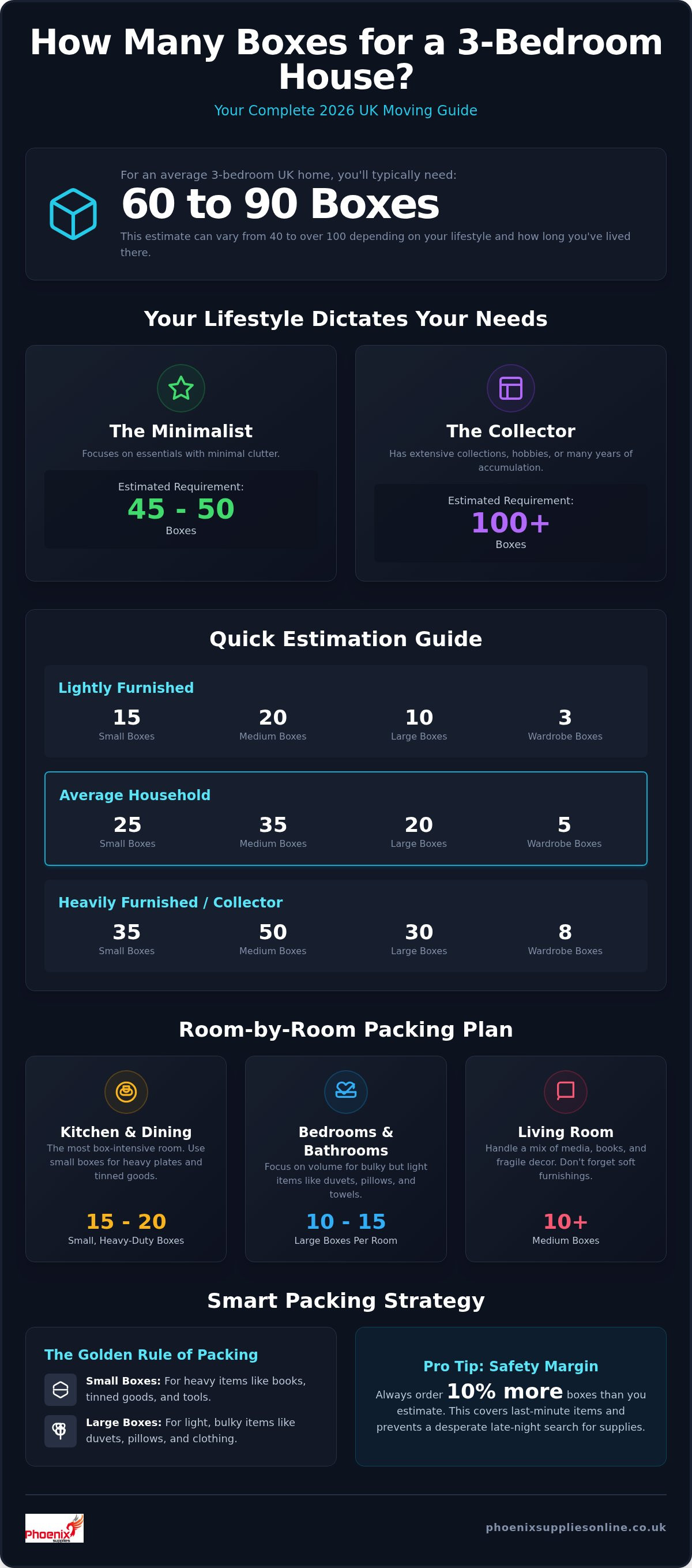
Whilst every home is different, the industry standard for a moderately furnished 3-bedroom UK home is typically 60 to 90 boxes. This range provides a reliable starting point, but relying on a single "one size fits all" figure often leads to frustration on moving day. If you underestimate, you'll find yourself making emergency trips for supplies; if you overestimate, you've spent money on cardboard that will simply sit in the hallway.
Your specific count depends on several personal factors. For instance, the length of time you've lived in your property is a huge indicator of how much "hidden" volume you've accumulated. A family who moved in two years ago will likely have far less than a household that has stayed put for a decade. Additionally, larger families naturally require more supplies to handle the extra clothing, toys, and kitchenware that accumulate over time. We always suggest ordering 10% more than your final estimate to account for those last-minute items that always seem to appear from the back of cupboards.
The Minimalist vs. The Collector
Your lifestyle dictates exactly how many boxes for a 3 bedroom house you'll actually use. A minimalist household focusing on essential furniture and a "capsule" wardrobe might only require 45 to 50 boxes. On the other end of the scale, collectors, hobbyists, or families with young children should budget for 100 or more. Before you place an order, perform a "pre-pack audit" by walking through each room and counting the cupboards. If a room has more than four full storage units, you're likely in the "Collector" category.
A Quick Reference Estimation Table
To help you visualise your needs, we've broken down the requirements based on how much furniture and "stuff" you currently own. This table assumes a mix of Small Moving Boxes, Medium Moving Boxes, and Large Moving Boxes to ensure you can pack everything from heavy books to light bedding safely.
| Inventory Level | Small Boxes | Medium Boxes | Large Boxes | Wardrobe Boxes |
|---|---|---|---|---|
| Lightly Furnished | 15 | 20 | 10 | 3 |
| Average Household | 25 | 35 | 20 | 5 |
| Heavily Furnished | 35 | 50 | 30 | 8 |
For the purposes of these calculations, we define a standard box as a 12x12x12 inch unit to provide a consistent baseline for your planning.
A Room-by-Room Breakdown for a 3-Bed Property
Deciding how many boxes for a 3 bedroom house is much easier when you stop looking at the property as a single, overwhelming unit. Instead, we recommend breaking your home into specific packing zones. This approach helps you track your supply levels and manage your timeline without feeling buried under cardboard.
The Kitchen and Dining Room: The Heavy Hitters
The kitchen is almost always the most box-intensive room in any house. Even in a modest home, you'll likely need 15 to 20 small, heavy-duty boxes just for your plates, tinned goods, and small appliances. These items are deceptively heavy. Packing them into large containers often leads to the bottom falling out or the box becoming nearly impossible to carry safely.
Don't forget that protective materials take up significant space too. Using our packing materials list for moving as a guide, you'll see that layers of bubble wrap and packing paper for fragile ceramics can quickly double the volume of a single box. It's better to have extra small containers on hand than to risk your favourite dinner service in an overstuffed crate.
Bedrooms and Bathrooms: Managing Soft Goods
Bedrooms generally require a different mix of supplies focused on volume rather than weight. You should estimate around 10 to 15 large boxes per bedroom to handle bulky items like pillows, duvets, and towels. Whilst these are light, they take up significant room in the removal van.
For your garments, Wardrobe Boxes are a necessity rather than a luxury. They allow you to move clothes directly from the rail without creases, saving you hours of ironing at the other end. If you're unsure about the best technique for your wardrobe, our guide on how to pack clothes for moving in boxes covers the most efficient methods for British households.
Living rooms often hide a surprising amount of media, books, and fragile decor. You should plan for at least 10 medium boxes for your electronics and library, alongside several large ones for cushions and soft furnishings. Taking the time to walk through these communal areas is vital for an accurate final count of how many boxes for a 3 bedroom house you'll need to order.
If you're feeling overwhelmed by the numbers, starting with one of our pre-configured moving packs is often the simplest way to ensure you have the right mix for every room in your home.
Small, Medium, or Large? Getting the Size Ratio Right
A common mistake many people make is assuming that bigger is always better. Whilst it's tempting to buy only large containers to speed things up, this often results in boxes that are impossible to lift or, worse, break under their own weight. Getting the ratio right is just as important as knowing how many boxes for a 3 bedroom house you need in total.
The Golden Rule of Packing is simple: the heavier the item, the smaller the box. By following this, you ensure your belongings stay protected and your back stays safe. Professional-grade double-wall cardboard is essential here. These sturdier boxes form the foundation layers in a removal van, supporting the weight of everything stacked above them without buckling. If you use single-wall boxes for heavy items, they'll likely crush under the pressure of the stack, leading to damaged goods and a precarious load.
Small Boxes: Your Best Friend for Books and Tins
Small moving boxes are the unsung heroes of any relocation. Books, for example, should never be packed into anything larger than a small container. If you've ever tried to lift a large box filled with hardbacks, you'll know exactly why. Our guide on small moving boxes for books explains the safest ways to organise your library for transport. Beyond literature, these smaller units are perfect for "dead weight" items like tinned food or heavy hand tools. Using a smaller footprint prevents the bottom from falling out and keeps individual loads manageable for whoever is doing the heavy lifting.
Medium and Large Boxes: Versatility for the Home
Medium boxes serve as your versatile all-rounders. They're the perfect size for toys, kitchen gadgets, ornaments, and folded clothing. Because they offer more volume without becoming excessively heavy, they'll likely make up the largest portion of your order. They strike the right balance between storage capacity and ease of movement, making them the most used item in any packing kit.
Large boxes require a bit more discipline. You should reserve these exclusively for light, bulky items like duvets, pillows, and cushions. If you find yourself with a half-empty large box, don't leave the space vacant; use removal blankets to pad out the gaps. This prevents the contents from shifting during transit and stops the box from collapsing when another is placed on top. When calculating how many boxes for a 3 bedroom house to purchase, aim for a balanced mix that reflects the specific weights of your household goods. A typical ratio for a standard UK home involves roughly 30% small, 50% medium, and 20% large boxes.
Beyond the Bedrooms: Accounting for the Loft, Garage, and Garden
When calculating how many boxes for a 3 bedroom house, it's incredibly easy to overlook the spaces that aren't lived in daily. Lofts, garages, and garden sheds are often packed to the rafters with items we haven't touched for years. Experience shows that most people underestimate the volume of these "hidden" rooms by at least 50%. This oversight can lead to a sudden shortage of supplies just as you think you're finishing the job.
The emotional challenge of decluttering these spaces is often the biggest hurdle. It’s tempting to just box everything up and deal with it at the new house, but this only increases your costs and packing time. We recommend a strict "keep, donate, or recycle" policy for everything found in outdoor storage. Reducing the clutter here is the most effective way to bring your final box count down to a manageable level.
The Loft: The "Hidden" Fourth Bedroom
Because items in the loft have often sat undisturbed for years, they tend to be more fragile and susceptible to damage. You'll likely need a higher volume of bubble wrap than expected to protect these older belongings from the bumps of the journey. Seasonal decorations, old suitcases, and long-term storage can easily account for another 10 to 15 medium boxes in a standard 3-bed property.
If you discover stacks of old tax records, birth certificates, or family paperwork tucked away in the eaves, our archive boxes are the superior choice for organising these documents. They are designed specifically for paper weight and allow you to keep records accessible without the risk of the box collapsing under the heavy load.
The Garage and Shed: Heavy Duty Requirements
Garages present a unique challenge because of the weight and sharp edges of the contents. You should always use heavy-duty, double-wall boxes for tools and hardware to avoid puncturing the cardboard. Accounting for these outdoor spaces is essential for an accurate final tally of how many boxes for a 3 bedroom house your specific relocation will require.
Be mindful of safety whilst packing the shed. You should never pack flammable garage liquids, such as petrol, paint thinners, or gas canisters, into your removal boxes. Most removal firms won't carry them for insurance reasons. For "non-boxable" items like lawnmowers, bicycles, and garden furniture, focus on using removal blankets and webbing straps to secure them safely in the van.
To ensure you're fully prepared for these high-volume areas, you can order your heavy-duty moving supplies today and benefit from our personalised, family-run service.
Why Moving Packs Are the Smart Choice for a 3-Bedroom Move
After walking through every room from the kitchen to the loft, you likely have a long list of requirements. Attempting to buy each item individually is not only time-consuming but often more expensive. This is why a pre-configured moving pack is such a sensible choice for most families. It removes the stressful guesswork of deciding exactly how many boxes for a 3 bedroom house you need by providing a tested, reliable volume of supplies in one go.
Bulk buying isn't just about the price per unit; it's about the efficiency of the delivery. Getting everything in one shipment means you won't be caught short mid-pack, which is when most people end up overpaying for low-quality boxes at local shops. A professional kit usually includes a generous amount of bubble wrap and at least half a dozen rolls of tape. These are the items people most frequently forget to buy enough of. If you're unsure where to begin, learning how to buy moving boxes online in the UK will help you navigate the different kit options available for 2026.
The Convenience of Pre-Curated Kits
These kits aren't just random assortments. They're designed using professional removalist data to reflect the needs of average UK homes. You gain peace of mind knowing you have the right ratio of small, medium, and large sizes from day one. Because these kits are based on real-world data, they account for the items that novices often forget, such as the need for more medium boxes than large ones. Having the correct ratio helps you stack the removal van more effectively, as uniform box sizes are much easier to secure with webbing straps.
At Phoenix Supplies UK, we focus on including high-quality, double-wall boxes in every kit. This isn't just about volume; it's about the strength needed to protect your valuables during transit. Using professional-grade cardboard ensures that the bottom layers of your stack won't buckle under pressure, keeping your belongings safe until you reach your new front door.
Final Checklist Before You Click "Order"
Before you finalise your purchase, take one last look at your inventory. Do you have any specialist electronics that need extra care? We often suggest adding a best TV moving box UK to your order to protect those expensive screens. Also, check your tape supply. We recommend at least 6 rolls for a standard three-bedroom move to ensure every seam is securely sealed.
Moving house is a major life event, but it doesn't have to be a logistical nightmare. By choosing a comprehensive 3-bedroom packing kit, you're giving yourself the best possible start. Prepare for your move with our comprehensive 3-bedroom packing kits and enjoy the reassurance that comes from having professional-grade supplies at your fingertips.
Get Ready for Your Smoothest Move Yet
Planning your relocation becomes much simpler once you move past the initial guesswork. By breaking your home into zones and prioritising heavy-duty double-wall boxes for your most valuable items, you're already ahead of the curve. It's vital to stick to the golden rule of packing: keep your heaviest belongings in small containers and save the large ones for light, bulky soft goods. Don't let the "hidden" volume of your loft or garage catch you out at the last minute.
Working out exactly how many boxes for a 3 bedroom house you'll need is the foundation of a stress-free experience. As a family-run business, we're here to provide the expert advice and high-quality materials you need to protect your home. You can view our range of 3-bedroom house moving packs and supplies today, with the added benefit of free UK delivery on all orders. We're proud to be your dependable partner during this big transition. Good luck with your move; you've got this handled.
Frequently Asked Questions
How many boxes for a 3 bed house UK on average?
On average, a standard three-bedroom UK home requires between 60 and 90 boxes. This estimate accounts for a typical mix of furniture and belongings across the main living areas and bedrooms. However, if you've lived in your property for over a decade or have a high volume of hobby equipment, you might find your final count reaching 100 or more. Knowing exactly how many boxes for a 3 bedroom house to order ensures you don't stall your packing process.
What is the best mix of box sizes for a three-bedroom move?
The ideal mix consists of roughly 30% Small Moving Boxes, 50% Medium Moving Boxes, and 20% Large Moving Boxes. This ratio ensures you have enough small containers for heavy items like books and tinned goods whilst providing ample medium boxes for general household items. We also recommend adding specialist Wardrobe Boxes and Archive Boxes to your inventory to handle hanging clothes and important paperwork without the risk of damage or clutter during the transition.
Is it cheaper to buy moving boxes individually or in a pack?
Purchasing a pre-curated moving pack is significantly more cost-effective than buying individual boxes. These kits are designed using professional removalist data to provide the exact ratio of sizes needed for a typical home. By ordering in bulk, you benefit from lower unit costs and the convenience of a single delivery. This approach removes the guesswork and ensures you have all the essential tape and bubble wrap required to start your project immediately.
How many wardrobe boxes do I need for a 3 bedroom house?
Most three-bedroom households require between 4 and 8 Wardrobe Boxes. As a general guide, one standard wardrobe box holds roughly 2 feet of hanging rail space. If you have multiple bedrooms with large built-in wardrobes, you should aim for the higher end of this estimate. Using these specialist containers allows you to transfer clothes directly from the rail, which keeps them clean and crease-free whilst saving you hours of folding and ironing at your new home.
Can I use supermarket boxes for a house move?
Whilst supermarket boxes are free, they are rarely sturdy enough for a full house move. Most are single-wall cardboard that has been weakened by humidity or heavy use. They often lack the structural integrity to be stacked safely in a removal van. For a three-bedroom move, it's safer to use professional-grade double-wall boxes. These provide the strength needed to protect your valuables and ensure the bottom container doesn't buckle under the weight of the stack.
How much bubble wrap do I need for a 3-bed house?
We suggest starting with at least 50 to 100 metres of bubble wrap for a property of this size. The kitchen alone often consumes 25 metres when you factor in every plate, bowl, and glass. You'll also need a significant amount for protecting electronics in the lounge and fragile items found in the loft. It's always better to have a surplus on hand, as running out of protective wrap can lead to rushed or unsafe packing at the last minute.
Should I use single-wall or double-wall boxes for my move?
You should prioritise double-wall boxes for almost every part of your move. Double-wall cardboard features two layers of fluting, which provides superior strength and puncture resistance compared to single-wall alternatives. This is especially important for the items at the bottom of the removal van stack, which must support the weight of everything above them. Single-wall boxes are only suitable for very light, non-fragile items like cushions or soft toys that won't be under any pressure.
What happens if I order too many moving boxes?
Having a few spare containers is actually a benefit rather than a problem. Extra boxes can be used for last-minute items from the kitchen cupboards or broken down to provide extra floor protection during the move. If you have a significant surplus, you can store them flat in a dry area for future use or offer them to a neighbour. Because they are high-quality cardboard, they are also fully recyclable through standard domestic collection services.


