

The "sturdier" plastic bin might actually be the riskiest choice for your house move. We've all felt that familiar knot in the stomach when lifting a box and feeling the base start to give way, or worrying that a stack might tumble in the back of a van. It's natural to want the toughest protection for your belongings, but when weighing up cardboard vs plastic moving boxes, the obvious choice isn't always the best one for your budget or your new home's floor space.
We understand the pressure of trying to organise a seamless move without spending a fortune on materials you'll never use again. This 2026 guide offers a definitive comparison to help you ensure your items arrive safely whilst keeping your costs down. We'll look at everything from the reliability of heavy-duty double-wall cardboard to the practical reality of what happens to your packing gear once the final van is unloaded.
You will discover how to choose materials that support everything from fragile kitchenware to bulky wardrobes, ensuring an efficient process with minimal post-move waste. By the end, you'll know exactly how to pack with confidence and avoid the headache of fifty empty plastic crates cluttering up your new garage.
Key Takeaways
- Compare the initial costs and long-term value of cardboard vs plastic moving boxes to ensure your packing budget goes further whilst keeping your items safe.
- See how professional-grade double-wall cardboard provides superior shock absorption for fragile items compared to the rigid, brittle nature of some plastic alternatives.
- Avoid "van-space waste" by understanding why the uniform, square shape of cardboard boxes allows for more stable and efficient stacking than tapered plastic bins.
- Minimise post-move clutter by choosing flat-packable materials that are easy to recycle or store, rather than being stuck with dozens of bulky plastic containers.
- Learn how a hybrid approach, using specialist containers like wardrobe boxes for clothing, can provide the ultimate protection for your most valuable belongings.
Cardboard vs Plastic Moving Boxes: A Practical Comparison
Choosing between cardboard vs plastic moving boxes usually comes down to how you value your time and your budget. While a plastic crate might look invincible, the reality of a UK house move often tells a different story. We've seen many families opt for plastic thinking it's the "premium" choice, only to find that these heavy bins are difficult to handle once the stairs and narrow hallways of a typical terrace house come into play.
For fragile items like glassware or electronics, cardboard's secret weapon is its structure. The fluted layers in a double-wall box act like a crumple zone in a car; they absorb the energy of a bump or a shift in the van. Rigid plastic doesn't flex in the same way. Instead, it vibrates, which can lead to chips and cracks in your favourite plates if the van hits a pothole. Cardboard is also significantly lighter. A large plastic bin adds several kilograms of "dead weight" before you've even packed a single item, making the physical job of moving much more taxing on your back.
Key Factors at a Glance: Comparison Table
- Cost per unit: Cardboard offers a much lower upfront cost, especially when bought in bulk packs. Plastic requires a higher investment or ongoing rental fees.
- Stackability: Cardboard boxes have square edges for perfect vertical alignment. Plastic bins are often tapered, which can lead to sliding during transit.
- Moisture Resistance: Plastic is naturally waterproof. However, professional-grade cardboard is perfectly resilient for the short trip between the house and the van in typical British weather.
When to Choose Traditional Cardboard
Cardboard remains the gold standard for professional removal companies for a reason. It's the most cost-effective way to organise a move, particularly when you're working to a budget. Because cardboard boxes can be taped shut, they are also more secure against dust and debris than many plastic bins with clip-on lids that can pop open if the box is slightly overfilled.
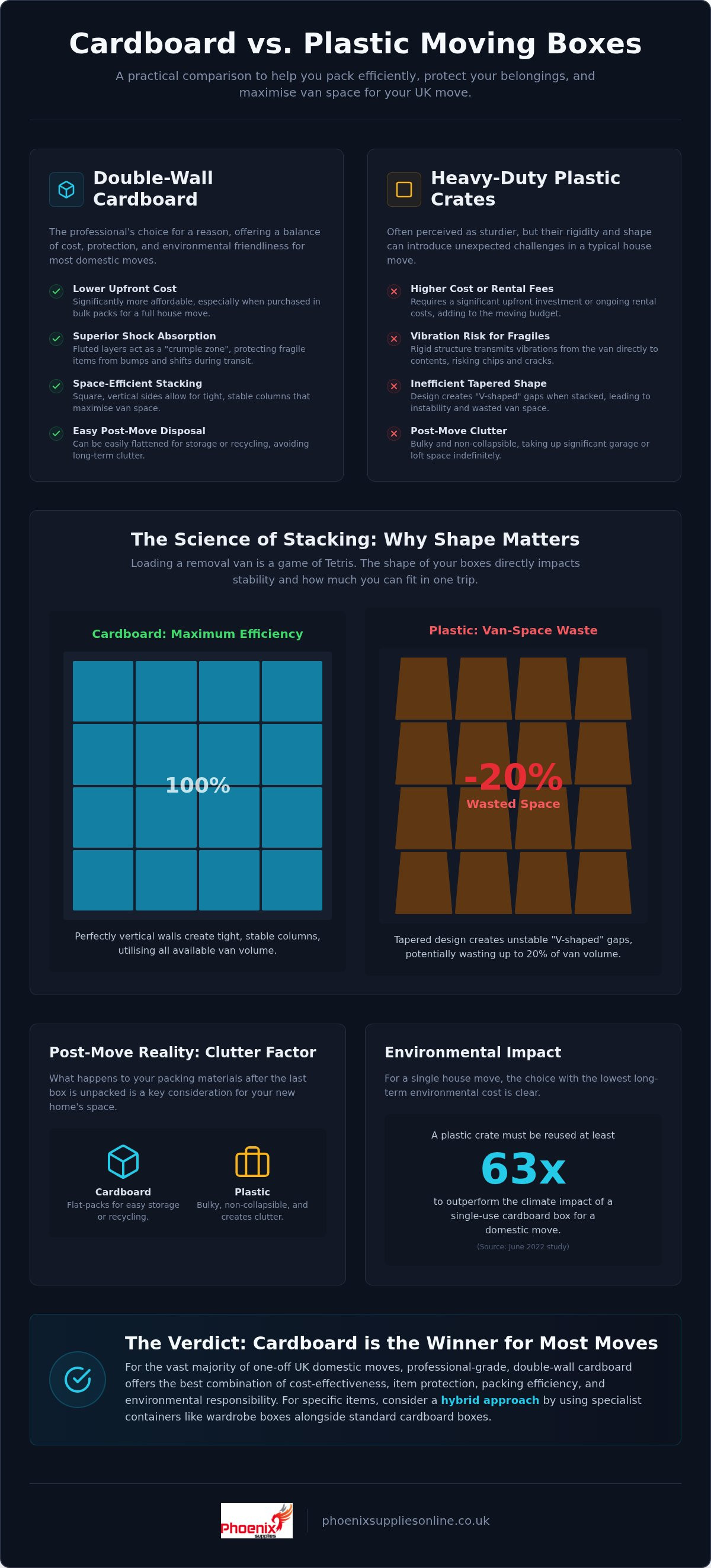
If you're packing heavy items, cardboard is often the safer bet. It's much easier to find the right size for the job, such as using small moving boxes for books to prevent over-packing. These smaller containers ensure that heavy libraries remain manageable to lift. Finally, consider the environmental impact. The UK's household packaging recycling rate was approximately 44.6% in 2023, and cardboard is one of the easiest materials to process. A study from June 2022 indicated that plastic crates would need to be reused at least 63 times to outperform cardboard in terms of climate impact, making cardboard the clear winner for most one-off domestic moves.
The Science of Stacking: Why Shape Matters in the Van
Loading a removal van is a high-stakes game of Tetris. Every gap left unfilled is a missed opportunity to save space, and every unstable stack is a potential disaster waiting to happen at the first roundabout. When you're deciding between cardboard vs plastic moving boxes, the physical shape of the container plays a much larger role in the success of your move than most people realise. While plastic bins look tidy in a bedroom, they often become a logistical headache once they reach the van floor.
The primary issue with most plastic storage crates is their tapered design. These bins are wider at the top than they are at the base, a feature meant to help them nest together when they're empty on a shop shelf. However, when they're full and stacked in a van, this creates "V-shaped" gaps between the boxes. Industry experts often find that this waste can account for up to 20% of the total van volume. In a standard house move, that's the difference between fitting everything in one trip or having to drive back across town for a second load.
Maximising Van Space with Square Edges
Cardboard boxes are true cuboids with perfectly vertical walls. This allows you to create tight, uniform columns that run from the floor right up to the ceiling of the van. By removing the gaps caused by tapered sides, you ensure that the weight of the stack is distributed evenly through the corners of the boxes below. This structural integrity is vital for a safe journey. To get the most out of your space, it's helpful to consult a packing materials list for moving to ensure you have the right mix of sizes for a stable load.
The smooth interior of a plastic bin also presents a challenge for your belongings. Items inside tend to slide and shift against the slick walls during transit, which increases the risk of breakages. Cardboard has a natural texture that provides more internal friction, helping your bubble-wrapped items stay exactly where you placed them. If you want to make the process even easier, our heavy-duty cardboard moving packs are designed to fit together perfectly, saving you time and van space.
Preventing Toppling and Damage
Safety in a moving van is all about friction and grip. Cardboard has a slightly rough surface that "bites" into the van floor and against neighbouring boxes. This natural resistance makes a stack of cardboard far less likely to slide than a stack of smooth plastic bins. When you're comparing cardboard vs plastic moving boxes, consider the risk of the "skating" effect, where a whole row of plastic crates can shift during a sudden brake.
There's also the danger of lid failure. Plastic lids are often the weakest point of the container. Under the pressure of a heavy stack, these lids can crack or bow, causing the entire column to lean or collapse. Cardboard's double-wall construction is designed to bear weight through the vertical panels, which are significantly stronger than a clip-on plastic lid. For extra security, using webbing straps for moving can help tie down your stacks, but you'll find that cardboard's natural stability makes the job much simpler from the start.
Strength and Durability: Double-Wall Cardboard vs Heavy-Duty Plastic
When people compare cardboard vs plastic moving boxes, the word "flimsy" often gets thrown around. This is usually because they are picturing the thin, single-walled boxes found at the back of a local supermarket. Professional-grade moving boxes are a different breed entirely. If you are packing heavy kitchen appliances or stacks of dinner plates, the structural strength of the container is non-negotiable. You need a box that can hold its shape under pressure, and this is where the engineering of corrugated cardboard really shines.
One of the biggest misconceptions is that plastic is always tougher. While a plastic bin is rigid, that rigidity can actually be a disadvantage during a move. Rigid materials transfer the energy of every bump and vibration directly to the items inside. In contrast, the layers within a cardboard box act as a shock absorber. This impact resistance is vital for protecting electronics and glassware. A high-quality cardboard box can comfortably hold up to 20 or 25kg, which is more than enough for most household items, provided you've chosen the right size for the weight.
The Anatomy of a Professional Moving Box
The secret to the reliability of our range lies in the "double-wall" construction. Unlike standard boxes, double-wall moving boxes feature two layers of corrugated fluting sandwiched between three layers of sturdy kraft paper. This creates a thick, resilient barrier that is incredibly difficult to crush. Professional removers favour this design because it allows for high vertical stacking without the bottom boxes bowing or collapsing. It's this "edge crush" strength that ensures your belongings don't end up squashed at the bottom of the pile. While plastic crates are waterproof, double-wall cardboard is surprisingly resilient. It will easily handle a dash through the British rain from the front door to the van without losing its integrity.
Plastic Bins: When is the Extra Strength Necessary?
There are specific scenarios where the extra-heavy-duty nature of plastic might seem appealing, such as long-term storage in a damp loft or a garage. However, plastic has its own weaknesses. In cold temperatures, certain types of plastic can become brittle and may crack if they are knocked or dropped. This is a risk you don't face with cardboard. For most domestic moves, you can achieve better protection by combining double-wall boxes with plenty of bubble wrap for moving house. This combination provides both the external strength to support a stack and the internal cushioning needed to keep fragile items still. By using the right materials together, you get the security of a "hard shell" without the added weight and cost of a fleet of plastic bins.
The Post-Move Clutter Factor and Environmental Impact
You've finally reached your new doorstep. The van is empty and the kettle is on, but now you're faced with a mountain of empty containers. It's at this point that the decision between cardboard vs plastic moving boxes becomes a matter of home organisation rather than just transport safety. Unpacking is a long process. Having the right materials can be the difference between a tidy transition and living in a maze of bulky crates for the next six months.
While plastic bins served a purpose during the journey, they often become a burden the moment they are empty. Cardboard offers a simplicity that plastic cannot match once the heavy lifting is over. You can quickly clear a room by breaking down boxes, whereas plastic crates remain just as large and cumbersome as they were when full. This disposal ease is why most people find cardboard to be the more practical choice for a stress-free start in a new home.
Flat-Packing for Future Use
Cardboard is the king of the post-move phase because of its flat-pack design. Once you've emptied a box, you simply slice the tape and collapse it into a slim panel. A whole house worth of boxes can be tucked away behind a wardrobe or in the rafters of a loft, ready for your next move or to lend to a friend. For items you want to keep accessible but tidy, archive boxes are a great middle-ground. They are designed for long-term document storage but work perfectly for keeping seasonal clothes or Christmas decorations organised in your new space.
From an environmental perspective, cardboard remains the most recycled packaging material in the UK. With a household packaging recycling rate of approximately 44.6% in 2023, it's a material that the British waste system is well-equipped to handle. If your boxes have reached the end of their life, they can be placed in your standard kerbside recycling, ensuring they don't end up in a landfill. This is a far simpler path than trying to find a specialist facility that will accept large, broken plastic containers.
The Hidden Cost of Plastic Storage
Many people don't consider the "cost of space" in their new home. If you've used fifty plastic bins for your move, you've essentially committed a large portion of your garage or spare room to storing empty plastic. It's a significant hidden cost, especially if you've moved to a home where storage is at a premium. Unlike cardboard, these bins cannot be flattened. They sit there, taking up room and gathering dust, until you eventually find a way to get rid of them.
Disposing of plastic is also increasingly difficult and expensive. Under the Producer Responsibility Regulations 2024, there is a growing focus on the full lifecycle of packaging. If a plastic bin cracks during the move, it's not as simple as putting it in your domestic recycling bin. Most councils won't take large plastic items at the kerbside, meaning a trip to the local tip is required. Choosing moving house packing kits UK provides a much more balanced approach. These kits give you the professional-grade materials you need without the long-term clutter. If you're ready to start your move the right way, you can order our high-quality cardboard moving boxes online for a simple, clutter-free experience.
The Verdict: Choosing the Right Boxes for Your UK Move
The debate over cardboard vs plastic moving boxes doesn't have to be a headache. For the vast majority of UK moves, professional-grade double-wall cardboard is the most sensible, reliable, and cost-effective choice. It protects your fragile items through shock absorption, stacks perfectly in the van to save space, and doesn't leave you with a storage crisis once you've unpacked. While plastic has its place in long-term damp storage, cardboard is the undisputed champion of the moving day itself.
A hybrid approach is often the smartest way to manage your transition. If you already own heavy-duty plastic bins for your Christmas decorations or garden tools, by all means, use them. However, investing in a full set of plastic crates for a single move is rarely worth the high upfront cost or the space they'll occupy in your new garage. By sticking with cardboard for the bulk of your belongings, you keep your move lightweight and your new home clutter-free.
Specialist Solutions for Tricky Items
Specialist items require specialist care, and this is where cardboard truly excels. When you are looking into how to pack clothes for moving in boxes, you will find that wardrobe boxes are the ultimate exception to the rule. These tall, sturdy containers include a metal hanging rail, allowing you to move your suits, dresses, and coats directly from the cupboard. This saves you hours of folding and prevents the need for a massive ironing session in your first week at the new house.
For your electronics and paperwork, dedicated containers are essential. A specialist TV moving box provides the exact dimensions and cushioning needed for modern, fragile screens, which is something a generic plastic tub simply cannot offer. Likewise, archive boxes are superior for heavy paperwork. They are designed to hold the specific weight of files and documents without the base bowing, ensuring your important records stay organised and intact during the journey.
Ready to Start Packing?
When you are ready to buy moving boxes online UK, it pays to trust a specialist who knows the industry inside out. As a family-run business, we understand that you aren't just moving "stuff"—you're moving your life. We recommend focusing on heavy-duty double-wall cardboard for anything heavy or fragile. It's the same material used by professional removal teams because it offers the best balance of strength, weight, and value. We even include free delivery on orders to help keep your moving costs as low as possible.
Before the removal van arrives, make sure you have your final checklist ready. You'll need a mix of small and large double-wall boxes, plenty of packing tape, and protective materials like bubble wrap or removal blankets. By choosing the right tools for the job, you can turn a potentially stressful day into an organised, efficient success. If you're looking for professional-grade materials that won't let you down, browse our range of heavy-duty moving boxes today and get your packing off to the best possible start.
Take the Stress Out of Moving Day
Deciding between cardboard vs plastic moving boxes is about more than just cost; it's about protecting your belongings and your new home's floor space. We've seen how professional-grade double-wall cardboard provides the essential shock absorption and vertical strength that rigid plastic often lacks, whilst allowing you to stack the removal van with confidence. This ensures your items won't slide or collapse during the journey.
Once you've reached your destination, the ability to simply flatten and recycle your containers ensures a clutter-free start in your new surroundings. As a family-run UK business, we're committed to providing the high-quality materials you need for a smooth transition. Our focus is on helping you move efficiently without the long-term headache of storing bulky crates or dealing with cracked plastic.
Explore our range of professional-grade moving boxes today and benefit from free delivery on all orders. You're one step closer to a successful move, and we're here to support you every step of the way.
Frequently Asked Questions
Is it cheaper to use cardboard or plastic boxes for moving?
Generally, cardboard is much cheaper for a one-off house move. Buying a bulk pack of double-wall cardboard is a fraction of the cost of purchasing heavy-duty plastic crates. Even rental services for plastic can often exceed the cost of buying cardboard once you factor in delivery fees and deposits. Cardboard also removes the need for long-term storage or disposal fees that are frequently associated with bulky plastic bins once the move is complete.
Why do professional removal companies prefer cardboard boxes?
Professionals favour cardboard because of its uniform shape and superior stackability. Unlike tapered plastic bins, cardboard boxes create a solid, vertical wall in the van that does not shift during transit. The natural friction of the material also prevents columns from sliding. Since they can be flattened, they take up very little room in a removal truck once they are emptied, making the logistics of a multi-load day much simpler for the crew.
Are plastic moving boxes waterproof?
Plastic is naturally waterproof and protects against dampness, but it is not always airtight. Lids can pop open or allow moisture in through the handles if boxes are left in heavy rain. For a standard UK move, double-wall cardboard is perfectly adequate for the short trip from the house to the van. If you are worried about wet weather, using mattress and furniture covers or bubble wrap provides the necessary extra protection for your belongings.
How many cardboard boxes do I need for a 3-bedroom house move?
A typical 3-bedroom house usually requires between 60 and 80 boxes of varying sizes. This count includes a mix of small boxes for books, medium boxes for kitchenware, and large boxes for bedding. We recommend ordering a comprehensive moving pack to ensure you have enough materials, including wardrobe boxes for your clothes. It's always better to have a few spare boxes than to run out of supplies on the morning of your move.
Can I reuse cardboard moving boxes more than once?
Yes, high-quality double-wall boxes are designed for multiple uses. As long as they haven't been exposed to extreme moisture or over-packed beyond their weight limit, you can easily collapse them and store them for your next move. Many families pass their boxes on to neighbours or friends after they've finished unpacking. This durability makes the choice of cardboard vs plastic moving boxes even more cost-effective and sustainable for the average UK household.
What is the difference between single-wall and double-wall cardboard?
Single-wall boxes have one layer of corrugated fluting, making them suitable for very light items like cushions or soft toys. Double-wall boxes feature two layers of fluting, which provides significantly more strength and crush resistance. For a house move, double-wall is the essential choice for anything heavy or fragile. It ensures that the boxes at the bottom of a stack don't buckle under the weight of those above, keeping your most valuable belongings safe.
Do plastic boxes take up more space in a removal van?
Yes, plastic bins often waste a significant amount of van space because of their tapered sides. This design creates gaps between the containers that cannot be filled, leading to an unstable and inefficient load. Cardboard boxes are true cuboids with vertical walls, allowing you to pack them tightly together without any wasted room. This efficiency often means you can fit your entire home into a smaller van or complete the move in fewer trips.
How do I dispose of cardboard boxes after moving house?
Disposing of cardboard is straightforward because it is widely accepted by UK kerbside recycling schemes. Once you've finished unpacking, simply remove any tape, flatten the boxes, and place them in your recycling bin. If you have a large volume, most local recycling centres have dedicated skips for corrugated cardboard. This is a much easier process than trying to find a facility that will accept large, rigid plastic containers that have reached the end of their life.


