

What if your largest moving boxes are actually the biggest threat to your cherished home library? It’s a common mistake to assume that a bigger box is better for clearing a bookshelf, but with over two million household moves happening across the UK this year, many people are discovering the hard way that weight adds up incredibly quickly. You’ve likely experienced that moment of worry when a box bottom starts to bow or your back twinges after trying to shift an overfilled crate.
We understand that your books are more than just items; they’re memories and investments that deserve to arrive at your new home without a single crushed corner or torn spine. By choosing the right small moving boxes for books, you can ensure your library stays protected whilst making the entire process much kinder to your physical health. This 2026 guide will show you exactly why heavy-duty, double-walled cardboard is the essential choice for heavy items and how to create an organised system for the removal van. We’ll cover everything from preventing structural damage to your volumes to the practical benefits of the "small box strategy" for a smooth, injury-free move.
Key Takeaways
- Avoid the common "Weight Trap" by learning how smaller box dimensions prevent structural failure and protect your physical health during the move.
- Understand the technical difference between single and double-wall cardboard to ensure your library has the necessary support for heavy transit.
- Learn the step-by-step loading method for small moving boxes for books that keeps spines intact and corners sharp.
- Master the "Shelf-Metre" rule to accurately estimate your packing supplies and avoid the frustration of running out of boxes.
- Discover how to use professional protective materials like bubble wrap to safeguard your most valuable or sentimental first editions.
Why Small Moving Boxes are the Best Choice for Books
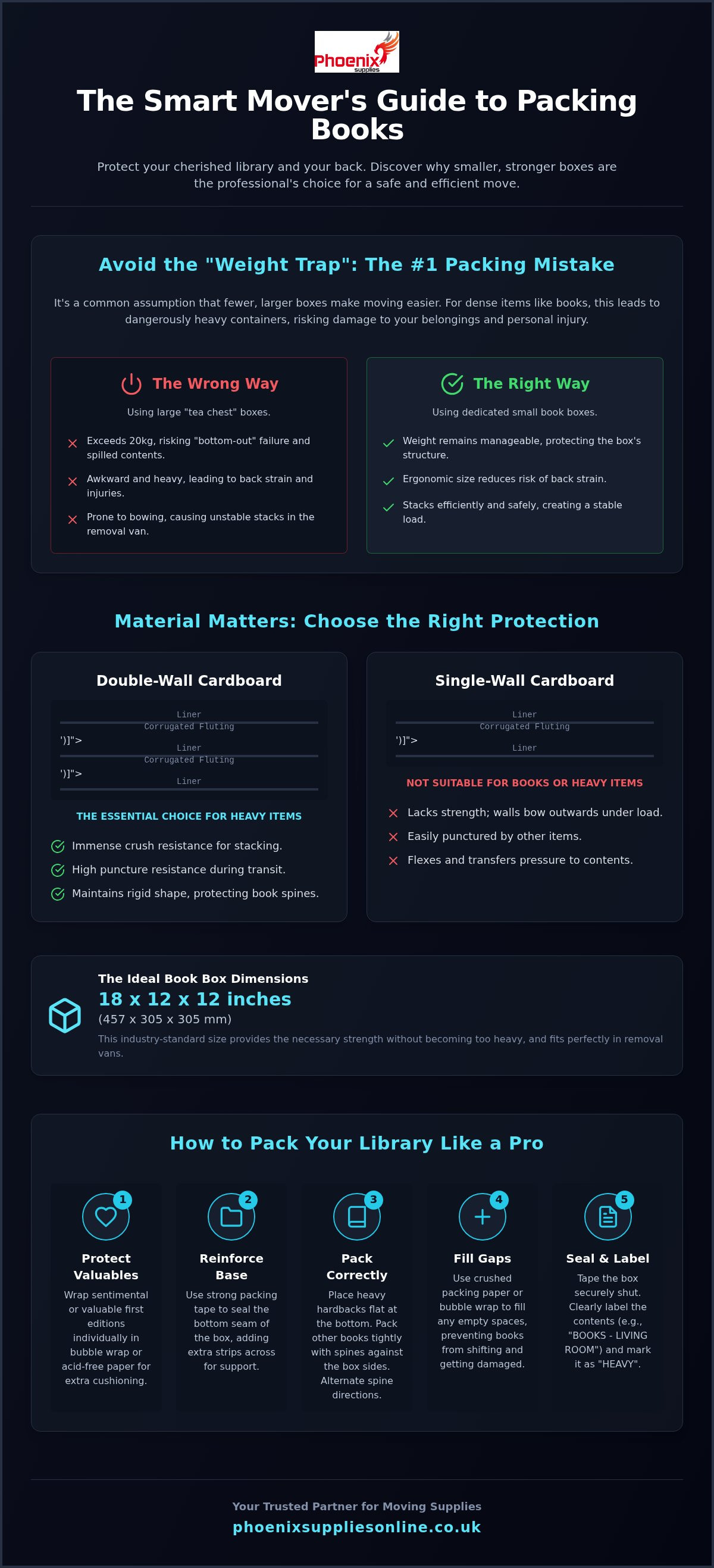
It's a common packing mistake to think that fewer, larger boxes will make your move faster. In reality, filling a large tea chest with hardbacks is a recipe for disaster. Books are incredibly dense; a single large box can quickly reach a weight that's impossible for one person to lift safely. This is where the "Weight Trap" catches most people out. Using small moving boxes for books ensures that the weight remains manageable and the structural integrity of the cardboard isn't compromised.
Physics plays a huge role in a successful move. A smaller base means the weight is distributed over a more compact area, which stops the bottom of the box from bowing or splitting. This physical support is vital for the long-term Conservation and restoration of books, as it prevents the volumes from shifting and crushing one another during transit. Smaller boxes also stack much more efficiently in a removal van, creating a stable "wall" of items that won't topple when the driver turns a corner.
Beyond the safety of your belongings, there's the human element to consider. Ergonomics matter during a long moving day. Smaller boxes allow you to keep the load close to your centre of gravity, which significantly reduces the risk of lower back strain. You'll find it much easier to maintain a steady pace when you aren't struggling with awkward, oversized containers that block your view of your feet whilst you walk.
The Problem with Large Moving Boxes
When a box exceeds 20kg, you risk a "bottom-out" failure. This is when the weight simply becomes too much for the packing tape or the cardboard fibres to hold, leading to your library spilling across the pavement. Large boxes are also notoriously difficult to handle. Manoeuvring an overfilled, heavy crate through narrow British doorways or up a flight of stairs often leads to scuffed walls and strained muscles. They encourage poor weight distribution, leaving you with a box that's heavy on one side and prone to tipping during the journey.
Standard Dimensions for Book Boxes
The industry standard for a dedicated book box is 18x12x12 inches, or 457x305x305mm in metric. This size is intentional. It fits perfectly on the internal shelving found in most modern removal vans, allowing for an organised and secure load. For 2026, the ideal book box is a double-walled container measuring 457mm in length, as it provides the necessary strength to protect your collection without becoming too heavy to carry.
Double Wall vs Single Wall: Choosing the Right Protection
Choosing the right material is just as important as choosing the right size. To understand why double-wall cardboard is the gold standard for removals, you need to look at its anatomy. It consists of two layers of corrugated fluting sandwiched between three sturdy paper liners. This construction creates a series of vertical arches that provide immense crush resistance. When you're using small moving boxes for books, this structure is what allows you to stack several boxes high in a removal van without the bottom one collapsing under the weight.
Single-wall boxes, whilst cheaper, simply aren't designed for the density of a home library. They lack the puncture resistance needed to survive a long-distance house move where other items might shift and press against them. Without that second layer of fluting, the box walls often bow outwards, leading to a domino effect where the entire stack becomes unstable. This is particularly dangerous for valuable collections, which is why following professional Library of Congress packing advice regarding sturdy housing is so critical for long-term preservation.
Double-wall cardboard maintains its shape even when under significant pressure. This rigidity ensures that the weight of the books is supported by the box itself rather than the books inside. If you use a weaker box, the cardboard will flex, transferring the pressure directly onto the book spines and corners, which can lead to permanent warping or tearing of the dust jackets.
When to Use Heavy Duty Moving Boxes
You should opt for heavy-duty options whenever you're packing items with high density or sharp edges. Hardback novels, encyclopaedias, and even heavy kitchen jars require this extra layer of security. If your move involves a long journey or multiple handling stages, the added puncture resistance of a double-wall box is a small price to pay for peace of mind. For a deeper dive into material types, see The Essential Guide to Cardboard Moving Boxes.
Archive Boxes vs Standard Book Boxes
There's often confusion between a standard moving box and an archive box. A moving box is designed to be taped shut for maximum security during a frantic relocation. In contrast, an archive box features a removable lid and hand-holes, making it better for items you need to access occasionally. If you're planning on long-term loft storage after your move, an archive box might be the better investment. You can find more details in our Archive Boxes: The 2026 Buying Guide. For immediate moves, however, the taped-shut security of our double-wall small boxes is usually the safer bet.
How to Pack Your Home Library Safely
Having the right small moving boxes for books is only half the battle; how you arrange your collection inside them determines whether they arrive in pristine condition. Your library represents years of collecting, so taking a methodical approach to packing is a small investment of time that pays off in preserved dust jackets and straight spines. Following expert tips for packing books can help you avoid the common pitfalls that lead to permanent damage during transit.
One of the most debated topics amongst bibliophiles is whether to pack books flat or upright. For standard novels and paperbacks, packing them upright, just as they sit on a shelf, is generally the safest orientation. However, you must ensure they aren't packed too tightly, as this can cause the covers to warp. Because small moving boxes for books are compact, you'll find it much easier to keep the internal contents secure without needing excessive filler. Before you place the first book, remember to reinforce the base of the box with high-quality packing tape using the "H-tape" method, running tape across all seams to create a supportive cross-shape.
The Three Golden Rules of Book Packing
- Rule 1: Always place your heaviest hardbacks at the bottom of the box to create a stable base, saving lighter paperbacks for the top layers.
- Rule 2: Never pack books with the spines facing upwards; the weight of the text block can pull away from the binding over time, causing the book to lose its shape.
- Rule 3: Fill any remaining gaps with crumpled packing paper or clean newsprint to prevent the books from shifting when the box is tilted or carried.
Protecting Special Collections
Delicate items like oversized coffee table books or antique editions require an extra layer of care. For these treasures, we recommend wrapping each volume individually in bubble wrap for moving house to provide a cushion against impact and a barrier against moisture. Large, heavy books should be packed flat to prevent the binding from collapsing under its own weight. Packing books spine-to-spine prevents the pages of one book from interlocking with the pages of another, which can cause tearing during unpacking. This simple technique keeps your most expensive volumes looking exactly as they did on your library shelves.
Calculating How Many Book Boxes You Need
Guesstimating your supplies often leads to a mid-pack panic when the last shelf is still full but your stack of cardboard is empty. To avoid this, we recommend performing a quick "library audit" using the shelf-metre rule. Measure the total length of your bookshelves in centimetres. For every 80cm of shelf space, which is the standard width for most British bookcases, you'll typically need 1.5 small moving boxes for books. This calculation accounts for the density of the volumes whilst leaving just enough room for protective padding.
A single small box usually holds between 20 and 30 standard paperbacks, or roughly 10 to 15 thick hardbacks. It's always a safer bet to over-order your boxes by 10% rather than running out. If you have leftovers, they are incredibly useful for other heavy, compact items like tinned goods or hand tools. To keep the moving van organised, use a thick marker pen to colour-code your boxes by room. This simple step ensures your "History" collection ends up in the study rather than being buried under kitchen supplies.
Estimation Framework for 2026
Your requirements will vary significantly based on your lifestyle. From a small reading nook in a flat to an extensive home office in a 3-bedroom house, the volume of cardboard needed changes. For a typical family home with a moderate collection, we suggest starting with 20 to 30 small boxes. If you're clearing out a dedicated library or a professional office, you may need upwards of 50. For those looking for a complete solution, our house moving packing kits offer a bulk-buy approach that covers all your bases in one go.
Weight Limits for Safe Lifting
Even though our double-walled cardboard is exceptionally strong, your physical limits are the real benchmark. The "sweet spot" for a manageable book box is between 15kg and 20kg. You can test this easily before sealing the top; if you can't comfortably slide the box across the floor with one hand, it's likely too heavy for safe lifting. For extremely heavy loads, we recommend using webbing straps to maintain a secure grip and removal blankets to cushion the boxes against each other in the van. To ensure you have the right tools for the job, you can order your small book boxes today and start your audit with confidence.
Why Choose Phoenix Supplies UK for Your Moving Supplies
Moving home is one of life's most significant transitions, and it shouldn't be a journey you take alone. At Phoenix Supplies UK, we've built our family-run business on the foundation of personal connection and professional reliability. We don't just see ourselves as a supplier; we're your helpful neighbours in the packing process. When you're searching for the right small moving boxes for books, you aren't just buying cardboard. You're investing in the peace of mind that comes from knowing your cherished library is supported by specialists who understand the rigours of a British house move.
We take immense pride in the quality of our materials, specifically selecting heavy-duty double-wall cardboard that stands up to the weight of dense hardbacks and encyclopaedias. Our national delivery service ensures that whether you're moving across town or to the other side of the UK, your supplies arrive exactly when you need them. The convenience of buying your moving boxes online with us means you can focus on the logistics of your relocation whilst we handle the heavy lifting of getting the equipment to your doorstep.
Our Commitment to Quality
Every box in our inventory undergoes a strict selection process to ensure it meets our standards for puncture resistance and vertical strength. This commitment to quality is why we're a trusted partner for both domestic movers and professional commercial removal firms across the country. We understand that a successful move requires more than just book boxes. That's why we offer a comprehensive range of supplies, from protective wardrobe boxes that keep your clothes crease-free to furniture covers and removal blankets that shield your larger investments from scuffs and dust.
Easy Ordering and National Support
Our online shop is designed for straightforward, stress-free navigation. You can easily select individual boxes for a small project or opt for bulk packs if you're clearing out a large family home. If you're unsure about the exact quantities you need after performing your library audit, our dedicated office team is always within reach. We value personal accountability over automated systems, meaning you'll always find a friendly expert ready to provide honest advice on the best packing strategy for your specific needs. View our range of small moving boxes for books and start your move today!
Preparing Your Library for the Journey Ahead
Your books aren't just paper and ink; they're a lifetime of stories and knowledge that deserve the best possible protection. By embracing the "small box strategy," you've already taken the most important step towards a successful relocation. Choosing small moving boxes for books made from double-wall cardboard ensures your collection remains safe from crushed corners whilst protecting your back from unnecessary strain. Remember to use the shelf-metre rule to audit your library and always prioritise spine-safe packing techniques to keep every volume in pristine condition.
As a family-run UK business, we're here to support you with durable double-wall cardboard as standard and free national delivery included with your order. We want your move to be as smooth as the first time you opened your favourite novel. Our team is ready to help you find exactly what you need for a secure, organised house move. You've done the hard work of building your library; let us help you move it safely to its new home.
Browse our heavy-duty small moving boxes and packing supplies and take the first step towards a stress-free moving day. We look forward to helping you get settled into your new space with your library perfectly intact.
Frequently Asked Questions
What is the best size box for moving books?
The industry standard for moving books is a box measuring 18x12x12 inches, or 457x305x305mm. This size is specifically designed to prevent the weight from becoming unmanageable for a single person to lift safely. Using larger containers often leads to boxes that are too heavy to carry or bottoms that split under pressure. These dimensions also fit perfectly on the internal racking of most removal vans, ensuring a stable and secure load during transit.
How many books can I fit into a small moving box?
You can typically fit between 20 and 30 standard paperbacks into one of our small moving boxes for books. If you're packing thick hardbacks or academic textbooks, this number drops to approximately 10 to 15 volumes. It's better to have a few extra boxes than to overfill a single one. Keeping the weight between 15kg and 20kg ensures that you can move your collection safely without risking injury or box failure.
Should I pack books flat or upright in the box?
Standard novels and paperbacks should be packed upright, sitting on their bottom edges just as they would on a library shelf. This orientation protects the spine from unnecessary pressure. For very large or heavy coffee table books, it's safer to pack them flat to prevent the text block from pulling away from the binding. Never pack books with the spines facing upwards, as the weight will eventually cause the covers to warp and the binding to crack.
Can I use second-hand boxes for my book collection?
We don't recommend using second-hand boxes for heavy items like books because cardboard fibres weaken every time a box is handled. A box that looks fine on the surface might have internal structural damage that causes it to collapse when filled with 20kg of hardbacks. Investing in new, high-quality small moving boxes for books is the only way to guarantee the safety of your collection and prevent accidents on moving day.
Do I need double-wall or single-wall boxes for heavy books?
You should always use double-wall boxes for heavy items to ensure maximum crush resistance. Single-wall cardboard is fine for light items like bedding, but it lacks the vertical strength needed for stacking heavy loads. Double-wall construction features two layers of corrugated fluting, which provides the puncture resistance and structural integrity required to keep your books safe whilst they are stacked in a removal van or stored in a garage for long periods.
How do I prevent my book boxes from breaking at the bottom?
To prevent a box from breaking, you must use the H-tape method to reinforce all the seams on the base. Apply high-quality packing tape across the centre join and then along the side edges to create a secure seal. Additionally, avoid the temptation to use large boxes for heavy items. Sticking to smaller dimensions ensures the weight is concentrated over a compact area, which significantly reduces the physical stress placed on the cardboard and tape.
How many book boxes do I need for a standard bookshelf?
For a standard 80cm wide bookshelf, you'll generally need 1.5 small boxes to pack the contents safely. If your library consists mostly of thick hardbacks, you may need to increase this estimate to two boxes per shelf. Performing a quick audit of your shelving metres before you order your supplies helps prevent mid-pack delays. It's always a sensible idea to order 10% more than you think you'll need to account for oversized volumes.
What other materials do I need to pack books safely?
Beyond sturdy boxes, you'll need high-quality packing tape, bubble wrap for delicate editions, and plain packing paper. Use the paper to fill any small gaps inside the box, which stops the books from shifting and rubbing against each other during the journey. For particularly valuable or sentimental books, a layer of bubble wrap provides a vital moisture barrier and extra cushioning against impact, ensuring your library arrives at your new home in perfect condition.


