

Did you know that since April 2026, UK businesses are legally required to keep detailed holiday pay and annual leave records for at least six years? It is a daunting prospect for any office manager already struggling with towers of paperwork that seem to grow of their own accord. We understand how frustrating it is when you finally try to organise the chaos, only to have your office archive boxes tear or collapse the moment they are stacked. It feels like a losing battle against clutter that also carries a real risk of non-compliance with HMRC regulations.
The good news is that document management doesn't have to be a headache. In this guide, we will show you how to transform your workplace storage into a professional, easy-to-navigate system using high-quality materials designed for the job. You will learn the best ways to label your files, how to maximise your floor space, and how to ensure your records stay safe for the long haul. We'll explore everything from choosing the right double-walled boxes to setting up a retrieval process that saves your team hours of searching through dusty stacks.
Key Takeaways
- Identify the structural features that make professional office archive boxes superior to standard moving boxes for long-term document security and easy handling.
- Learn how to categorise your paperwork by retention period and implement a logical indexing system for effortless file retrieval.
- Discover why double-walled cardboard is essential for safe stacking and how to arrange your storage area to prevent boxes from collapsing.
- Find out how to shield your physical archives from environmental damage such as damp, direct sunlight, and extreme temperature shifts.
- Understand the logistical and financial advantages of ordering your storage solutions in bulk pallet quantities from a reliable UK supplier.
What are Office Archive Boxes and Why Does Your Business Need Them?
At its heart, an archive box is a heavy-duty cardboard container specifically engineered for the safe, long-term storage of business paperwork. Unlike standard packing boxes, these are built to withstand the weight of dense paper files without sagging or splitting. They serve as the physical foundation of a robust document management system, allowing you to move from a disorganised pile of folders to a structured library of information. Using professional office archive boxes isn't just about tidying up; it's about meeting your legal obligations. From HMRC tax records to the new holiday pay record requirements introduced in April 2026, having your data accessible and protected is a core part of running a responsible UK business. When your storage is easy to navigate, it reduces administrative stress and lets your team focus on their actual work.
The Anatomy of a Professional Archive Box
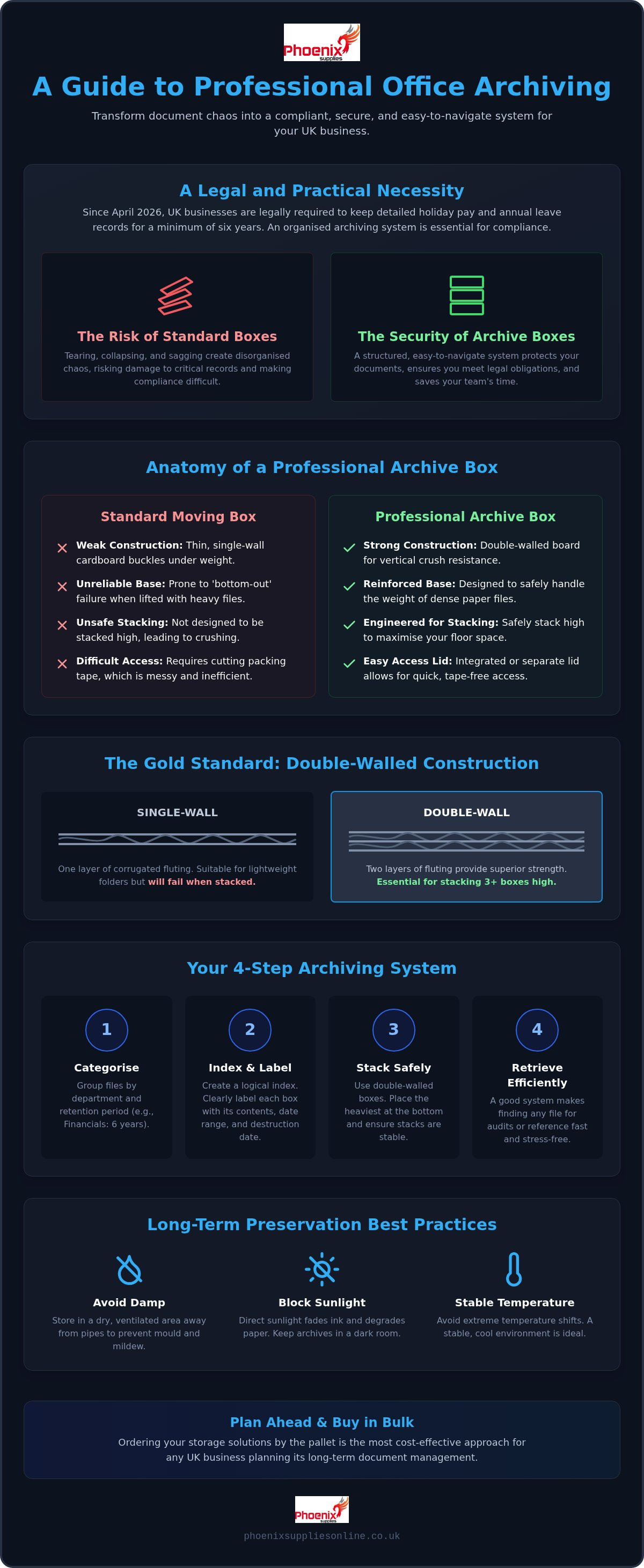
A professional box isn't just a generic cube. It's designed with specific dimensions to fit A4 and foolscap lever arch files perfectly, preventing documents from sliding around or getting crushed. You'll find integrated handle holes on the sides, which make manual handling much safer for your team during a move or a reorganisation. Perhaps the most helpful feature is the lid. Whether it is a separate piece or integrated into the design, it allows you to check a file quickly without having to cut through layers of packing tape. This simple design choice saves time and keeps the storage area looking tidy and professional.
Physical vs Digital: Why Paper Records Still Matter in 2026
While many processes have moved online, physical records remain vital for modern UK companies. Certain contracts, deeds, and legal documents still require original "wet ink" signatures to be considered valid. Paper archives also act as a crucial fail-safe. If your business suffers a cyber security incident or a total digital data loss, your physical files are your ultimate backup. Technology changes fast, and digital formats can become obsolete or unreadable over decades. High-quality office archive boxes ensure that your most important records remain legible and accessible, regardless of how your software updates. For organisations that need additional support, 100storage offers professional document box and large object storage services. It's a low-tech solution that provides high-level security and peace of mind.
Selecting the Right Archive Boxes for Your Document Management
Picking the right container for your records is about more than just finding a cardboard box that fits. It's a choice that impacts the safety of your data and the physical safety of your staff. When you are looking at office archive boxes, the most important factor is board grade. This refers to the thickness and construction of the cardboard. High-quality boxes use a fluting mechanism; a wavy layer of paper sandwiched between flat liners. This fluting provides vertical crush resistance, which is what allows boxes to be stacked from floor to ceiling without the bottom ones buckling under the pressure.
Double-walled cardboard is the gold standard for any business that needs to stack more than three units high. It features two layers of fluting, providing a sturdy frame that protects your files from being crushed. While single-wall boxes are fine for lightweight folders or short-term transport, they often fail when used for long-term storage of dense lever arch files. You also need to consider reinforced bases. A reinforced bottom prevents 'bottom-out' failures, where the weight of the paper causes the base to give way while a team member is carrying it. Sticking to a single box type across your storage centre creates aesthetic consistency, which makes the whole area look professional and easier to navigate.
Single Wall vs Double Wall Cardboard
The difference between these two grades comes down to the number of fluted layers. Single-wall cardboard is lightweight and cost-effective, making it a decent choice for archives that won't be stacked. However, for most professional environments, double-wall is essential. It provides the structural strength needed to support the weight of thousands of pages. If you are planning how long to keep business documents, you'll likely find that a six-year retention period requires a box that won't degrade over time. Choosing a sturdier grade ensures your records remain intact from day one until they are ready for secure shredding.
Lidded vs Fold-Top Designs
Your choice of lid depends on how often you need to get into your files. Removable lids are perfect for documents that require frequent retrieval. They allow you to lift the top off and find what you need in seconds. Fold-top designs, where the lid is part of the box structure, can offer a bit more security for sensitive files and often fit better on tight shelving units. Keeping your boxes consistent across your storage area doesn't just look professional; it makes the space easier to manage. If you need help finding the right fit for your workplace, you can browse our range of archive boxes to see which style suits your shelving best.
A Step-by-Step Guide to Organising Your Office Archive System
Setting up a storage area is a methodical process that pays dividends every time you need to find a specific file. Once you have sourced your office archive boxes, the following steps will help you move from a cluttered cupboard to a professional library. It's about creating a system that stays tidy long after the initial sort-out is finished.
- Step 1: Audit and Categorise. Start by grouping documents based on their retention period. Most financial records need to be kept for six years; as of April 2026, UK employers must also retain holiday pay and annual leave records for that same duration.
- Step 2: Implement a Labelling Protocol. Decide exactly what information needs to be on the outside of every box. Consistency here is vital for a professional-looking storage area.
- Step 3: Pack with Care. Ensure boxes are full so the contents support the lid; this prevents crushing when they are stacked. However, don't make them so heavy that they become a manual handling risk for your colleagues.
- Step 4: Create a Master Log. Record every box and its contents in a central document. This acts as your map when you need to retrieve a file years later.
- Step 5: Schedule Annual Reviews. Set a recurring date to identify boxes that have reached their destruction date. This keeps your storage system lean and prevents you from paying to store records you no longer need.
Effective Labelling and Colour-Coding
Avoid using vague descriptions like "Miscellaneous" or "Admin 2026" on your boxes. Instead, be specific about the contents and the department they belong to. We recommend placing labels on the short side of the box. This ensures they remain visible even when the office archive boxes are stacked deep on shelving units. Colour-coded stickers are a brilliant way to manage destruction dates at a glance. For example, a red sticker could indicate files ready for shredding in 2032, while a green sticker marks those that must be kept until 2035. It's a simple, visual win for busy offices.
Indexing for Fast Retrieval
Indexing is the bridge between a physical box and the specific information tucked away inside. To make this work, assign a unique alphanumeric code to every box, such as HR-26-001 or ACC-26-042. You can then link these codes to a simple spreadsheet or a database that lists the specific files within that container. This hybrid approach bridges the gap between physical storage and digital searchability. When a request for a document comes in, you won't need to dig through stacks; you simply check your digital log, find the box code, and walk straight to the correct shelf.
Best Practices for Safe and Secure Long-Term Storage
Once you have organised your records, the focus shifts to preservation. Cardboard is a fantastic material for office archive boxes, but it is sensitive to its surroundings. You should avoid storing your files in areas prone to damp, such as unheated basements or draughty lofts. Extreme temperature shifts can lead to condensation inside the box, which may damage the paper over time. Similarly, keep your archives away from direct sunlight; UV rays don't just fade your labels, they can eventually make the cardboard fibres brittle and weak.
Security is just as important as structural integrity. For sensitive client data or confidential HR files, ensure your storage area is restricted and potentially locked. We recommend a quick check of your boxes every 12 to 24 months. This allows you to spot any signs of pest activity or moisture damage before it becomes a disaster. If you notice a box beginning to sag, it's time to replace it or redistribute the weight to ensure the stack remains stable and safe for anyone working in the area.
The Golden Rules of Stacking
Stacking is where most workplace accidents happen. To keep your team safe and your files intact, never place boxes directly on a concrete floor. Concrete can hold moisture that seeps into the base of the box, leading to a failure of the reinforced base we discussed earlier. Use pallets or metal shelving to provide a buffer from the ground. While vertical columns are excellent for strength, as the corners of the box carry the weight, ensure they are braced or kept to a safe height. We suggest a maximum of four to five boxes high for standard cardboard units to prevent toppling.
Fire and Water Protection whilst Archiving
Location is everything. Positioning your archive area near water pipes or heating elements is a recipe for trouble. A burst pipe can ruin years of records in minutes, whilst a radiator can create a fire hazard and dry out the cardboard. Always maintain clear aisles between your stacks. This isn't just for ease of access; it's a vital fire safety requirement for emergency exits. For smaller, heavier items like bound ledgers or reference books that don't fit the standard archive shape, using small moving boxes can provide a sturdy alternative that complements your main system.
If you are ready to secure your workplace records, you can order your heavy-duty archive boxes today and start building a safer, more professional storage system.
Sourcing High-Quality Archive Boxes in Bulk for Your UK Office
Taking the leap from a handful of folders to a comprehensive document management system requires a steady supply of reliable hardware. When you are planning a large-scale office clearance or a departmental reorganisation, sourcing your office archive boxes in bulk becomes a logistical priority. Ordering in pallet quantities ensures that your team has every tool they need on hand, preventing delays and keeping the momentum of your project alive. It is a one-off investment in quality that provides a physical fail-safe for your most important business records.
The Benefits of Bulk Purchasing
Ordering by the pallet is the most cost-effective route for UK businesses. It significantly reduces the cost-per-unit, which is essential when you are dealing with hundreds of lever arch files. Beyond the financial savings, bulk purchasing allows you to standardise your storage centre. When every box is the same size and grade, they stack together more securely and look far more professional to auditors or visiting clients. It also helps your sustainability goals. Receiving one large delivery on a single pallet is much better for the environment than multiple smaller shipments arriving throughout the month.
Why Choose Phoenix Supplies UK for Your Office Archives?
We take pride in being a family-run business that understands the human side of commercial logistics. We don't just ship boxes; we act as a dependable partner for offices across the country. Our office archive boxes are designed for professional use, featuring the double-walled durability and reinforced handles needed for long-term storage. Whether you are a small local firm or a national organisation with multiple sites, our national UK delivery service ensures you have the supplies you need exactly when you need them.
You'll find that we value personal accountability over automated systems. If you have a specific requirement for a large-scale move, our team is always within reach to offer straightforward, honest advice. For more information on professional storage, see our 2026 archive boxes buying guide. We are here to help you turn your workplace clutter into a tidy, compliant, and efficient system that serves your business for years to come.
Take Control of Your Office Records Today
Setting up a professional document management system doesn't have to be overwhelming. By choosing the right board grade for your office archive boxes and following a structured indexing plan, you can turn years of paperwork into a tidy, accessible resource. This approach ensures your business stays compliant with the latest 2026 record-keeping requirements whilst freeing up valuable floor space for your daily operations. A successful archive area is built on the foundation of durable materials and a methodical retrieval process.
At Phoenix Supplies UK, we offer the personal service and expert advice of a family-run business. Our durable double-wall cardboard construction provides the strength needed for safe, long-term stacking. From small local offices to large national corporations, we're committed to being your dependable storage partner. Browse our range of heavy-duty archive boxes for your office today and benefit from free national UK delivery on every purchase.
You're now equipped with the knowledge to clear the clutter and protect your company’s history. It’s a simple step that brings immediate peace of mind to any workplace.
Frequently Asked Questions
How many lever arch files can fit into a standard archive box?
A standard archive box is designed to hold five 75mm lever arch files comfortably. If you use the slimmer 35mm ring binders, you can typically fit between ten and twelve files. It's important not to force extra folders in, as this can distort the box shape and make it difficult to fit the lid securely. Keeping the contents snug but not cramped ensures the box remains easy to carry and stack.
Are archive boxes strong enough to be stacked in a storage unit?
Yes, our double-walled archive boxes are specifically engineered for vertical stacking. The structural strength comes from the fluted layers of cardboard that resist crushing under weight. To ensure safety, always place the heaviest boxes at the base of the stack. We recommend stacking them no more than four or five units high to maintain stability and prevent the bottom boxes from sagging over several years of storage.
What is the best way to label archive boxes for long-term storage?
Use a permanent black marker to write clearly on the short side of the box so the information is visible when stacked on shelving. You should include a unique box code, the department name, and the destruction date. Avoid vague descriptions like "Admin" and instead list specific contents. Colour-coded stickers are also helpful for identifying at a glance which boxes are ready for shredding in a particular year.
How long should I keep business records before shredding them?
Most UK business records, including accounting and tax files, must be kept for at least six years from the end of the relevant financial year. From 6 April 2026, new regulations also require employers to retain holiday pay and annual leave records for a minimum of six years. Always check with your legal advisor or the latest HMRC guidance to ensure your document retention policy meets current UK standards and specific industry requirements.
Can archive boxes be reused after they have been emptied?
You can certainly reuse office archive boxes if they remain structurally sound and free from damp. Once you've shredded the old contents, simply apply a new label over the previous one to start a new filing cycle. If the box shows signs of softening or the handles have begun to tear, it's safer to recycle it and replace it with a fresh unit to protect your next batch of documents.
Are your office archive boxes recyclable and eco-friendly?
Yes, all our office archive boxes are made from cardboard, which is a fully recyclable material. Many businesses choose these over plastic tubs because they can be easily flattened and placed in standard recycling bins once they reach the end of their life. Buying in bulk also helps reduce the carbon footprint of your deliveries, making it a more sustainable choice for large office clearances and long-term storage projects.
Do I need tape to secure the lid of an archive box?
You don't need tape to secure the lids of professional archive boxes. They're designed with either a separate lift-off lid or an integrated fold-top that stays in place through its own weight and structure. This design is intentional, as it allows you to retrieve documents quickly without having to cut through tape. This prevents damage to the cardboard and ensures your storage area remains looking tidy and professional for years.
What is the difference between an archive box and a standard moving box?
The main differences are the specific dimensions and the lid design. Archive boxes are sized to fit A4 or foolscap files perfectly. Moving boxes come in various sizes that might leave wasted space. Archive units also feature integrated handles and removable lids for frequent access. Standard moving boxes usually require tape to close and aren't always built with the double-walled strength required for years of stacking in a commercial environment.


