

What if the first thing you need in your new home is already sealed in a box at the bottom of the van? On moving day, everyday essentials can be hard to find just when you need them. A practical moving day survival kit checklist keeps them together and within reach.
You’ll want more than a few snacks and a phone charger. The right kit can help you manage the last hours in your old home, keep useful items close during the journey and settle in on your first evening. What you pack depends on who’s moving, how long you’ll be travelling and what your household needs each day.
This guide helps you build a kit that works for you, from important documents and basic toiletries to children’s comfort items, pet supplies and the essentials for a simple first meal. You’ll also find practical ways to keep these items separate from belongings packed for later, so you arrive with what you need ready to hand.
Key Takeaways
- Use the moving day survival kit checklist to identify what should stay accessible instead of going into sealed boxes.
- Group essentials by purpose so you can find what you need quickly during the move.
- Adapt the kit to your household, adding items only when they meet a practical or personal need.
- Choose a recognisable container, label it clearly and keep it separate from your packed boxes.
- Pack non-essentials in suitable moving boxes and protective packaging, leaving your kit close at hand. Phoenix Supplies UK is a family run business supplying these materials.
What belongs in a moving day survival kit checklist?
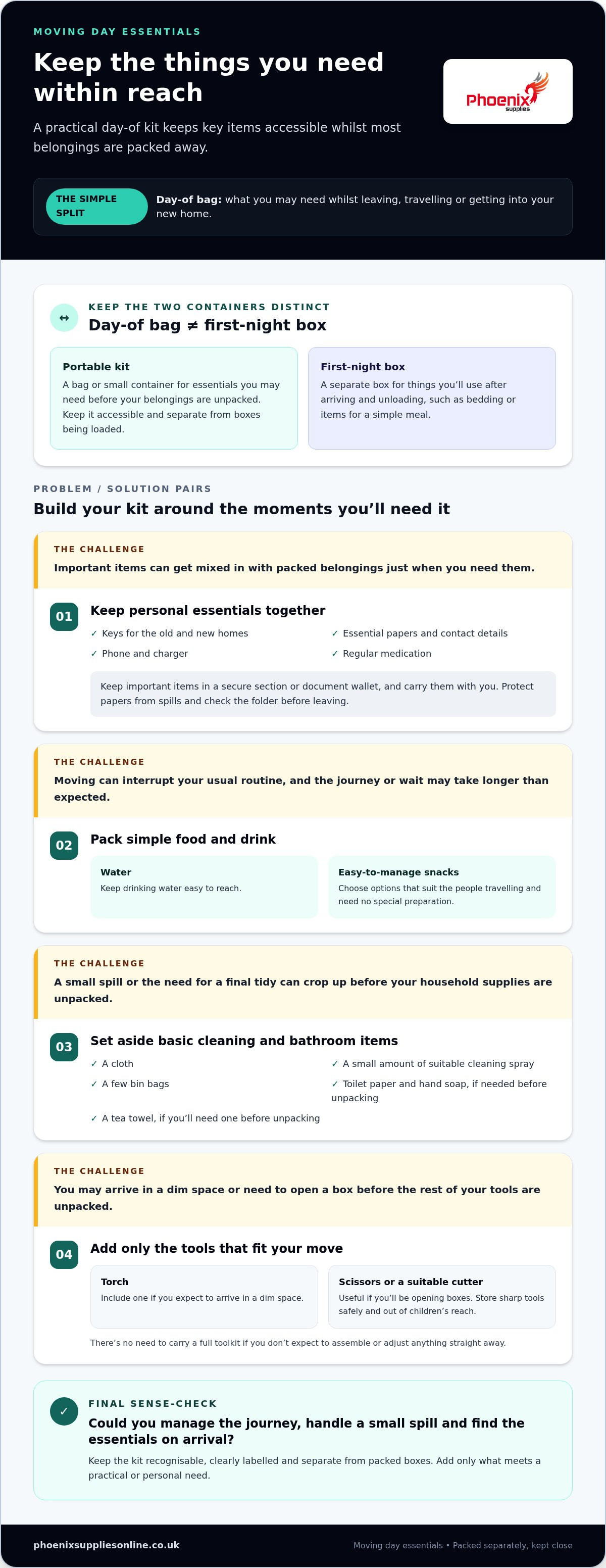
A moving day survival kit is a small, accessible group of essentials kept out of your packed boxes. It travels with you, so you can reach what you need without searching through labelled cartons. A first-night box is separate and holds things you’ll use after you arrive and unloading is done.
That distinction gives your moving day survival kit checklist a useful priority system. Ask whether you’ll need an item while leaving, travelling or getting into the new home. If so, keep it in the portable kit. If it can wait until you’ve arrived, put it in the first-night box. This simple split stops both containers becoming catch-alls.
The idea is similar to a general survival kit: keep useful items together for a particular situation. For a house move, the situation is practical rather than extreme. You’re making everyday necessities easy to find while most belongings are packed away. The best kit isn’t the biggest one. It’s the one that fits your routine and journey.
A day-of bag is different from a first-night box
Choose a bag or small container for items you may need before your belongings are unpacked. Keep it accessible and separate from boxes being loaded. Use a different box for things needed once you’re settled, such as bedding or items for a simple meal. What goes in each depends on your household and how long you’ll be travelling.
Start with needs, not a long shopping list
Think through the move from each person’s point of view: what would be awkward to search for or replace before the boxes are unpacked? Prioritise those items, then leave out anything without a clear purpose. One household may need a particular daily essential close by; another may not. You don’t need every item suggested in a generic list.
A quick test can help: picture a delay, a journey break or arriving before you can unpack. Would you need the item then, or can it stay packed? Keep the first group close and reserve the second for your first-night box. This keeps your kit manageable and makes it easy to check that the essentials are ready.
Moving day survival kit checklist: essentials to keep within reach
Build your list around the things you may need before the boxes are unpacked. Group items by purpose, so you can find documents, personal essentials or a quick snack without rummaging through your bags. This isn’t a fixed list for every household. Add what fits your day and leave out what doesn’t.
Keep your keys, important papers, phone, charger, regular medication, water, snacks and a few basic cleaning supplies accessible throughout moving day.
Personal essentials and useful paperwork
Put important items in a secure section of your bag or in a separate document wallet. Keep it with you rather than in a box that may be loaded with other belongings. This is especially useful for anything you’ll need during the journey or as you arrive.
- Keys: Keep the keys you’ll need for the old and new homes together. Separate or label them if that helps avoid confusion.
- Documents and contacts: Carry essential paperwork and important contact details, either on paper or stored on your phone.
- Phone and charger: Keep your phone charged and pack its charger where you can reach it easily.
- Regular medication: Keep medicines you take as part of your routine close by, not buried in packed boxes.
Protect paper documents from spills by putting them in a folder or wallet, away from drinks and cleaning supplies. Keep the folder with the person responsible for the keys and other important items, then check it before leaving. This helps prevent paperwork from being mixed in with household packing or left behind during the final clear-out.
Food, cleaning and everyday practicalities
Moving can interrupt your usual routine, so pack simple provisions that are easy to carry and eat. Drinking water and snacks can be useful during a busy day, particularly if your journey or wait between homes takes longer than expected. Choose options that suit the people travelling and don’t need special preparation.
- Food and drink: Pack water and easy-to-manage snacks for the journey and short breaks.
- Quick clean-up: Include a cloth, a small amount of suitable cleaning spray and a few bin bags for minor spills or a final tidy.
- Bathroom and kitchen basics: Keep toilet paper, hand soap and a tea towel to hand if you’ll need them before unpacking.
Include practical tools only if they match your move. A torch can help if you arrive in a dim space, while scissors or a suitable cutter may be useful when you’re ready to open boxes. Store sharp tools safely and out of reach of children. There’s no need to carry a full toolkit if you don’t expect to assemble or adjust anything straight away.
Use the list as a final sense-check: could you manage the journey, deal with a small spill and find the essentials on arrival? Phoenix Supplies UK supplies moving boxes and packaging materials, helping you keep less urgent belongings packed while your day-of kit stays close. Find suitable moving boxes and packaging materials for the rest of your move.
How to tailor the kit for children, pets and household needs
The core checklist is a starting point, not a fixed formula. Your household’s routines, health needs and journey will shape what belongs in the kit. Add an item if someone will need it before their packed belongings are unpacked. Leave it out if it doesn’t meet a clear practical need. This keeps the kit manageable and avoids packing extras just because they appear on a generic list.
It can help to separate individual essentials and shared household supplies. A phone charger or familiar comfort item may belong with one person, while water or a cloth could be shared. Decide who is carrying each shared item so you don’t pack duplicates or assume someone else has it.
Planning for children and pets
Set aside familiar comfort items and everyday supplies that may help children or pets through the move. Keep each person’s or pet’s items together in a clearly identifiable bag or section, so they’re easy to find without searching the main kit. Needs vary, so use your usual routine as a guide rather than assuming every child or animal needs the same things.
- For a child: Consider a familiar toy, book, snack or other item they usually rely on during a busy day.
- For a pet: Set aside familiar supplies needed for the journey and immediate care on arrival.
- For everyone: Keep personal items distinct from shared supplies, and make sure the person who needs each item can reach it.
A personalised list can make planning clearer. Start with the routines that matter to your household, then note what each person or pet may need between leaving home and unpacking. This keeps the kit focused on your actual move, rather than every suggestion on a general checklist. Review the list together so everyone knows which items are personal and which supplies are shared.
Account for health, access and travel needs
Think about what must stay reachable during the journey and just after arrival. Keep essential medication and personal items out of packed boxes, and consider whether anyone needs particular items close by to follow their established routine. Make the kit easy for the right person to access, especially if you’ll be carrying it alongside other belongings.
- Health: Include essential medication and any personal care item you’ll need before unpacking.
- Access: Place frequently needed items near the top or in a separate, labelled pouch.
- Travel: Consider the length and pattern of your journey when deciding what to keep within reach.
Before you finish the moving day survival kit checklist, ask each household member what they’ll need between leaving the old home and settling in. Check shared items once, then confirm personal essentials individually. A short conversation can prevent duplicate packing and help everyone know where their things are. Keep the list flexible: if a need changes, adjust the kit instead of carrying items that no longer serve a purpose.
How to pack, label and check your survival kit before moving day
A little preparation makes it easier to keep the kit separate from everything being packed. Use the moving day survival kit checklist to decide what belongs in it, then follow a short routine to keep the essentials easy to spot and reach.
- Choose a recognisable container. Pick a bag or small container that’s easy to distinguish from your moving boxes. Choose one that suits what you need to carry, and keep important papers in a separate folder or wallet inside it.
- Gather the essentials before the final packing session. Set aside the items you’ve chosen for the day, such as keys, personal documents, medication, phone and charger. Check each item against your household’s usual needs rather than adding things simply to fill the bag.
- Label it clearly. Use a visible label such as “Moving day essentials, keep with us”. If other people are helping with the move, tell them which container must stay accessible and must not be loaded with the packed boxes.
- Keep it with a named person. Agree who is responsible for the kit, keys and essential documents. This avoids uncertainty about who has them and helps keep the bag easy to find during the day.
- Keep the first-night box separate. Label it for use after arrival, and keep its contents distinct from items you may need during the journey. Both containers should be easy to recognise, but they serve different parts of the move.
Assemble and label the kit in advance
Gather your chosen essentials before the last packing session, while there’s still time to notice anything missing. Keep the kit in a consistent, accessible place and let everyone involved know it isn’t part of the boxes to load. The person looking after documents and keys can also take responsibility for keeping the kit close.
Do a last check before leaving each property
Before the remaining belongings are packed, make sure the kit is still accessible. Check that the keys, phone, charger and each person’s essential items are accounted for. At the new home, keep the first-night box distinct so you can find it after arrival without opening other boxes.
A good final check confirms that your essentials are accessible, not that you’ve added more to the kit. Pause before leaving and ask the person responsible to confirm they have it. That simple handover helps prevent a clearly labelled bag from being mistaken for another box.
Keep the rest of your belongings packed separately, using suitable boxes and protective materials for the move. Browse moving boxes and protective packaging to organise the items that don’t need to stay in your day-of kit.
Finish your moving day checklist with the right packing materials
Your essentials kit works best when the rest of the move is organised around it. Pack belongings you won’t need on moving day separately, label their boxes clearly and keep the kit out of the area used for packed items. Packaging helps protect and group belongings, but it doesn’t replace keeping important documents, medicines and other immediate essentials apart.
Keep packed belongings organised around the essentials
Choose moving boxes to suit the belongings going into them, and mark each box with its contents or destination room. This makes items you can leave packed easier to identify when you’re ready to unpack. Keep the day-of kit in a separate, recognisable place rather than relying on a label on a box to distinguish it from everything else.
Protect fragile belongings with Bubble Wrap where appropriate. Furniture Removal Blankets and furniture covers can help protect furniture during a move. Consider the item and the protection it needs, then keep these materials with the belongings they’re intended for. The kit should remain separate and accessible as other items are packed and protected.
- Everyday belongings: Use suitable moving boxes for items that can stay packed until you’re ready to unpack.
- Fragile items: Use Bubble Wrap where it suits the item, and keep protected items clearly identified.
- Furniture: Consider Furniture Removal Blankets or furniture covers as part of your packing plan.
A clear division makes the moving day survival kit checklist more useful in practice: packing materials help organise and protect what’s going into the move, while the kit keeps immediate essentials close. Don’t put the kit inside a larger box or use it to store spare tape and packing supplies. Keep it distinct from items being packed away.
Choose straightforward support when ordering supplies
Phoenix Supplies UK supplies moving boxes and packaging materials, including Bubble Wrap, Furniture Removal Blankets and furniture covers. Its online range is easy to navigate, and you can speak directly with a real person, without voice menus or answering machines. Free delivery is available on every order with no minimum spend, subject to geographical restrictions.
Before ordering, group your packing needs by what you’re protecting and what can stay packed. This gives you a practical way to select boxes and protective materials without mixing them up with the items you need on the day. Keep the kit’s contents list separate from your packing-supplies list, so each has a clear purpose.
For the supplies that help keep non-essential belongings packed and protected, browse moving boxes and protective materials from Phoenix Supplies UK.
Make your next move easier to manage
Let your moving day survival kit checklist be a working note, not another task to perfect. As your moving plans take shape, review it against your household’s actual needs and the journey ahead. If a routine changes, adjust the list. Keep it practical and focus on what will make the day easier for you.
One helpful next step is to decide where the kit will go when you arrive. Choose a familiar spot where it can be set down promptly, rather than left among boxes to sort later. That gives everyone a clear starting point in the new home and helps you shift from travelling to settling in.
For the boxes and protective materials that support the rest of your move, explore Phoenix Supplies UK’s moving boxes and packaging materials. Make your packing plan easier: browse the range and choose the supplies that suit your move.
Frequently Asked Questions
Should I pack a kettle in my moving day survival kit?
Usually, a kettle is better in your first-night box than in your portable moving day survival kit checklist. It’s bulky and you may not need it during the journey. Pack it with mugs and tea or coffee if you expect to make a hot drink soon after arriving. Keep it accessible once you reach the new home, and pack it safely with its cable stored neatly.
Can I use a suitcase or bag for a moving day survival kit?
Yes, a suitcase or bag works well if it’s easy to recognise and carry. Pick one that fits your essentials without becoming awkward to manage, and avoid using a container that looks like an ordinary box. A separate pocket can hold smaller items such as keys or a charger. If several people are travelling, agree who’ll carry the bag and where it will stay during the journey.
What should I keep in a moving day kit for a baby?
Pack the items you normally rely on to care for your baby between leaving home and unpacking. Depending on your routine, that may include nappies, wipes, a change of clothes, a feeding item and a familiar comforter. Keep them together in a clearly recognisable bag, with the things you’re most likely to need easiest to reach. Let your usual care routine guide the contents.
What should I put in a moving day kit for a pet?
Set aside familiar essentials your pet may need during travel and shortly after arriving, such as food, a lead or carrier, and any usual care items. Include waste bags for dogs or familiar litter supplies for cats if those suit your arrangements. Keep the pet’s items together and easy to identify, but separate from household supplies. Follow the routine that works for your animal and journey.
How do I keep important documents safe on moving day?
Place important papers in a closed folder or document wallet, then carry it with you rather than packing it with household belongings. Keep it away from drinks, cleaning products and items that could crease or damage the papers. Before setting off, check that the documents you’ll need are inside and that the folder is with the person responsible for it. Avoid leaving it unattended among boxes.
When should I prepare my moving day survival kit?
Prepare it before the final packing rush, while you still have time to gather the items you use every day. You can choose the container and make a draft list earlier, then add last-minute essentials such as your phone charger on moving day. Keep the kit in a known place and tell anyone helping that it must stay accessible. Do a quick contents check before leaving.
What should I put in a first-night box after moving house?
Pack items that will help you manage the first few hours at the new home, rather than things needed during the journey. Depending on your household, this might include bedding, pyjamas, basic toiletries, a towel and simple kitchen items. Add only what you expect to use before unpacking properly. Mark the box clearly and keep it distinct from the bag carrying your moving-day essentials.


