

A clear inventory makes moving day easier to manage. A moving box inventory list template should give every box a unique number and record its destination room and contents. Add notes for fragile or valuable belongings, then use the list to check boxes as they’re loaded and unloaded.
You don’t need to describe every small item separately. A room, box number and useful summary of the contents are usually enough to find what you need. Record valuable items and existing damage in more detail. A well-kept list can also help you spot missing or damaged belongings before you finish checking the move.
This guide explains how to choose a paper or digital format, build your inventory, record valuable items and keep box labels in step with the list. You’ll also learn how to check it during loading and unloading, so you have a clearer idea of what’s where as you settle in.
Key Takeaways
- Give each box a unique number and record its destination room and main contents so you can find items more easily.
- Choose a paper or digital format that’s easy for you to update and use during the move.
- Add clear notes for valuable, fragile or already damaged belongings to create a useful record of their condition.
- Match box labels to your list and use it to check what’s loaded, delivered and ready to unpack.
Checking the inventory during loading and unloading
A moving box inventory checklist should follow every box from packing to unpacking. Record each box number, room and contents, then check it at both ends. To prevent lost items during a UK move, match labels to your list and note discrepancies before signing paperwork.
- Prepare the checklist before loading. Keep one master list with a unique number for every box, its destination room and a brief contents description. The UK Government highlights checklists as a way to avoid missing tasks during a move.
- Match each label to its entry. Write the same box number and room on the box and inventory. For example, label a box “12, kitchen” and record “12, kitchen, mugs and plates”. The NHS also advises clear box labels that correspond with destination rooms.
- Tick boxes as they’re loaded. Compare each box with its inventory entry as it leaves the property. Mark it loaded only after checking its number and label. If a box is expected but absent, flag its entry instead of assuming it is already on the vehicle.
- Repeat the check during unloading. Use the list to direct boxes to their recorded rooms, then mark each one as delivered. This gives you a room-by-room packing checklist and helps you unpack essentials without searching through unrelated boxes.
- Check contents as you unpack. Compare the box’s actual contents with its description. If “12, kitchen, mugs and plates” contains no mugs, update the entry and note what is missing. A broad label such as “kitchen items” makes this check less useful.
- Record discrepancies straight away. Note missing items, damage or a mismatch in both your inventory and the mover’s paperwork before signing. A paper checklist can be awkward to update or search once boxes are scattered, so keep it together; a digital copy in Google Sheets is easier to edit as you go.
Should I Use a Digital or Paper List?
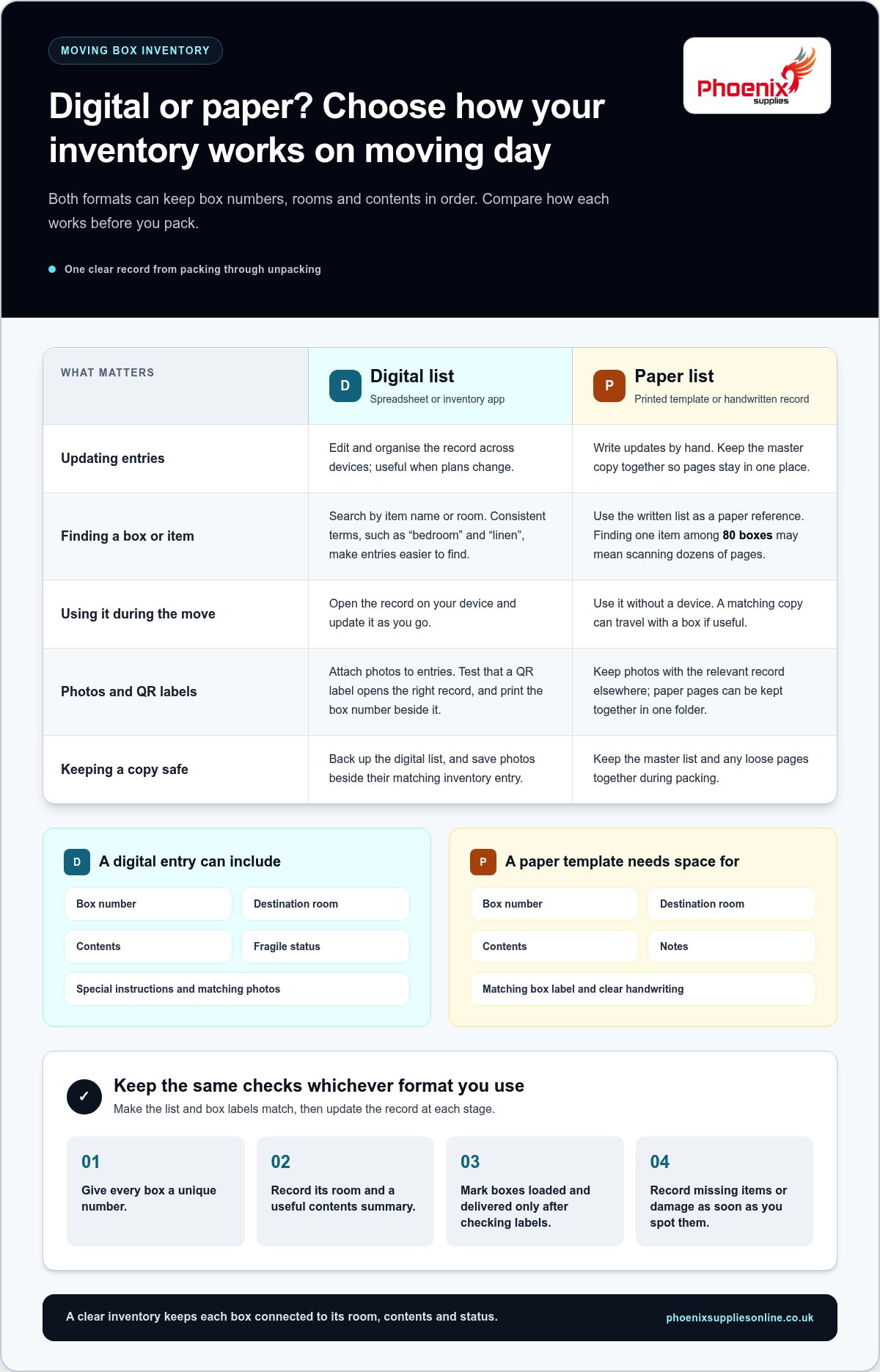
A free printable moving box inventory list template for a UK move can be made in a spreadsheet, then printed for packing day. Choose digital, paper or both according to how you’ll access and update the record.
-
Create a Digital List with Apps or Spreadsheets
Open a spreadsheet or inventory app and create a row for each box. Add columns for its number, destination room, contents, fragile status and special instructions. Google Sheets lets you edit and organise the record across devices, which helps when plans change. Use search to find belongings by name or room. Keep descriptions clear, and test any app features you plan to rely on.
-
Use a Printable Inventory Template
Print a template if you prefer handwriting or want a paper reference beside each box. Include space for the box number, room, contents and notes, then attach a matching copy to the box if useful. A paper list is easy to use without a device, but updates need to be written by hand. Keep the master copy together so pages don’t become separated during packing.
- Choose based on access. A digital inventory is editable and can be opened on multiple devices, while a paper list can travel with its corresponding box. For a large move, finding one item among 80 boxes may mean scanning dozens of paper pages. Searchable entries can make that task quicker, provided descriptions use consistent terms such as “bedroom” and “linen”.
- Add photos and QR labels carefully. Attach photos to digital entries to create a visual reference for valuable belongings or a box’s packed contents. If you use a QR label, test that it opens the intended record before packing. Keep the box number printed beside the code so you can still identify it without scanning.
- Keep evidence easy to find. Store photos with the matching inventory entry, rather than in an unlabelled camera album. If you later need records for a claim, the box number, description and image can help you locate relevant details. Back up a digital list, or keep paper pages together in one folder.
Describing valuable items and their condition
There’s no single box count for every house move. Estimate what you’ll need by listing belongings, grouping small items and considering room use and box sizes. Adjust your estimate as you pack.
- Assign identifiers to valuable items. Give each high-value belonging its own inventory line and a unique reference, such as “ART-01” for a painting. Record the item’s name, assigned number and destination room. This makes it easier to distinguish similar belongings, such as two lamps, when you unpack.
- Describe condition before packing. Note existing marks, chips or faults in plain language, such as “wooden cabinet, chipped left corner”. Record the condition before the item is handled, so later notes can be compared with a clear starting point. Keep descriptions specific rather than writing only “used” or “worn”.
- Document valuable belongings. Take clear photos of each valuable item and save them beside its inventory entry. Photograph furniture from every side before it is moved, then take close-ups of existing damage. Give each photo the same reference as its written record, so the images remain easy to match.
- Mark fragile items and instructions. Add a fragile note to the inventory and mark the corresponding box clearly. Include practical handling details, such as “glass shade, keep upright”, in a special-instructions column. This helps anyone handling the box understand what needs care without opening it.
- Group small items by category. Record related contents together when individual entries would make the list hard to use. For example, describe a kitchen box as “saucepans, lids and utensils”. Keep valuable or fragile pieces as separate entries, even when they share a box, so nothing important disappears within a broad category.
- Use one method throughout your sheets. Apply the same category names and reference style to every room. Separate entries for furniture, electronics, kitchenware and documents, then check that each valuable item has a number, condition note and matching photo. Consistent records make later comparisons easier.
Benefits of a moving box inventory
A useful inventory can guide decisions before and after packing, not just describe belongings. Treat it as a planning tool for sequencing tasks, sharing responsibilities and keeping household routines in mind.
- Plan what to pack first. Add a priority note such as “early”, “later” or “last” to each group of belongings. Start with books, seasonal decorations and equipment you rarely use. Leave everyday cooking items and work equipment until closer to moving day, so packing doesn’t disrupt your routine too soon.
- Share tasks across the household. Add an “assigned to” field for the person packing each group. For example, one household member can handle paperwork while another packs spare bedding. This makes responsibilities visible and helps everyone follow the same plan without duplicating work.
- Keep daily routines in view. Mark items needed for regular activities, such as school mornings, remote working or caring for a pet. Use those notes to decide what stays accessible until the last practical moment. Planning around real routines can make the final days feel less disruptive.
- Separate belongings with different destinations. Use a destination category for items going to your new home, storage or donation. That way, belongings with different next steps aren’t treated as one packing job. Review the categories before sealing boxes, while each item is still easy to redirect.
- Prepare for a temporary stay. If you’ll spend time away from your belongings during the move, identify what you’ll need separately. A short “keep with me” category could include medication, chargers and important documents. Use it to prepare a personal essentials bag rather than packing those items with household contents.
- Make decisions before packing day. Review the inventory as a household and resolve uncertain choices early. If two people disagree about an item, record the decision or who will make it. Settling these small questions in advance keeps packing time focused on practical tasks.
Phoenix Supplies UK: Small Moving Boxes
Phoenix Supplies UK offers Small Moving Boxes for organising smaller belongings within your inventory. Choose from small, medium and large boxes for different contents, with Extra Large TV Moving Boxes for televisions. Matching box size to its contents helps you plan what to record and where each box belongs.
As you prepare your list, assign each box a number and room, then add a concise contents description. This makes the inventory easier to use alongside your packing plan, whether you’re moving home or sorting belongings for storage. Clear records also help you see which box sizes suit the items you still need to pack.
Visit phoenixsuppliesonline.co.uk to view the moving box options, or contact Phoenix Supplies UK for assistance.
Make your inventory useful after moving day
Once you’ve finished unpacking, save a clean copy of your moving box inventory list template with your household records. It can be a helpful reference if you need to organise a future move or review what you’ve kept.
If you’re preparing for a move, Phoenix Supplies UK offers moving boxes and packaging supplies to help you organise your packing. Browse the options and choose what suits your needs.
Contact Phoenix Supplies UK about moving supplies when you’re ready to plan your next move. A clear record and a little preparation can help you approach it with confidence.
Frequently Asked Questions
How Detailed Do I Really Need to Be?
Choose the level of detail according to how you’ll use the list after the move. For ordinary household items, a broad description may be enough; for a collection or matching set, record what belongs together. For example, note that a boxed board game includes its pieces and instructions. This gives you a useful completeness check without turning every small possession into a separate entry.
What information should I include in a moving box inventory list?
Note whether an item belongs to a set and how many parts it has. For example, write “six dining chairs” rather than only “chairs”, or record that a lamp has a separate shade. This makes it easier to notice if a set is incomplete later. Add a short note if a component is packed separately, so the connection stays clear.
How should I set up a moving box inventory spreadsheet with room and box number?
Use a summary area to count the boxes assigned to each room, then compare those totals with your packing plan. For example, a bedroom total can help you see whether its inventory is complete before you move on. Keep the summary separate from individual entries, so a quick overview doesn’t replace the detailed record you’ll need to find particular belongings.
How should I label moving boxes for an inventory system?
Keep external labels discreet when a box contains valuable belongings. Use a neutral code on the outside and keep the fuller description in your private inventory. This avoids advertising the contents to people handling the box during the move. Agree on the code with anyone helping, so they can identify where the box belongs without seeing sensitive details.
How do I create a moving inventory list in Excel or Google Sheets?
Use drop-down menus for repeated entries such as room names or packing status. In Excel or Google Sheets, this helps prevent variations such as “spare room” and “guest room” from splitting one room’s records. Set the choices before entering the full list, then update them if your room names or packing stages change.
What should a moving inventory list for fragile and valuable items include?
Record accessories and detachable parts that may be packed separately. For example, list a camera body, lens and charger as related components, even if they travel in separate containers. Note any assembly or pairing details you’ll need at your new home. This is especially useful for equipment that’s difficult to use until its separate parts are reunited.


