

Moving day rarely goes wrong because of one dramatic mishap. More often, it’s a series of small tasks left until too late. The common moving mistakes to avoid UK movers face often start weeks earlier, with missed admin, unclear plans or boxes packed without a system.
It’s easy to focus on getting everything into boxes and overlook what needs doing before they’re sealed. A little planning can help you avoid last-minute rushing, misplaced essentials and damage to belongings.
This practical guide explains which mistakes cause the most disruption and how to prevent them. You’ll find clear steps for organising tasks, labelling boxes, protecting fragile items and checking access at both properties.
From measuring a tight doorway to choosing suitable Packaging Materials for a specific risk, the right decision at the right time can make moving day more manageable.
Key Takeaways
- The common moving mistakes to avoid UK movers face often begin with delayed decisions. Plan sorting and packing in stages to ease the pressure as moving day approaches.
- Choose boxes that suit their contents, avoid overfilling them and cushion belongings that could be damaged.
- Measure large furniture and its route through the property, then plan practical details such as parking and entry instructions.
- Use a simple moving-day sequence to check essentials, keep walkways clear and review labels before items are loaded or unpacked.
- Match supplies to the risk: moving boxes, wardrobe boxes, bubble wrap, Furniture Removal Blankets and furniture covers each have a practical role.
Common moving mistakes start with poor timing: what to plan first
Many avoidable moving problems begin with a decision that’s missed or put off, then become harder to sort as moving day gets closer. A simple plan gives you time to decide what’s coming, pack in stages and keep everyday essentials accessible. You don’t need a long checklist to get started. Focus on what needs deciding now, what can wait and what must stay within reach.
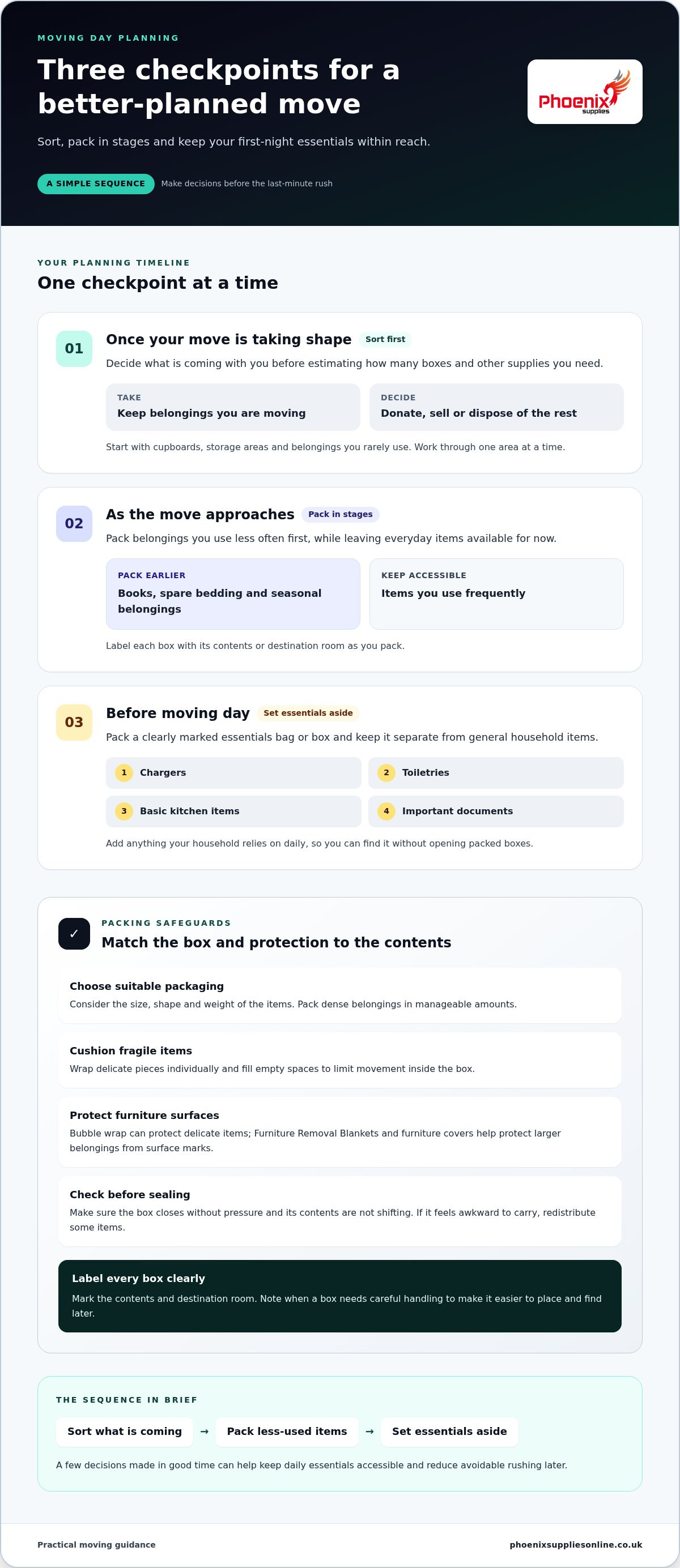
Timing can slip because the move date feels far away while normal routines carry on. Sorting and packing then compete with work, family commitments and daily tasks. Set a few checkpoints around the move rather than trying to plan every detail at once:
- Once your move is taking shape: sort belongings into items to take, donate, sell or dispose of. This helps you estimate how many boxes and other supplies you’ll need.
- As the move approaches: pack things you use less often, such as books, spare bedding or seasonal belongings. Leave frequently used items until later.
- Before moving day: set aside the essentials you’ll need straight away and keep them separate from boxes bound for the new home.
Leaving decluttering and packing until the last minute
Packing belongings you don’t intend to keep adds work at both ends of the move: first to box them, then to sort them again. Decide what’s moving before estimating how many boxes or other supplies you need. Start with cupboards, storage areas and belongings you rarely use. As you pack, label each box with its contents or destination room so your progress is still useful when you unpack.
This is one of the common moving mistakes to avoid UK movers can tackle early: letting undecided belongings determine how much packing is needed. A clear-out doesn’t have to happen all at once. Work through one area at a time and decide what to do with each item before packing it.
Forgetting the first-night essentials
After a tiring day, searching several boxes for a phone charger or clean towel can make settling in harder. Pack a clearly marked essentials bag or box and keep it separate from general household items. Include chargers, toiletries, basic kitchen items and important documents. Add anything your household relies on daily, so you can find it without opening boxes you’ve already stacked away.
Think of the move as a sequence, not a single burst of activity. Early sorting helps you estimate your packing needs; packing less-used belongings first keeps daily essentials available; setting those essentials aside helps you start the first evening with the basics to hand. These small decisions take little effort when made in good time and can prevent avoidable rushing later.
Packing mistakes that put belongings at risk
Packing is more than getting everything into boxes. The size and strength of each box, how much you put inside and how well you protect the contents all affect how easy items are to handle. A box that’s too large may encourage you to add more than is manageable; one that’s too small can leave belongings squeezed in awkwardly. Choose packaging to suit the contents rather than treating every box as interchangeable.
These common moving mistakes to avoid UK households encounter can often be prevented by considering the contents before packing. Books, kitchenware, ornaments and soft furnishings have different needs. For example, moving boxes and protective materials can help you match packaging to the job, rather than relying on one box or wrapping method for everything.
Overfilling boxes or choosing unsuitable packaging
Putting too many heavy items together can make a box difficult to lift and put extra strain on it during handling. Pack dense belongings in manageable amounts, and choose a box that fits without forcing the contents in. For bulky or fragile items, consider their shape as well as their weight. A book collection, for instance, needs a different approach from a lightweight duvet. Our Small Moving Boxes for Books: A Guide to Packing Your Library Safely covers that example in more detail.
Before sealing a box, check that it closes without pressure and that the contents aren’t shifting around. If it feels awkward to carry, redistribute some items rather than adding more tape and hoping for the best. Don’t guess at a box’s capacity or pack it beyond what feels safe to handle.
Skipping cushioning, labels or item-specific protection
Items that move freely inside a box can knock against one another during lifting and transport. Wrap fragile belongings individually, then fill empty spaces with suitable cushioning to limit movement. Bubble wrap can add a protective layer around delicate pieces, while furniture covers and Furniture Removal Blankets help protect larger belongings from surface marks during a move.
Labelling is just as useful. Mark the contents and destination room clearly on the outside, and note if a box needs careful handling. This helps you find items later and makes it easier to put each box in the right place, avoiding extra lifting. For a television, use packaging suited to its size and shape; the How to Choose the Best TV Moving Box in the UK guide explains what to consider.
- Use cushioning to limit movement around fragile items.
- Label the contents and the room where each box should go.
- Keep exposed furniture surfaces covered during handling.
Choose protection to suit the risk, not simply because it’s available. Phoenix Supplies UK offers moving boxes, Bubble Wrap, Furniture Removal Blankets and Mattress and Furniture Covers, so you can select practical supplies for the belongings you’re packing.
Moving-day oversights: access, measurements and essential details
Some of the common moving mistakes to avoid UK households face are about the route, not the packing. A sofa may fit through the front door but still be difficult to manoeuvre around a narrow hallway turn or on a staircase. Check measurements and practical arrangements ahead of time so you can make a plan before belongings are being moved.
Forgetting to check furniture dimensions and access
Measure large items and compare their dimensions with doorways, hallways and staircases at both properties. Include awkward turns and tight corners in your check. A tape measure and a few notes can reveal whether an item is likely to fit along the planned route, giving you time to consider another approach if needed.
Check the full path, not just the entrance. Look for narrow sections, low ceilings and other obstacles that could affect how an item is carried. If a piece looks difficult to move through the space, note the measurements and agree a practical plan with anyone helping with the move.
Leaving practical arrangements until moving day
A clear route inside helps too. Before items are carried out or brought in, move loose belongings away from doorways and hallways. This gives people space to pass and reduces the chance of tripping or knocking into obstacles. Consider the route from the parking area to the entrance as well, and plan for any access points that need to stay clear.
Handle essential home and address arrangements before the move, rather than leaving them until the first evening. Make a note of organisations and services that need your new details, such as utility providers, your bank and regular delivery services. Arrange relevant household changes, including the transfer or set-up of services at your new address, and review any personal insurance or other arrangements that apply to your move.
Use a short pre-move review to bring the details together:
- Compare large furniture measurements with the full route at both homes.
- Record entry instructions, parking details, key handover plans and useful contact numbers.
- Keep access routes clear and complete address and household updates ahead of time.
These checks don’t need to become a long administrative exercise. A few clear notes can help you spot a practical issue early and make the move between homes more straightforward. For households facing the added complexity of an overseas relocation, professional support from gersonmovingservices.com can provide fully managed international removals to keep every stage organised.
A simple way to avoid moving mistakes on the day
Even a well-planned move can feel rushed if everyone is trying to remember the next task at once. A short sequence gives you a clear order to follow, from the final check at your old home to settling into the new one. Keep it somewhere easy to see and share the key steps with anyone helping. You don’t need to account for every small task; focus on belongings, access and the things you’ll need straight away.
Build in time for a pause, a drink and a proper look around before leaving. Moving involves many small decisions, and a brief reset can help you notice what still needs attention. Keep the plan realistic: allow time to check rooms and routes instead of assuming everything will happen without a hold-up. A calm final review is more useful than rushing through a long list.
Before leaving the old home
Once the main items are ready to go, take a deliberate final walk through the property. Check cupboards, storage spaces and rooms where small belongings can be easy to miss. Keep keys, important documents and your essentials bag separate from packed boxes so they don’t get loaded by mistake. Before carrying items out, check the exit routes and move boxes or loose belongings that could obstruct the way.
Use a consistent final check rather than relying on memory. Look behind doors, inside cupboards and in any area used for temporary storage. If someone else is helping, agree who will make the final walk-through and who will keep important items with them. This avoids uncertainty about whether a space has already been checked.
On arrival at the new home
At the new property, use room labels to guide boxes to their intended spaces. This reduces unnecessary handling and makes it easier to find what you need later. Keep fragile items and essentials easy to identify as boxes come in, and make sure the main routes through the home stay clear. If the labels need a quick explanation, tell everyone helping before unloading begins.
Before unpacking, check that the first items you need are accessible and that boxes haven’t been placed across doorways or hallways. A packing materials list for moving house can help you review your supplies in advance, so useful protection is ready for the belongings that need it.
- Before leaving: check each room and storage space, keep keys and essential documents with you, and clear the exit route.
- During the move: pause when needed and keep the plan visible, rather than trying to hold every detail in your head.
- On arrival: direct boxes by room, identify fragile and essential items, and keep walkways open.
These steps help prevent common moving mistakes to avoid UK households often face, such as leaving belongings behind or losing track of key items in the rush. For boxes and protective supplies suited to your move, explore moving materials from Phoenix Supplies UK.
Choose practical packing supplies to prevent avoidable damage
The right packing supplies depend on what you’re moving and how each item needs to be handled. A book, a hanging outfit and a glass ornament call for different types of protection. Choosing materials to suit the contents can make packing and handling more straightforward, though no supply can promise that belongings will arrive without damage.
Use this guide to match a common risk with a practical supply category. Consider the item’s size, shape and surface, then choose packaging that helps contain or protect it during the move.
| Common risk | Supply category | Purpose |
|---|---|---|
| Loose household items are difficult to group | Moving boxes | Keep belongings together for carrying and placement. |
| Clothing becomes creased or mixed with other items | Wardrobe boxes | Keep hanging clothes grouped during the move. |
| Fragile items may knock against other contents | Bubble wrap | Wrap suitable breakables to add a protective layer. |
| Furniture or appliances may be marked during handling | Furniture Removal Blankets | Help protect larger items during moves. |
| Mattresses and furniture need a covering | Furniture covers | Cover items during the move. |
Match the protection to the item
For grouped belongings, choose boxes with a size and strength suited to their contents. A box should hold everything without being overfilled or difficult to handle. Wardrobe boxes are a practical choice for hanging clothes, while bubble wrap can be used to wrap suitable fragile items before placing them securely in a box.
For larger belongings, Furniture Removal Blankets can help protect furniture and appliances during moves. Furniture covers provide another option for covering mattresses and furniture. Consider which surfaces need protection and how each item will be carried, rather than choosing supplies by habit.
Make ordering and preparation straightforward
Preparing your supplies before packing gets under way gives you time to match materials to your belongings. Phoenix Supplies UK is a family-run source of Packaging Materials, including moving boxes, wardrobe boxes, Bubble Wrap, Furniture Removal Blankets and furniture covers. Complete house moving packs are also available to bring key supplies together.
The website is easy to navigate, making online ordering straightforward, and the helpful customer service team can support you as you organise the materials you need. Common moving mistakes to avoid UK movers can reduce include using unsuitable packaging or leaving protection until the last moment. Thinking about your belongings helps you choose useful supplies without adding materials that serve no purpose.
Browse moving supplies from Phoenix Supplies UK to find practical Packaging Materials for your move.
Give your next move a confident start
Planning around common moving mistakes to avoid UK movers face starts with one useful next step: decide what you need to protect and gather suitable supplies before packing begins. That gives you time to choose materials for your belongings instead of making rushed decisions as moving day gets closer. Keep your plan simple and focus on what will help your household settle into the new home.
Phoenix Supplies UK is a family-run business established in 1920, supplying packaging materials for home moves. Most orders placed by 1pm are dispatched the same day on a free next working day delivery service, helping you prepare without leaving supplies until the last moment.
Choose the boxes and protective materials that fit your move, from everyday belongings to furniture that needs an extra layer of care. Browse moving supplies from Phoenix Supplies UK and take the next step towards a well-prepared move. With a clear plan and the right materials to hand, you can approach moving day with greater confidence.
Frequently Asked Questions
Can I pack books in large moving boxes?
Books are usually easier to lift and handle in smaller moving boxes than in one large box filled with a heavy collection. Pack them snugly so they don’t shift, but leave room to close the box without forcing it. Add a clear label describing the contents and destination room. Grouping books by shelf or subject can also make it easier to find and unpack the ones you need first.
Should I empty drawers before moving furniture?
It depends on the furniture, what’s inside and how the item will be handled. Removing loose or heavy contents can make drawers easier to manage and reduce movement inside them. Small, light items may be less of a concern in some furniture, but don’t assume every drawer should stay full. Protect the furniture’s surfaces and secure drawers in a way that suits their design, without placing tape directly on a delicate finish.
How should I prepare a fridge or freezer before moving?
Follow the appliance manufacturer’s instructions for emptying, defrosting and preparing your fridge or freezer for transport. The steps can vary by appliance, so use its manual rather than relying on a general rule. Plan ahead, as preparation may take time and could involve using up or moving food before the move. Leaving it until moving day is among the common moving mistakes to avoid UK households can prevent with early planning.
Can houseplants be moved with the rest of my belongings?
Houseplants need separate consideration because temperature, movement and time without care can affect them. Plan how to keep each plant upright and accessible during the journey, rather than burying it among boxes. Think about when it may need attention and how you’ll place it at the new home. If your circumstances involve transport restrictions, check which ones apply before moving the plants, as requirements can depend on the journey and situation.
What should I do with pets on moving day?
Plan a calm, secure place for your pet away from busy doorways and the movement of boxes and furniture. Keep familiar essentials, such as food, water bowls and bedding, easy to reach so you can maintain familiar routines as much as possible. Consider your pet’s temperament and needs when deciding what arrangement will work. A plan that suits one animal may not suit another, so adapt it to your pet.
How can I protect floors and walls while moving furniture?
Clear the route first, then take care when moving items around corners and through narrow spaces. Use floor protection suited to the surface and task, and check that it stays in place as you work. Furniture Removal Blankets can protect furniture and appliances during moves, while covering exposed surfaces can help limit scuffs from contact. No material prevents every mark, so careful handling and a clear route still matter.


