

The best alternative to packing peanuts may not be another loose filler. If you’re deciding what you can use instead of packing peanuts, bubble wrap, air pillows and paper are practical options. Each can cushion items or fill the empty space around them, helping prevent movement inside a box.
Packing peanuts are familiar because they fill gaps around awkward shapes. But they can be messy to handle, and you may prefer another option for a house move or business parcel. Void fill means material placed in a box to stop its contents shifting during transit.
This guide explains how bubble wrap and air pillows compare, when shredded paper or cardboard can work, and what to consider with alternatives such as popcorn or corn starch peanuts. You’ll also find simple ways to choose cushioning for the item you’re packing, so you can protect it without adding more material than the box needs.
Key Takeaways
- Choose bubble wrap to cushion individual items, or air pillows to fill gaps around them; the right option depends on the item and how much space is left in the box.
- Unbuttered popcorn can cushion goods, but it may crush and leave dust, so consider wrapping items in paper first.
- Shredded waste paper and cardboard can fill empty spaces, giving household and business packaging another use before recycling or composting.
- Explore paper-based and corn starch alternatives if you want to avoid polystyrene, and pick a box that fits your item to reduce excess filler.
1. Bubble wrap and air pillows
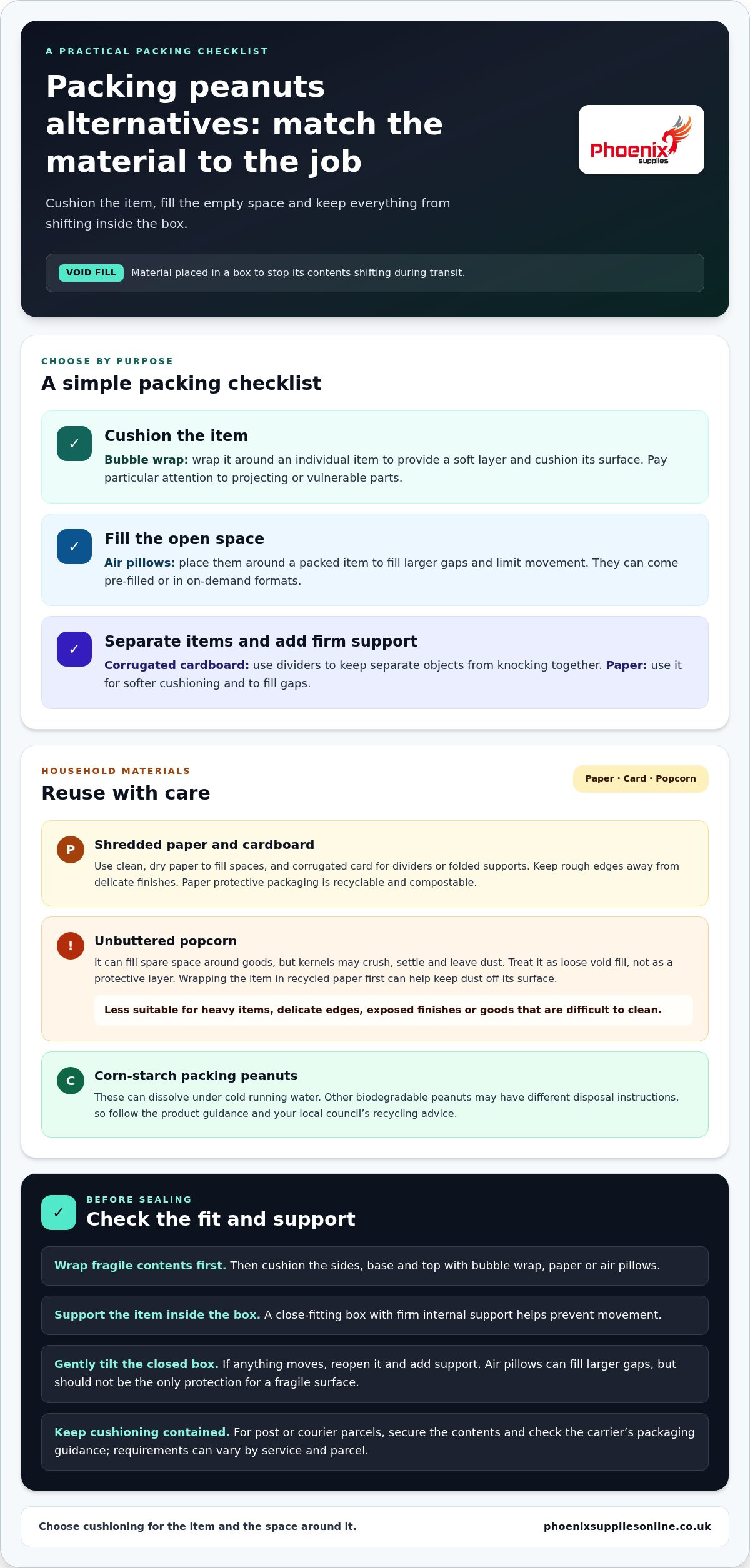
If you’re asking, “What can I use instead of packing peanuts?”, bubble wrap and air pillows are practical options. Wrap bubble wrap around an item to cushion its surface, then use air pillows to fill open space and limit movement. Air cushion packaging comes pre-filled or in on-demand formats, while bubble wrap is stored flat and used as needed.
Paper, corrugated cardboard and bubble wrap protect in different ways. Paper cushions and fills gaps, cardboard creates firmer dividers, and bubble wrap provides a soft layer around an individual object. For example, wrap a small glass ornament, then separate it from other contents with a cardboard divider.
For heavy, delicate or oddly shaped goods, protect vulnerable parts and support the item so it cannot shift. Wrap a ceramic lamp, paying attention to projecting parts, then add cushioning around it. A close-fitting box with firm internal support helps prevent movement. Air pillows can fill larger gaps, but shouldn’t be the only protection for a fragile surface.
For parcels sent by post or courier in the UK, secure the contents inside the box and keep cushioning material contained. Check the carrier’s packaging guidance, as requirements can vary by service and parcel. Before sealing, gently tilt the closed box. If anything moves, reopen it and add support.
Corn-starch packing peanuts can dissolve under cold running water. Other biodegradable peanuts may have different disposal instructions, so don’t assume they’re suitable for home composting or kerbside recycling. Follow the product guidance and your local council’s recycling advice.
A practical answer to “what can I use instead of packing peanuts” depends on the item and the space around it. Wrap fragile contents first, then cushion the sides, base and top with bubble wrap, paper or air pillows. Close the box and gently tilt it; add more cushioning if the item shifts.
Bubble wrap is typically shipped and stored flat, then inflated when needed to package a product. Void fill packaging is cushioning material used to keep products immobile inside a box until they reach their destination.
2. Unbuttered popcorn as cushioning
Plain, unbuttered popcorn can fill spare space around goods in a parcel. Treat it as loose void fill, not as a protective layer wrapped directly around a product. For example, place a sturdy item already packed in its own box inside a larger carton, then fill the surrounding gaps with popcorn.
Popcorn is lightweight and can settle between objects, but it doesn’t provide firm support. During rough handling, kernels may crush and leave the parcel less evenly filled. This makes popcorn a poor sole cushion for heavy objects or goods with delicate edges. Consider how the contents may be handled before choosing it.
There’s also a cleanliness issue: broken kernels can create dust that collects on a product or inside its packaging. Wrapping the item in recycled paper first can help keep popcorn dust away from its surface. Keep the paper snug, then place the wrapped item in the carton before adding loose filler.
Use popcorn only where crumbs won’t affect the contents. A sealed product in an inner carton is more suitable than an unwrapped item with crevices, fabric or an exposed finish. Avoid putting popcorn directly against goods that could be marked or difficult to clean. Keep the carton dry, as damp filler can make a parcel untidy.
Before choosing popcorn, consider the parcel’s contents, handling and recipient. It can be a convenient household material for a low-risk shipment, but it may become messy as it breaks down. For fragile or valuable goods, choose cushioning that provides more dependable support and won’t leave kernels or dust among the contents.
If a parcel is likely to be knocked around, the popcorn may lose its shape and create a cleanup task when opened. Wrapping the product in recycled paper can help keep popcorn dust off it and separate the loose material. This is useful when the product’s surface needs to stay clean, but it does not make popcorn a firmer cushion.
3. Using shredded waste paper and cardboard
Shredded waste paper can fill spaces around goods, while corrugated cardboard can form dividers and folded supports. Use paper for softer cushioning and card to stop separate objects knocking together. For example, fold corrugated card into a simple partition between jars in a carton. Paper protective packaging is recyclable and compostable.
Paper void fill comes in several formats for different packing routines. Rolls can be torn by hand, while pre-cut or pre-crinkled pieces are ready to place around products. Hand packing suits occasional parcels; paper void fill can also be used with an automated packaging machine. Choose a format that fits your packing volume and the shapes you need to protect.
Clean, dry paper and cardboard are the most suitable household scraps for parcels. Avoid damp pieces, food-stained packaging and paper with rough edges that could mark a delicate finish. For a small framed picture, use flat card as a face shield and add paper around the edges. This keeps cushioning away from the surface that needs protection.
Packing peanuts may be reused if they remain clean and usable. Their recycling or disposal route depends on their material and local household waste arrangements, so don’t assume polystyrene and corn-starch peanuts belong in the same recycling stream. Follow the relevant disposal guidance for your area.
Paper void fill and wood wool are sold by packaging suppliers in the UK. Their cost depends on the material, format and quantity, so there is no single figure for these options. Household paper can be handy for an occasional parcel, while ready-to-use materials may suit regular packing.
Shredded paper can compress or escape through gaps, and fabric scraps may shift or leave fibres on goods. Wrap delicate items separately before adding either material, and keep loose filler away from exposed surfaces. These household options work best when clean, dry and suited to the item’s weight and finish.
4. What eco-friendly alternatives to polystyrene packing peanuts are available in the UK?
UK packers can consider paper, corn-starch peanuts, sphagnum peat moss and packaging made with coconut husk. Each material has different handling and disposal considerations, so choose according to the goods, packing process and what happens to the filler after use. “Eco-friendly” doesn’t mean every material suits every parcel or disposal route.
Paper is a familiar option for filling and cushioning parcels. Corn-starch peanuts are another alternative to conventional polystyrene. They can be used as loose fill around a product, but make sure the parcel stays dry and the contents are supported. These options may suit different routines, from occasional household parcels to regular business orders.
Sphagnum peat moss can create a springy protective layer and is described as compostable. It can be bought in bulk or grown in-house for packaging use, making it a potential option for businesses with space and a regular packaging need. For occasional parcels, consider whether storing and handling it fits your routine.
Some companies combine coconut husk with thermoplastic to make compostable packaging. This differs from loose coconut husk fibre, which can be difficult to dispose of after use. Consider the material’s form and end-of-use route rather than judging by its natural origin alone.
To compare these choices, start with the item’s shape and cushioning needs. A compact, sturdy product may need less loose fill than a delicate item with gaps around it. Then consider how the filler will be handled and disposed of after unpacking. For a house move, reusing clean packing materials can reduce waste. For regular dispatches, a consistent material may make packing easier to organise.
Paper, corn-starch, peat moss and coconut-husk blends offer different alternatives to conventional polystyrene. The useful choice is the one that protects the goods and fits your packing and disposal plans.
Phoenix Supplies UK: Small Moving Boxes
Phoenix Supplies UK offers Small Moving Boxes for smaller belongings. Choosing a box that fits the contents can reduce unused space and the amount of void fill needed. Medium Moving Boxes and Large Moving Boxes provide further size options for household items, while Extra Large TV Moving Boxes are designed for televisions.
Match the box to the item, then add paper, bubble wrap or another suitable cushioning material where needed. This gives you a practical starting point for packing everything from smaller household goods to a television, without relying on loose filler alone.
Visit phoenixsuppliesonline.co.uk to browse box options for your move.
Choose your box before your filler
Before packing, measure the item and choose a carton that leaves room for protection without excessive empty space. This helps you judge how much cushioning you need and where to place it. If you’re deciding what you can use instead of packing peanuts, start with the item’s shape, fragility and the space around it.
Your next step may be choosing the right box. Phoenix Supplies UK offers Small Moving Boxes, Medium Moving Boxes and Large Moving Boxes for different household items. A well-matched carton gives you a practical base for arranging paper, bubble wrap or another suitable filler around your belongings.
Take a look at the available sizes and choose what fits your packing plan. Browse moving boxes at Phoenix Supplies UK and get your next move organised with confidence.
Frequently Asked Questions
What is Void Fill?
Void fill is material used inside a parcel to keep its contents in position during handling. It fills unused space, unlike wrapping, which sits directly around an item. For example, a wrapped candle may need separate fill so it doesn’t slide into the box walls. Choose the type and amount based on the parcel’s contents and remaining space.
What household materials can replace packing peanuts for cushioning parcels?
Clean, dry shredded paper, scrap cardboard and fabric can help cushion household parcels. Fold cardboard into a divider for separate items, or wrap a sturdy object in a clean tea towel before placing it in a snug box. Keep household filler clean and dry, and check that the contents stay still after closing the parcel. Fragile goods need suitable protection around the item itself.


