

You might think a soft, flexible laundry bag is the natural home for your winter duvet during a house move, but those shapeless bundles are often the biggest cause of frustration when loading a removal van. Finding the right large moving boxes for duvets is essential because it's a common worry that expensive bedding will end up dusty, damp, or crushed under heavier items during transit. We understand that your home comforts are precious, and the last thing you want is to be washing every pillow and quilt the moment you arrive at your new house.
In this guide, we'll help you choose the best containers so your bedding stays clean and easy to stack. Whilst fabric bags are fine for long-term storage in a cupboard, rigid double-wall cardboard boxes are the only professional choice for a safe, stackable move. We'll explain how to select durable containers that won't collapse, ensuring your van space is used efficiently and your linens remain in pristine condition from start to finish.
Key Takeaways
- Learn why high-volume cardboard containers are the best choice for bulky items like king-size duvets and winter blankets.
- Understand why double-wall large moving boxes for duvets are essential for safe stacking in a removal van, even though the bedding itself is lightweight.
- Discover why rigid cardboard offers superior protection against dust and damp compared to flexible fabric storage bags during a house move.
- Get practical advice on lining your boxes and folding bedding into rectangles to maximise space and prevent shifting.
- Find out how a family-run specialist can provide the personal service and quality materials needed for a smooth transition to your new home.
What are Large Moving Boxes for Duvets and Bedding?
When we talk about large moving boxes for duvets, we aren't just describing a standard container that happens to be big. These are specialised, high-volume cardboard units designed specifically to accommodate lightweight yet bulky household items. Standard medium boxes are excellent for heavy items like books or tinned goods, but they simply aren't up to the task of holding a king-size winter duvet or a set of thick woollen blankets. Attempting to force a bulky quilt into a smaller box usually results in bulging sides and lids that won't tape shut, making them impossible to stack safely in a removal van.
Most professional-grade moving boxes are made from corrugated fiberboard, which provides the structural integrity needed to protect your belongings. This material allows the box to remain light enough for one person to carry comfortably, even when filled to capacity with pillows and linens. Using these dedicated containers means you can keep your sleeping essentials organised and separate from heavier items, from kitchen equipment to furniture, making the unpacking process much more straightforward when you reach your new home.
The primary goal of using large moving boxes for duvets is to ensure every inch of the removal van is used effectively. In the removal industry, we often refer to this as "cubing out" the vehicle. By using uniform, rigid boxes, you can stack your bedding all the way to the ceiling of the van. This creates a stable wall of boxes that won't shift or tumble during the journey, protecting both the bedding inside and the more fragile items nearby. It’s a simple change that makes the difference between a chaotic load and a professional, secure move.
The Role of Volume in Bedding Boxes
Capacity is often measured in litres, and for bedding, you need every bit of it. High-volume boxes allow you to pack an entire bedding set in a single place, protecting your investment. Over-compressing a high-quality down or feather duvet into a tiny space can snap delicate quills and damage the natural loft of the filling. A larger box ensures your bedding arrives ready to use without needing professional fluffing or repair.
Why Rigid Cardboard Matters for Transit
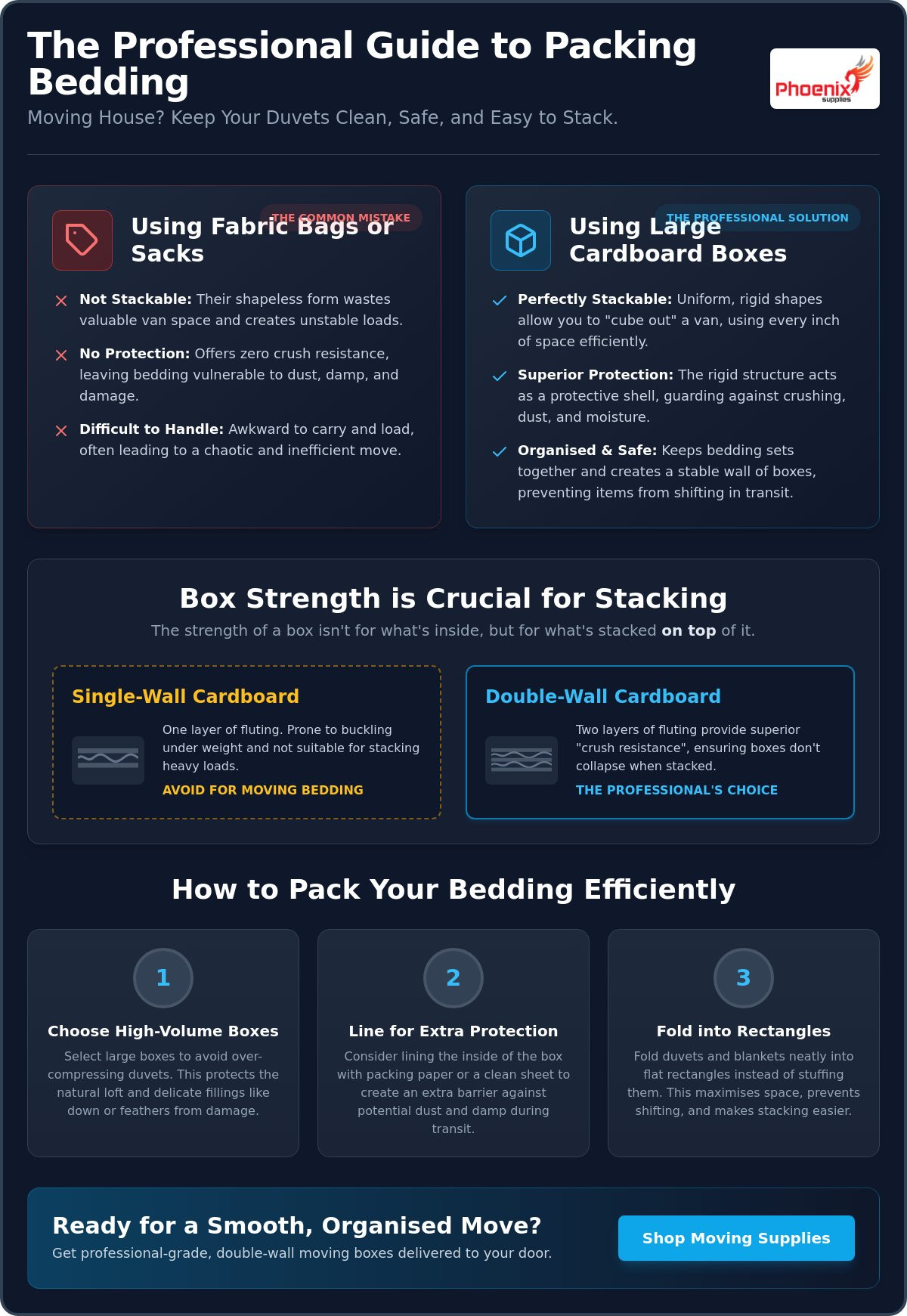
Whilst many people use fabric storage bags for duvets, these are often a poor choice for a house move. Fabric bags have no crush resistance, meaning they collapse as soon as another item is placed on top of them. Rigid cardboard boxes act as a protective shell, supporting the weight of other light boxes stacked above. This ensures your bedding doesn't end up damp or dusty if it comes into contact with the van floor or other equipment.
Choosing the Right Strength: Single Wall vs Double Wall Cardboard
When you're selecting large moving boxes for duvets, the strength of the cardboard is just as important as the dimensions. It's a common misconception that because bedding is light and airy, you can get away with using thinner, cheaper boxes. However, the strength of a box isn't just about what's inside; it's about what's sitting on top of it. In a removal van, every bit of vertical space is used, meaning your bedding boxes will likely have other items stacked on them. If the cardboard is too thin, the box will buckle, potentially damaging your expensive duvets or causing the entire stack to topple.
The structural difference comes down to the "fluting," which is the wavy layer of paper between the flat liners. Single-wall boxes have one layer of fluting, whilst double-wall boxes have two. This second layer provides the "crush resistance" that makes double-wall containers the favourite choice for professional movers. For bulky items like a king-size winter duvet or a heavy feather quilt, the extra rigidity of a double-wall box ensures the sides don't bow outwards when you lift it. If you're looking for a reliable solution, choosing large moving boxes with double-wall construction is the best way to keep your linens safe and your van load stable.
When to Use Double Wall Boxes
If you're following a professional ultimate moving checklist, you'll find that structural integrity is a recurring theme. Double-wall boxes are essential for any move involving a van or a long-distance journey. They offer superior protection against the shifting weights of a moving vehicle and provide better insulation. This extra layer of cardboard acts as a barrier against temperature fluctuations and dampness, which is vital for keeping natural fillings like down or wool in pristine condition. Because they don't lose their shape easily, these boxes are also far more likely to be reusable for future moves or for organised attic storage.
Understanding Weight Limits and Bedding
A typical large double-wall box has a weight capacity of 25-30kg, yet even the heaviest king-size bedding set rarely exceeds 5kg. This creates a high "volumetric weight," where the box takes up significant space despite being very light. To manage this effectively, avoid the temptation to overfill the box until it bulges. If the lid doesn't sit perfectly flat, you won't be able to stack other boxes on top, which wastes valuable space in the removal van. Instead, fold your bedding neatly to fit the corners and use high-quality tape to secure the flat lid, ensuring the box maintains its rectangular shape throughout the move.
Cardboard Boxes vs Fabric Bags for Moving House
Choosing between large moving boxes for duvets and flexible fabric bags is a decision that impacts both the safety of your bedding and the efficiency of your moving day. Whilst fabric bags are excellent for long-term under-bed storage or keeping spare linens in a cupboard, they often fail the test of a removal van. The main issue is their lack of structure. In a transit environment, you need a container that holds its shape regardless of what is happening around it. Cardboard provides a rigid shell that resists punctures from the sharp corners of furniture or bed frames, something a thin fabric zip-up bag simply cannot do.
Investing in quality cardboard is essentially an insurance policy for your expensive bedding. High-quality duvets, especially those filled with natural down, are a significant investment. Replacing a torn or soiled king-size duvet costs far more than the price of a few sturdy boxes. Rigid containers ensure that your linens don't become a squashed, shapeless mess at the bottom of a pile. By using a box, you're choosing a professional standard that prioritises protection over mere convenience.
The Stackability Factor
Professional movers rely on a technique called "tiering" to load a van safely. This involves building vertical walls of uniform boxes that lock together to prevent shifting. Because large moving boxes for duvets have flat tops and square corners, they sit perfectly within these tiers. Fabric bags, by contrast, are slippery and rounded. They tend to slide out of place or topple over when the van turns a corner. By using boxes, you create a stable load that is faster to pack and much safer to unload when you arrive at your new home.
Protection from Dust and Moisture
Dust is the primary enemy of fresh bedding. Whilst fabric bags have zips, these are often the weakest point, allowing fine dust or damp air to seep in during the transition from your bedroom to the van. Cardboard acts as a solid primary barrier against the elements. For the ultimate level of protection, we recommend using mattress and furniture covers as an internal liner inside your boxes. This double-layer approach keeps your whites brilliant and your pillows smelling fresh. Cardboard also has a natural ability to "breathe" slightly better than thick plastic or synthetic fabric, which helps prevent that stale, musty odour that can develop when items are packed away for a few days.
How to Pack Your Duvets and Pillows Efficiently
Packing bedding might seem straightforward, but a methodical approach ensures your items arrive clean and ready for your first night in the new house. Start by lining the bottom of your large moving boxes for duvets with a clean bedsheet or a furniture cover. This simple step creates an extra moisture barrier, protecting your linens from any dampness that might occur during the transition from your bedroom to the removal van. It's a small detail that makes a significant difference in keeping your whites pristine and smelling fresh.
- Step 2: Fold your duvet into a neat rectangle that matches the internal dimensions of the box. Avoid rolling it into a cylinder, as this creates "dead space" in the corners which can cause the box to lose its structural integrity when other items are stacked on top.
- Step 3: Place your pillows on top of the folded duvet. This fills the remaining gap and provides a soft cushion for the lid, ensuring the box remains firm but not overstuffed.
- Step 4: Seal every seam with high-quality packing tape. Don't just tape the centre; secure the side edges to prevent dust ingress during the journey.
- Step 5: Label the box clearly on at least two sides with "Bedding" and the specific bedroom it belongs to, such as "Master Bedroom" or "Guest Room".
Following these steps helps you avoid the common pitfall of having boxes that are half-empty or awkwardly weighted. When your bedding is packed snugly, the box maintains its rectangular shape, which is vital for the "tiering" process we discussed earlier. If you're looking for the right tools to get started, you can find a full range of professional packing materials at Phoenix Supplies UK.
Using Removal Blankets for Extra Cushioning
For particularly delicate or expensive bedding, wrapping the items in removal blankets before placing them in the box offers an added layer of security. These blankets are excellent for filling any remaining gaps in a large box, which prevents the contents from shifting whilst the van is in motion. Removal blankets provide a professional-grade buffer against transit vibrations, ensuring your bedding stays exactly where you put it without rubbing against the cardboard.
The Vacuum Bag Controversy
Many people consider vacuum-sealing their duvets before boxing them to save space. Whilst this is effective for synthetic fillings, we advise caution when dealing with natural down or feather duvets. Long-term compression can snap the delicate quills of the feathers, permanently damaging the loft and warmth of your bedding. There is also a risk that vacuum bags can make your large moving boxes for duvets unexpectedly heavy. If you pack too many shrunken items into one container, you might find the box exceeds a safe lifting weight. It's usually better to let the bedding breathe and use the box's natural volume to your advantage.
Professional Moving Supplies from Phoenix Supplies UK
Phoenix Supplies UK is more than just a warehouse; we're a family-run business that prides itself on being a reliable partner for your house move. We understand that moving can be an overwhelming experience, which is why we focus on providing straightforward advice and professional-grade materials. Our range of large moving boxes is specifically selected to meet the needs of UK households, ensuring you have the right tools to protect everything from your kitchenware to your bulky bedding. Finding the right large moving boxes for duvets is just one part of a successful move, and we are here to support you through the entire process.
When you choose our large moving boxes for duvets, you aren't just buying cardboard; you're gaining the peace of mind that comes from using supplies designed for the rigours of transit. We believe that professional reliability shouldn't come with a corporate chill, so we maintain a "helpful neighbour" approach in everything we do. Whether you're moving a small flat or a large family home, we offer free delivery on all orders, regardless of the size. This ensures you get the supplies you need delivered directly to your door without any hidden costs or complications.
Quality You Can Trust
Every box in our catalogue is sourced for its durability and strength. We know that a box is only as good as its ability to protect your belongings, so we don't cut corners on quality. For those who need to pack more than just the linen cupboard, we offer bulk moving packs that provide a cost-effective way to secure all the containers you need in one go. If you're unsure which sizes or strengths are best for your specific situation, our office team is always available to provide personalised advice. We're happy to help you calculate exactly what you need, from the number of boxes to the amount of tape required. Just give us a call.
Complete Your Packing Kit
While securing the right boxes for your bedding is a great start, a truly smooth move requires a complete packing solution. You might consider adding bubble wrap for your fragile items or wardrobe boxes to keep your clothes crease-free and ready to hang. Having the correct supplies on hand reduces the stress of moving day, as you won't be left scrambling for extra containers or worrying about whether a box is strong enough. We encourage you to browse our full catalogue, where you'll find competitive prices and a service that values the human element of every transaction. We're here to help you get moved safely.
Prepare for a Comfortable First Night
Ensuring your bedding arrives in perfect condition is one of the best ways to make your first night in a new home feel right. We've explored how opting for large moving boxes for duvets provides the rigid structure needed to keep your linens clean and your van load stable. By choosing double-wall cardboard over flexible bags, you're protecting your investment in high-quality quilts and pillows. Proper packing isn't just about saving space. It's about making sure your home comforts are ready to use the moment you unpack.
At Phoenix Supplies UK, we're a family-run business dedicated to making your move as straightforward as possible. We provide professional-grade materials and offer free delivery on all orders to take the weight off your shoulders. You can Browse our range of high-quality Large Moving Boxes at Phoenix Supplies UK to find the right sizes for your bedding and beyond. We wish you every success with your move. Have a very happy first night in your new home.
Frequently Asked Questions
Will a king-size duvet fit in a standard large moving box?
Yes, a standard large moving box is designed to accommodate a king-size duvet comfortably. You'll find the best results by folding the duvet into a neat rectangle that matches the box's base. This prevents the corners from being empty and ensures the box maintains its shape. A well-filled box is much easier to stack and won't collapse under the weight of other light items in the van.
How many pillows can I fit in a large moving box alongside a duvet?
You can typically fit two standard pillows on top of a single folded duvet in one large container. If you're packing a thinner summer-weight quilt, you might manage to fit four pillows instead. The goal is to fill the volume without forcing the lid shut. If the box bulges, it becomes difficult to stack, so it's always better to use an extra box than to overstuff one.
Should I wash my duvets before or after the move?
It's generally better to wash and thoroughly dry your bedding after you have arrived at your new home. Even with professional-grade boxes, the moving process involves a lot of dust and handling. Washing your duvets and pillows once you've unpacked ensures your bed is perfectly fresh for that first night's sleep. Just make sure everything is bone-dry before you put it back on the bed to avoid damp.
Can I use large moving boxes for duvets to pack heavy books?
You should never use large boxes for heavy items like books or kitchen appliances. While our boxes are durable, a large box filled with books would be dangerously heavy to carry and could cause the cardboard to fail. We recommend using small or medium boxes for dense items. Reserve your large boxes for bedding, pillows, and other lightweight, bulky household goods to ensure a safe move.
How do I stop my bedding from smelling musty in a cardboard box?
The best way to prevent musty smells is to ensure all bedding is completely dry before it goes into the box. Using a clean furniture cover as an internal liner provides an extra layer of protection against damp. Cardboard is naturally more breathable than plastic, which helps keep air circulating. You can also tuck a few lavender bags or dryer sheets between the folds to maintain a fresh scent.
Are large cardboard moving boxes recyclable after the move?
Yes, all our cardboard moving boxes are fully recyclable and environmentally friendly. Once you've finished your move, simply peel off the packing tape and flatten the boxes for your local recycling collection. Many people also choose to pass their boxes on to friends or neighbours who are moving. This is a great way to reuse quality materials and help someone else save on their own moving costs.
What is the best way to tape a large box for heavy-duty use?
The most effective technique is the "H-tape" method, where you seal the centre seam and both side edges. This reinforces the flaps and creates a barrier against dust and moisture. When you're preparing large moving boxes for duvets, this secure seal is vital. It keeps the box rigid and square, which allows the removal team to stack them efficiently from the floor to the ceiling of the van.
Do I need a double-wall box if I am only moving a short distance?
We always suggest using double-wall boxes if you intend to stack your items in a van or storage unit. Even for a short trip, a single-wall box can buckle if another container is placed on top of it. Using double-wall large moving boxes for duvets gives you the peace of mind that your bedding won't be crushed. It's a small investment that provides significantly better protection for your belongings during transit.


