

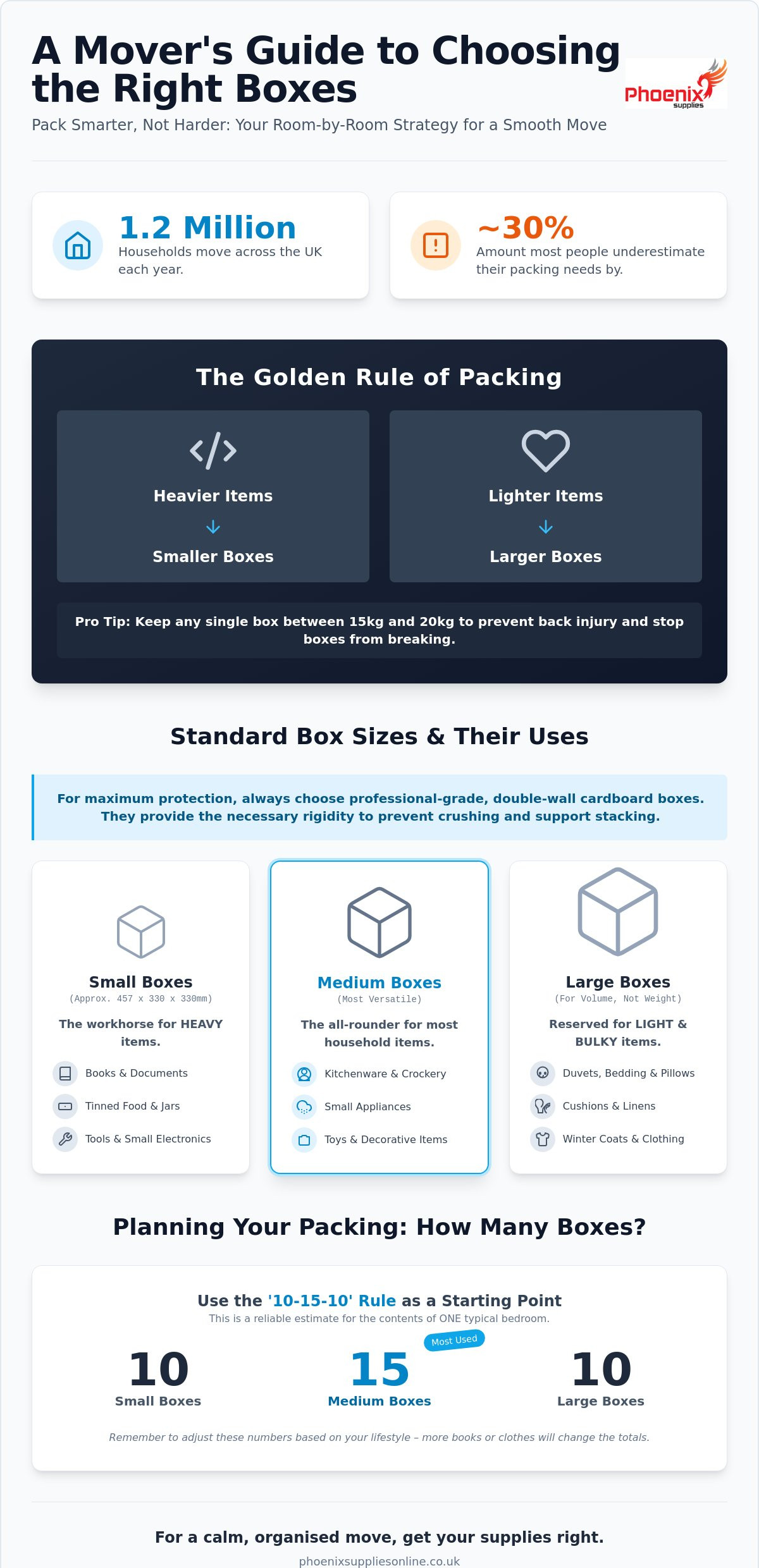
Did you know that roughly 1.2 million households move across the UK every year, yet most people underestimate their packing requirements by nearly 30%? It's a staggering figure that often leads to a last-minute rush for supplies. When you're standing amongst half-packed rooms, the most pressing question is usually what size boxes for moving you actually need to get the job done safely.
We understand that staring at a mountain of belongings feels overwhelming. You want to avoid the common pitfalls of overloading a large box until it's impossible to carry, or seeing a fragile heirloom break because it wasn't snug in its packaging. This guide will help you master the art of packing by selecting the perfect containers for every room in your home. We'll walk you through the specifics, from small boxes for heavy books to specialist wardrobe boxes for your clothes. You'll finish with a clear shopping list and the confidence to ensure a calm, organised move to your new front door.
Key Takeaways
- Learn why matching item weight to box volume is the essential 'Golden Rule' for a safe and manageable move.
- Discover exactly what size boxes for moving you need for every room, ensuring heavy items go in small boxes whilst bulky items fill larger ones.
- Understand the benefits of speciality containers, such as wardrobe boxes for hanging clothes and extra large TV moving boxes for screen protection.
- Master our '10-15-10' rule to accurately estimate how many boxes you need for each bedroom and avoid running out of supplies.
- Get a room-by-room breakdown to help you organise your packing strategy and protect fragile kitchenware and electronics effectively.
The Fundamentals of Choosing Box Sizes for Moving
Choosing exactly what size boxes for moving you require involves more than just guessing how much stuff you own. It starts with one simple, albeit counterintuitive, rule: the heavier the item, the smaller the box should be. It is tempting to grab the largest container available to clear a room quickly, but this is the most common mistake DIY movers make. A large box filled with books is almost impossible to lift safely; the structural integrity of the cardboard will likely fail before it even reaches the van.
Understanding the science behind your supplies helps prevent these mishaps. Most professional-grade options rely on specific Corrugated Box Design principles to manage weight and pressure. For most household moves, you should prioritse double-wall cardboard. This features two layers of fluting that provide the necessary rigidity to prevent the bottom from dropping out. You can easily test if a box is correctly sized by checking for "box bulge." If the sides are bowing outwards once the lids are taped shut, you have either picked a box that is too large for the weight of the contents or you have overstuffed it.
The Weight-to-Size Ratio Explained
Small Moving Boxes are the real workhorses of any house move. They are designed specifically for high-density items like hardback books, tinned food, and heavy hand tools. By using a smaller volume, you naturally limit the weight to a manageable level. We recommend keeping the total weight of any single box between 15kg and 20kg. This range ensures that you can lift and carry the items without risking a back injury or dropping the load. It also prevents the cardboard from crushing under its own weight when stacked.
Why Box Uniformity Matters for the Van
When you choose a consistent range of sizes, you make the loading process significantly easier. Think of the removal van as a giant game of Tetris. Standardised dimensions allow you to stack boxes tightly from the floor to the ceiling. This maximises your available space and prevents shifting during transit. Randomly sized containers from supermarkets often have weak corners and irregular shapes. These create unstable stacks that are prone to toppling whilst the van is turning corners or braking. Using professional Small, Medium, and Large boxes ensures each layer supports the one above it perfectly, keeping your belongings secure until you reach your new front door.
Standard Cardboard Box Sizes: Small, Medium, and Large
Selecting the right containers is about more than just volume; it's about structural integrity. When you're deciding what size boxes for moving to purchase, you'll encounter three industry standards. We prioritise double-wall construction for all our standard sizes. This extra layer of fluting ensures that whether you're packing a heavy stack of novels or a bulky duvet, the box maintains its shape and protects the contents from external pressure. Single-wall alternatives might save a few pennies, but they often buckle under the weight of a standard household move.
Small Boxes: Books, Tools, and Canned Goods
Small Moving Boxes are the unsung heroes of any successful pack-out. Measuring roughly 457mm x 330mm x 330mm, they are the ideal choice for heavy, dense items. If you fill a larger box with hardback books or tinned goods, it becomes a health and safety hazard. Small boxes naturally limit the weight you can pack, making them the first items you should buy in bulk. They are also incredibly useful as 'inner packing' for fragile items, providing a snug environment before being placed inside a larger, cushioned container.
Medium Boxes: Kitchenware and Small Appliances
Medium Moving Boxes are the versatile all-rounders that you'll likely use most frequently. These are perfectly sized for kitchenware, small appliances like kettles and toasters, and various decorative items. For a deeper dive into specific measurements, this Moving Box Size Guide offers a clear breakdown for different household needs. Because they balance volume and weight so well, they are the easiest size to carry up and down stairs without obstructing your view or straining your arms. In a typical three-bedroom house move, these usually make up the bulk of your packing inventory.
Large Boxes: Bedding, Pillows, and Toys
Large Moving Boxes should be reserved exclusively for 'light and fluffy' items. This includes duvets, pillows, cushions, and winter coats. It's a common trap to fill these with kitchen plates or heavy electronics, but doing so often leads to the box bottom failing or the stack collapsing in the van. Keep these boxes for the items that take up space but don't add significant weight. Knowing exactly what size boxes for moving are best for specific rooms makes the unpacking process much faster at the other end. If you're ready to begin your packing journey, our selection of standard moving boxes offers the professional strength required to keep your belongings safe from start to finish.
Speciality Moving Boxes for Challenging Items
Standard containers are fantastic for the bulk of your belongings, but certain items require a more tailored approach. If you've ever tried to fold a tailored suit into a medium box or squeeze a 65-inch screen into a standard large container, you know the frustration. Using the wrong containers for these high-value or awkward items often leads to creases, cracks, or complete breakage. When you're assessing what size boxes for moving you need, speciality options should be at the top of your list for the bedroom, living room, and home office. They save time. Protection is paramount.
Consulting a professional guide to moving box sizes can help you determine exactly how many of these speciality containers you'll need alongside your standard supplies. Choosing the right speciality box isn't just about convenience; it's about giving your most valuable possessions the specific protection they deserve. It's a simple way to reduce moving-day stress.
The Magic of Wardrobe Boxes with Rails
Wardrobe Boxes are a game-changer for anyone who wants to avoid hours of ironing after a move. These tall, sturdy containers come with an integrated hanging rail, allowing you to transfer clothes directly from your cupboard. It's a process that takes minutes rather than hours. Beyond just clothes, the bottom of these boxes provides a perfect spot for heavier items like shoes, handbags, or even bulky winter boots. Because of their height and reinforced structure, they offer excellent stability when stacked amongst other items in the removal van. They keep your best outfits pristine.
Protecting Electronics with Dedicated TV Boxes
Most of us don't keep the original packaging for our televisions. However, modern flat screens are incredibly fragile and sensitive to pressure. Extra Large TV Moving Boxes provide that essential heavy-duty double-wall protection that standard boxes lack. For screens up to 65 inches, a dedicated box is non-negotiable to prevent the screen from flexing or cracking during transit. To ensure the highest level of safety, we recommend pairing these boxes with plenty of bubble wrap to cushion the corners and the screen surface itself. Safety comes first.
Organising the Home Office with Archive Boxes
For those with a home office, Archive Boxes are indispensable. Unlike standard boxes, these are designed with integrated handles and a lift-off lid, making it easy to access documents whilst you are still in the process of unpacking. They are sized perfectly for A4 folders and lever-arch files, ensuring your paperwork stays organised and doesn't become a jumbled mess. They work perfectly for tax records and household files. You can stack them easily in a spare room or storage unit until you're ready to file them away properly.
A Room-by-Room Guide to Box Sizing
Applying the general rules of weight and volume becomes much easier once you look at your home room by room. Every space has its own unique challenges, from the dense weight of a kitchen cupboard to the awkward shapes found in a garden shed. When you are deciding what size boxes for moving you need to order, it helps to visualise how your specific belongings will fit together. A standard three-bedroom house usually requires a mix of all sizes, but the ratio changes depending on the room you are tackling.
Kitchen and Dining Room Logistics
The kitchen is often the most time-consuming room to pack because it contains a high concentration of fragile and heavy items. You will likely need more Small Moving Boxes and Medium Moving Boxes here than in any other part of the house. Dinner plates should be packed on their edges in medium boxes with plenty of cushioning, whilst heavy mugs, glassware, and bottles of spirits are best suited to small, sturdy boxes to keep the weight manageable. To save space and protect your cookware, nest smaller pots inside larger ones within a Medium Moving Box, ensuring you place a layer of padding between each item. This nesting technique prevents items from rattling and keeps the box structure stable.
For the living room and bedrooms, the strategy shifts. Ornaments, small electronics, and bedside lamps fit comfortably into medium containers. However, bulky but lightweight items like cushions from the sofa or spare duvets from the guest room are the perfect candidates for Large Moving Boxes. In the garage or shed, resist the urge to throw all your hand tools into one large container. Tools are deceptively heavy; they should be distributed amongst several small boxes to prevent the bottom from failing during the carry to the van. If you are unsure about your quantities, our complete moving kits provide a pre-calculated mix of sizes tailored to the number of rooms in your home.
The Home Office and Library
The home office requires a very specific packing approach to ensure you can get back to work quickly in your new location. Archive Boxes are the gold standard here. They are designed specifically for A4 folders and sensitive documents, featuring integrated handles that make them easy to move even when full. Their lift-off lids allow you to check the contents without having to slice through layers of packing tape, which is a lifesaver when you are looking for a specific file mid-move.
Your library or book collection must be handled with care. Books are amongst the heaviest items in any home. You should never pack them in anything larger than a small box. Filling a medium or large box with books creates a weight that most people cannot lift safely, and it puts immense pressure on the cardboard seams. Finally, keep your office cables and peripherals organised by using small, labelled containers. This simple step prevents the "spaghetti junction" of wires that often occurs when electronics are packed hastily into larger, unorganised boxes.
Planning Your Packing Strategy: How Many Boxes Do You Need?
Estimating the volume of your life is one of the most challenging parts of any move. Most people underestimate their requirements by roughly 20 to 30 percent, which often leads to a frantic search for more supplies on moving eve. To avoid this, we recommend the '10-15-10' rule as a baseline for a standard room pack-out. This simple formula suggests ten Small Moving Boxes, fifteen Medium Moving Boxes, and ten Large Moving Boxes per room. While your kitchen might require a higher ratio of small containers and your bedrooms more large ones, this average helps you calculate a realistic starting point for what size boxes for moving you should order.
It is always better to have five boxes too many than to run out when you are halfway through a cupboard. Unused boxes can be kept flat for future storage or passed on to a friend who is also moving. Having a surplus ensures that you don't start overfilling containers just to finish the job, which protects both your back and your belongings. If the maths feels overwhelming, our pre-calculated bulk moving packs take the guesswork out of the process by providing a professional mix of sizes tailored to your specific home size.
If the logistical challenge of packing and calculating box counts feels overwhelming, you can learn more about Vision Movers and their approach to providing a completely stress-free, full-service relocation.
Calculating Your Box Order
A typical one-bedroom flat usually requires between 25 and 35 boxes in total, depending on how much furniture you have. For a larger four-bedroom family home, that number can easily climb towards 100 containers. When you are doing your walk-through, don't forget to look up and out. Loft storage and garden sheds are often the most densely packed areas of a British home. These spaces usually require a higher volume of Small Moving Boxes to handle heavy tools and archived paperwork. Using our specialised Moving Packs ensures you have the right structural strength for every area of your property, from the attic to the garage.
Final Preparations and Moving Essentials
Once you have sorted your boxes, you need to consider the items that simply won't fit inside cardboard. Furniture, large mirrors, and dining tables require a different kind of care. We strongly recommend using removal blankets to wrap these larger pieces, preventing scratches and dents whilst they are in the van. These blankets provide a thick, protective layer that tape and boxes cannot offer. Protection is key for a stress-free day.
Finally, ensure your perfectly sized boxes stay exactly where you put them during transit. Webbing straps are essential for securing stacks of boxes against the interior walls of the removal van. This prevents shifting when the driver is navigating roundabouts or braking suddenly. By combining the right box sizes with professional securing tools, you create a safe environment for everything you own. Ready to start? Browse our full range of heavy-duty moving boxes here.
Prepare for a Successful Moving Day
Packing your entire life into containers is a significant milestone. By now, you should have a clear understanding of what size boxes for moving will work best for your specific belongings. Remember the golden rule: keep your heavy items in small boxes and reserve larger containers for your lighter, bulkier possessions. Whether you are using wardrobe boxes to save time on ironing or extra large TV moving boxes to protect your screens, the right strategy ensures your valuables arrive at your new home in perfect condition.
We take great pride in being a family-run British business dedicated to supporting your journey. We provide high-quality double-wall cardboard as standard across our range to give you total peace of mind. To help keep your costs down during an expensive time, we also offer free delivery on all orders. Order your heavy-duty moving boxes from Phoenix Supplies today and take the first step towards a stress-free move. You've got the plan; now it's time to get started on your new adventure.
Frequently Asked Questions
What is the most common box size for moving house?
The Medium Moving Box is the most common and versatile choice for a typical UK house move. It strikes the perfect balance between volume and weight, making it suitable for everything from kitchen appliances to bathroom supplies. Whilst deciding what size boxes for moving you need, remember that medium boxes will likely make up the largest portion of your order because they are easy to carry and stack efficiently in the van.
Can I use large boxes for books if I only fill them halfway?
You should avoid using large boxes for books even if they are only half-filled. Large boxes are designed for lightweight items; filling them halfway with heavy books creates an unbalanced load that is prone to tipping or crushing. Additionally, the empty space at the top makes the box structurally weak when stacked. It is much safer to use Small Moving Boxes, which are specifically designed to handle the density of a full stack of books.
How many boxes do I need for a 3-bedroom house move?
A standard three-bedroom house move in the UK typically requires between 55 and 95 boxes. This range accounts for the varying amounts of belongings found in different households. Most people underestimate their needs by nearly 30 percent, so it is wise to aim for the higher end of this estimate. This total should include a healthy mix of small, medium, and large sizes to accommodate different room types throughout your home.
What is the difference between single wall and double wall boxes?
The primary difference lies in the number of corrugated layers, with double-wall boxes featuring two layers of fluting for maximum strength. Single-wall boxes are thinner and better suited for lightweight storage or shipping items that aren't being stacked. For a house move, double-wall cardboard is essential because it prevents the boxes from buckling under the pressure of being stacked floor-to-ceiling in a removal van. It ensures your belongings stay protected.
Are wardrobe boxes worth the extra cost for a local move?
Wardrobe boxes are definitely worth the investment for local moves because they keep your clothes on their hangers and ready to wear. They eliminate the need for hours of folding and subsequent ironing once you arrive at your new home. Even for short distances, these sturdy containers protect delicate fabrics from being crushed or soiled during the transition. They also provide extra storage space at the bottom for shoes or handbags.
How heavy should a moving box be once it is packed?
A packed moving box should never weigh more than 20kg to ensure it can be lifted safely by one person. Exceeding this weight increases the risk of the cardboard failing or the person carrying it suffering a back injury. Use Small Moving Boxes for your heaviest items to naturally limit the total weight. If you find a box is getting too heavy, swap the remaining contents for lighter items like cushions or towels to balance it out.
What size box do I need for a 55-inch or 65-inch flat-screen TV?
You will need an Extra Large TV Moving Box specifically designed to accommodate screens up to 65 inches. These containers provide the heavy-duty double-wall protection necessary to prevent the delicate screen from flexing or cracking during transit. When you are considering what size boxes for moving your electronics, always prioritise a dedicated TV box over a standard large container. Pair the box with plenty of bubble wrap for maximum cushioning during the journey.
Should I use plastic crates or cardboard boxes for moving?
Cardboard boxes are generally the better choice for residential moves because they are easier to stack and more cost-effective than plastic crates. Cardboard offers a degree of natural shock absorption and can be easily recycled or flattened for storage after the move. Whilst plastic crates are durable, they cannot be resized and often take up significant space in the van if they aren't filled perfectly. Stick with high-quality double-wall cardboard for a more flexible packing experience.


