
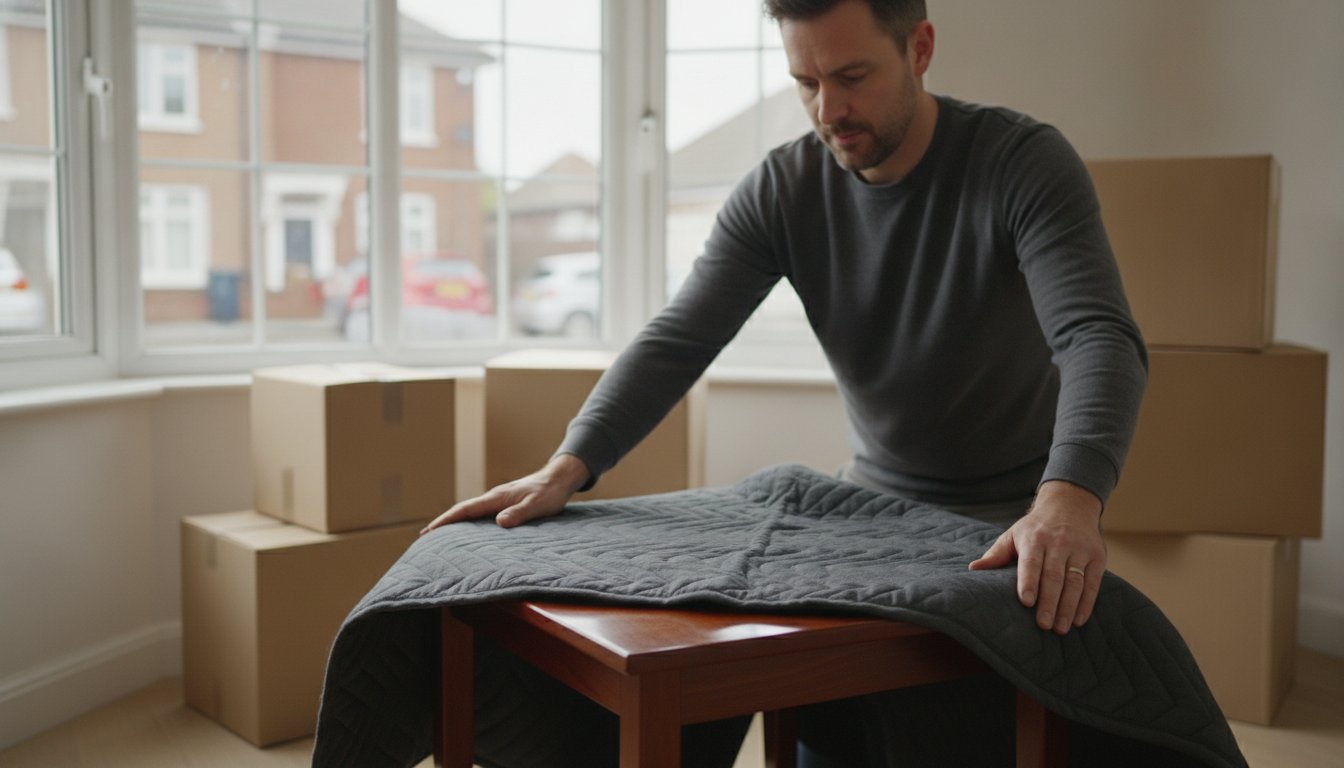
Imagine the sinking feeling of unwrapping your favourite mahogany dining table only to find a deep, jagged gouge across the polished surface. It's a heartbreak that happens to thousands of UK movers every year, yet it's almost entirely preventable with the right preparation. Most people assume an old duvet or a few layers of bubble wrap will do the job, but professional furniture transit blankets are engineered for a specific purpose: to provide the shock-absorption and "slip" needed to stop friction damage in its tracks.
We understand that moving house is one of life's most taxing events. You're likely juggling endless admin whilst worrying about fabric tears on your sofa or scuffs on your skirting boards. This guide is designed to take that weight off your shoulders. You'll discover how to select the best materials for your specific items and learn the professional wrapping techniques used by the experts. We'll also clear up the confusion around quantities, so you know exactly how many blankets are required for a standard house move. By the time you've finished reading, you'll have the knowledge to ensure your most prized possessions arrive at your new home without a single scratch.
Key Takeaways
- Understand the distinct roles of wool-mix and heavy-duty quilted covers to ensure you choose the right level of padding for your specific furniture items.
- Learn the professional "rule of thumb" for calculating how many furniture transit blankets you need based on your house size so you never run short on moving day.
- Master the "Enveloping Technique" and the importance of cleaning surfaces first to prevent trapped grit from causing hidden scratches during transit.
- Discover why the engineered "slip factor" of professional blankets offers superior protection compared to standard household bedding or bubble wrap.
- Realise the long-term value of investing in high-quality removal blankets that can be repurposed for garage storage or future moves.
What are Furniture Transit Blankets and Why are They Essential?
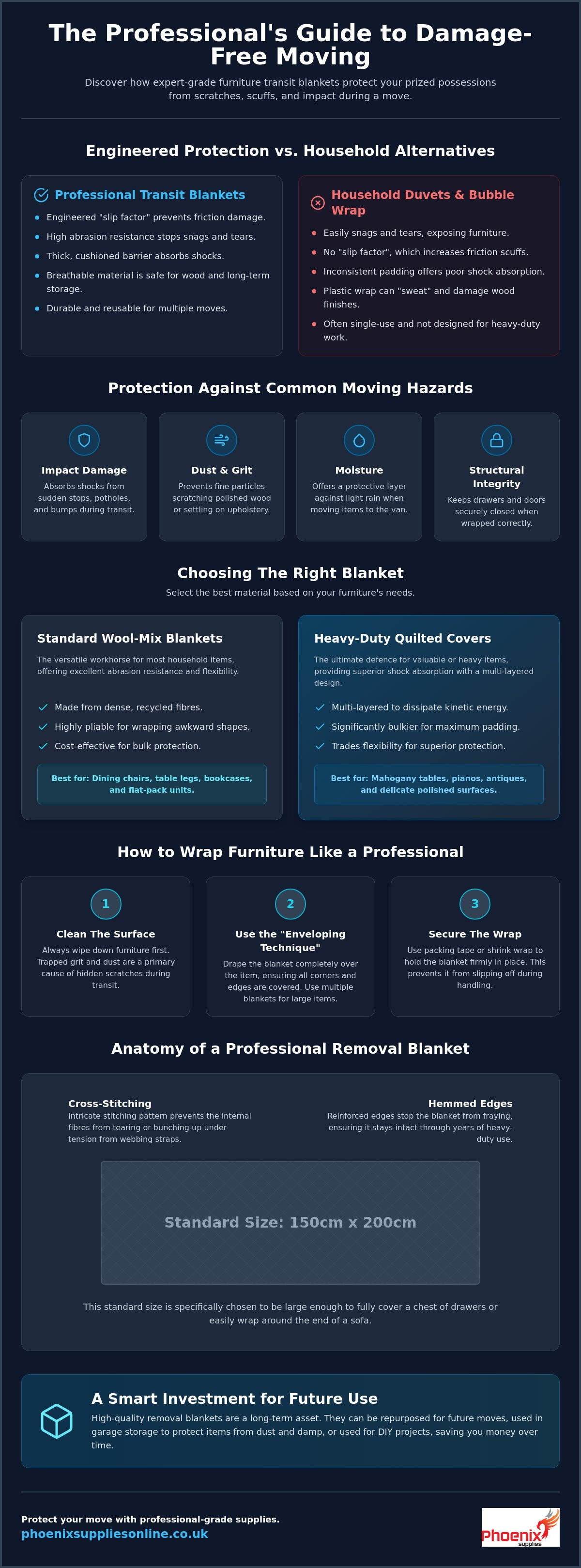
If you've ever watched a professional removal crew at work, you'll see them reaching for large, grey textile sheets almost immediately. These are furniture transit blankets, and they're the secret to a damage-free move. Unlike the old bedding you might have in the airing cupboard, these are heavy-duty, reusable textile sheets specifically designed to withstand the rigours of a house move. They offer a unique "slip factor" which is vital when packing a van tightly. This allows pieces of furniture to slide safely against one another during the journey, preventing the friction that causes scuffs and burns on delicate finishes.
Professional blankets are far superior to household duvets because they possess high abrasion resistance. A standard duvet can snag or tear easily, leaving your furniture exposed to the hard edges of the van or other boxes. In contrast, these specialised blankets provide a thick, cushioned barrier that protects against several common moving hazards:
- Impact Damage: Absorbs shocks from potholes and sudden stops.
- Dust and Grit: Prevents fine particles from settling on upholstery or scratching polished wood.
- Moisture: Offers a layer of protection against light rain whilst moving items from the front door to the tail lift.
- Structural Integrity: Keeps drawers and doors from swinging open when wrapped correctly.
Transit Blankets vs. Bubble Wrap: Making the Right Choice
Many people reach for bubble wrap as their first line of defence, but it isn't always the best choice for every item. Plastic can "sweat" when temperatures change, which often leads to permanent heat marks or cloudy patches on polished wooden surfaces. Because furniture transit blankets are breathable, they're a much safer option for items going into long-term storage. For the ultimate protection, you can wrap the item in a blanket first and then secure it with bubble wrap on the outside, giving you the best of both worlds without risking the finish of your wood.
The Anatomy of a Professional Removal Blanket
A quality removal blanket isn't just a random piece of felt. If you look closely, you'll see intricate cross-stitching across the entire surface. This pattern ensures the fabric doesn't tear or bunch up when it's under tension from webbing straps. Learning how to properly blanket wrap furniture is much easier when using these standard 150cm x 200cm sheets. They feature hemmed edges to prevent fraying, meaning they'll stay intact through years of use. This size is specifically chosen because it's large enough to cover a chest of drawers or wrap around the end of a sofa with ease.
Comparing Materials: Wool-Mix vs. Heavy-Duty Quilted Covers
Choosing the right armour for your belongings starts with understanding the materials available. In the UK removal industry, we generally categorise furniture transit blankets into two main camps: the classic wool-mix and the heavy-duty quilted covers. Each has a specific role to play in your packing strategy. Whilst they might look similar from a distance, the science behind their construction dictates how they behave when your furniture is being manoeuvred through tight hallways or stacked in a moving van.
The choice often comes down to the weight-to-protection ratio. A standard wool-mix blanket is relatively lightweight and highly flexible, allowing it to conform to the shape of the item it's protecting. Quilted covers are significantly bulkier. They trade that flexibility for a multi-layered defence system that can absorb much higher levels of kinetic energy. If a heavy box shifts slightly and knocks against a quilted cover, the internal padding dissipates the force before it reaches the wood. If you're planning a large domestic move, you'll likely find that a combination of both types offers the best balance of safety and budget.
When to Use Standard Wool-Mix Blankets
Wool-mix blankets are the undisputed workhorses of the moving world. They're usually made from a dense blend of recycled fibres, providing a tough, abrasion-resistant surface. These are your go-to choice for general household items like dining chairs, table legs, and flat-pack units. Because they're so pliable, you can easily fold them multiple times to create extra padding for particularly vulnerable areas. They're also the most cost-effective way to protect the bulk of your home. If you're looking to stock up for a big day, browsing a dedicated range of removal blankets will help you find the quantities you need without overcomplicating your budget.
The Case for Heavy-Duty Quilted Transit Covers
For your most prized possessions, standard protection might not feel like enough. This is where heavy-duty quilted covers excel. They're specifically recommended for highly polished antiques, pianos, or delicate electronics that can't risk even the slightest vibration. The outer fabric is usually a high-denier material that offers superior puncture resistance against sharp corners. Inside, the quilted layers act like a shock absorber. This construction is particularly useful for items with "high-gloss" finishes where the tiniest bit of grit trapped under a thinner blanket could leave a swirl mark. They're sturdier, thicker, and designed for those pieces of furniture that simply cannot be replaced.
Calculating How Many Furniture Blankets You Need
One of the most frequent mistakes people make during a house move is underestimating the volume of protection required. It's a frustrating moment when you're halfway through loading the van and realise you've run out of furniture transit blankets. We always suggest following a simple rule: it's better to have three or four spares left over than to be a single blanket short. A single deep scratch on a mahogany sideboard or a tear in a designer sofa often costs significantly more to repair than the price of a few extra textile sheets.
When you're planning your requirements, don't assume that one blanket equals one piece of furniture. Large items, such as a three-seater sofa or a king-size bed frame, often require multiple blankets to ensure every corner and surface is fully shielded. You also need to consider your timeline. If you're placing some of your belongings into long-term storage, those blankets will be tied up for the duration. You'll need a fresh supply for the items moving directly into your new property to ensure everything stays protected from start to finish.
Room-by-Room Estimation Guide
To help you visualise your needs, we've put together a basic guide based on a standard UK home. For a typical living room, you should budget for 8 to 12 blankets. This allows for a large sofa, two armchairs, the television, and a coffee table. In the bedroom, plan for about 6 blankets per room to cover the bed frame, headboard, and chests of drawers. Dining rooms usually require 6 to 8 blankets, as table legs and chair backs are particularly prone to scuffing if they aren't wrapped individually. If you have a home office, remember to account for the desk and any filing cabinets, which usually take another 3 to 4 blankets.
The "Double-Wrap" Strategy for High-Value Items
Some items deserve an extra layer of security. For highly polished antiques, mirrors, or items with glass panels, we recommend the "Double-Wrap" strategy. By overlapping two blankets, you create a seamless, cushioned shield that provides double the impact resistance. This is especially useful for preventing "pressure marks" that can occur when items are strapped tightly into the van. If you're managing a large-scale move, ordering removal blankets UK in bulk is the most practical way to ensure you have enough stock to protect your most precious belongings without compromise.
How to Wrap Furniture Like a Professional Mover
Before you even pick up your furniture transit blankets, there is one crucial step many people skip: cleaning. It might seem counterintuitive to dust a cupboard that is about to go into a van, but trapped grit is the primary cause of "blanket rub". If a layer of dust sits between the polished wood and the fabric, the vibrations of the journey turn that dust into sandpaper. A quick wipe down ensures the textile can do its job without causing the very damage you're trying to avoid.
When you're wrapping larger items, from slim bedside cabinets to heavy oak wardrobes, always work in a pair. Trying to manage a heavy blanket whilst balancing on a step-ladder is a recipe for an accident. Professionals typically wrap from the top down, ensuring the excess fabric is tucked securely at the base. This prevents the blanket from riding up as the item is tilted onto a sack barrow or lifted into the van. By keeping the wrap tight and starting from the highest point, you create a stable protective layer that won't shift during transit.
The 5-Step Enveloping Method
To get a snug, secure fit, we recommend the professional enveloping technique. First, drape the blanket centrally over the item so there is an even overhang on all sides. Second, fold the corners inward neatly, just like you would when gift-wrapping a parcel; this reduces bulk and makes the item easier to grip. Third, secure the "top" fold first to prevent the blanket from slipping down as you move. Fourth, wrap the remaining fabric around the middle and base. Finally, use webbing straps for moving to hold the textile firmly in place. This method creates a complete cocoon that protects the delicate corners and edges most prone to impact.
Securing the Load: Webbing Straps vs. Packing Tape
One of the biggest mistakes we see is the use of standard packing tape. Never apply tape directly to your furniture or even to the blankets themselves. Tape leaves a sticky residue on wood and can pull the fibres out of your textile sheets, ruining them for future use. Webbing straps provide the necessary tension without any risk of damage. They allow you to pull the blanket tight against the furniture, ensuring it won't budge even on bumpy roads. For extra security, you can apply a layer of stretch wrap over the blankets, which keeps the fabric perfectly flat and adds a final layer of moisture protection. If you're ready to start packing, you can find all the furniture protection you need to keep your belongings safe.
Why Quality Transit Blankets are a Smart Investment
Deciding to invest in professional gear often feels like an extra expense during an already costly period. However, high-quality furniture transit blankets are far more than just packing material; they're a practical insurance policy for your home. When you compare the cost of a bundle of blankets to the hundreds of pounds a UK furniture restorer would charge to fix a single deep scratch, the value becomes clear. It's about peace of mind. Knowing your belongings are shielded by industry-standard textiles allows you to focus on the excitement of your new home rather than the fear of what might happen in the back of the van.
The Phoenix Supplies UK Difference
At Phoenix Supplies UK, we take immense pride in being a family-run specialist. We don't operate like a faceless e-commerce giant; we prefer the "helpful neighbour" approach. Our blankets are the same ones we supply to commercial fleets across the country, yet they're perfectly suited for a DIY domestic move. We're here to advise you on exactly what you need, ensuring you don't overbuy or end up with substandard protection. Whether you're moving a single room or a five-bedroom house, our commitment to personal service and professional reliability remains the same.
Sustainable Moving: Reusing Your Blankets
One of the best things about professional textiles is their life after the move. Whilst single-use plastics often end up in a skip, these blankets are designed for years of service. Once you're settled in, they're incredibly useful for garage storage, protecting your car boot during trips to the garden centre, or even as heavy-duty floor covers during home renovations. Choosing reusable textiles is a much more eco-friendly way to move, reducing your reliance on plastics whilst providing a tool you'll use time and again. If you're ready to secure your belongings, you can browse our full range of furniture blankets and moving supplies to get started.
Secure Your Belongings for a Worry-Free Moving Day
Moving house shouldn't mean risking the furniture you've worked hard to own. By now, you've seen how the right choice between wool-mix and quilted covers makes all the difference, and how a simple enveloping technique keeps your items safe from friction damage. It's about taking that extra bit of care during the packing phase to ensure your new chapter starts without the stress of damaged property.
Investing in high-quality furniture transit blankets is a practical way to protect your investment. At Phoenix Supplies UK, we're a family-run UK business dedicated to helping you get the job done right. Our blankets feature high-strength cross-stitched designs to handle the toughest removals; plus, we provide free delivery on all orders to keep your moving budget on track.
View our professional-grade furniture transit blankets here and take the first step towards a damage-free move. You've got the knowledge, and the right tools are just a click away. We're here to help you make this your smoothest move yet.
Common Questions About Furniture Protection
Can I wash furniture transit blankets if they get dirty during a move?
You can wash furniture transit blankets, but it's best to use a cool, gentle cycle to prevent the fibres from breaking down. Most professional blankets are made from a blend of recycled textiles and wool; these materials can shrink or lose their shape if exposed to high heat. Always allow them to air dry completely before folding them away for storage to avoid any musty smells or mildew growth.
How do I stop removal blankets from sliding off polished wood?
The most effective way to stop blankets sliding off polished wood is to secure them with webbing straps or specialised furniture bands. Polished surfaces are naturally slippery, so a loose drape will almost always shift during transit. By applying tension with a strap, you lock the fabric against the wood. This prevents the friction that leads to scuffs and allows for a much safer grip when lifting.
Are these blankets thick enough to protect a flat-screen TV?
Standard blankets provide excellent surface protection, but modern flat-screen TVs are incredibly fragile and often require a dedicated TV moving box for structural support. For the best results, we recommend a "double-wrap" with furniture transit blankets to provide a thick cushion against impacts. This ensures the screen is shielded from scratches whilst the box provides the rigid exterior needed to prevent the panel from flexing during the journey.
What is the difference between a transit blanket and a moving quilt?
In the UK removal industry, these terms are often used interchangeably, though a "moving quilt" typically refers to a thicker, multi-layered version of the standard transit blanket. Whilst a standard blanket is a single sheet of dense wool-mix fabric, a quilted version features a padded inner layer stitched between two outer sheets. This extra padding offers superior shock absorption for high-value items like pianos or delicate antiques.
How many blankets do I need for a 3-bedroom house move?
For a standard 3-bedroom house, you should typically budget for between 25 and 35 blankets. This estimate accounts for three beds, several wardrobes, a sofa suite, and your dining furniture. It's always better to have a few spares on hand for unexpected items like large mirrors or garden furniture. Having a full pack of 25 or 50 ensures you aren't left vulnerable when the van is being loaded.
Can I use transit blankets for long-term storage in a damp unit?
We don't recommend using transit blankets for long-term storage in a damp environment. Because they're made from absorbent natural and synthetic fibres, they can pull moisture from the air and hold it against your furniture, potentially leading to mould or wood rot. If your storage unit isn't climate-controlled, it's safer to use breathable covers and ensure there's plenty of airflow around your items to prevent moisture buildup.
Do I need to use tape to keep the blankets on the furniture?
You should never apply packing tape directly to your furniture or the blankets themselves. The adhesive can leave a permanent, sticky residue on wood finishes and will tear the fibres of the blanket when you try to remove it. Instead, use webbing straps or furniture bands to create tension. If you need extra security, wrap a layer of stretch film over the blanket to hold everything in place without using glue.
Are removal blankets better than bubble wrap for protecting antiques?
Removal blankets are generally better than bubble wrap for antiques because they allow the wood to breathe. Plastic wrap can trap moisture against the surface, which often causes "clouding" or heat marks on delicate French polish. Blankets also provide a superior "slip factor", allowing heavy antique pieces to slide safely against other items in the van without the friction that causes deep scratches or surface burns.


