
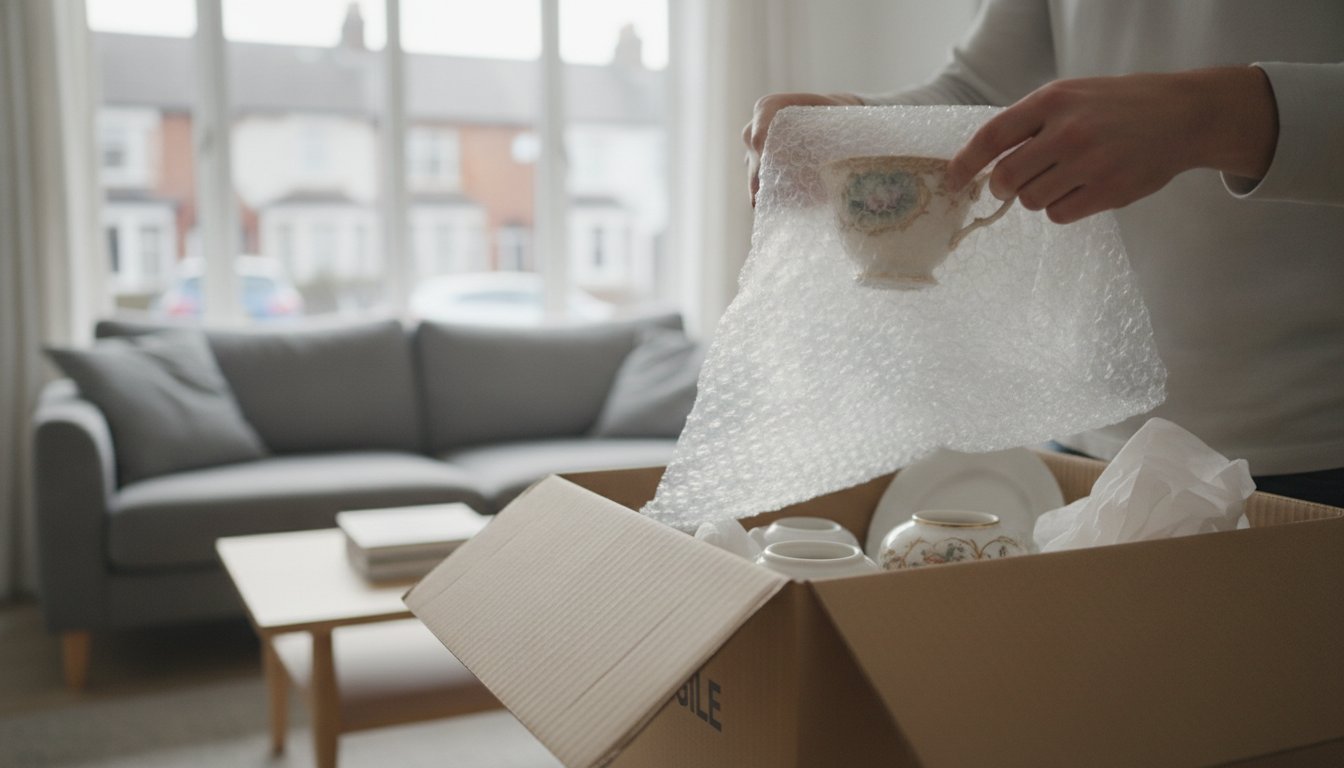
Imagine the sinking feeling of arriving at your new home, opening a box marked "kitchen," and hearing the unmistakable rattle of broken porcelain. It's a moment many of us dread, especially when the items inside aren't just things, but memories like a grandmother's tea set or a favourite crystal vase. We understand that the fear of damage is one of the biggest hurdles during any relocation. You shouldn't have to worry about flimsy cardboard collapsing under pressure or your most precious belongings shifting in transit.
This guide shows you exactly how to choose the right moving boxes for fragile items and use professional packing techniques to ensure your breakables arrive in one piece. We'll walk you through everything from the structural benefits of double-walled protection to the methodical steps for creating a cushioned environment. We'll also help you select the perfect box sizes for different items, giving you the confidence and the strategy needed for a completely damage-free move.
Key Takeaways
- Learn why double-walled cardboard is the essential standard for protecting delicate belongings from being crushed under weight.
- Discover why choosing smaller moving boxes for fragile items is the safest way to prevent internal movement and structural collapse.
- Master the correct way to layer bubble wrap and removal blankets to provide both primary cushioning and secondary impact protection.
- Understand the professional technique of vertical packing and base-layer cushioning to ensure your items withstand the bumps of the road.
- Recognise how a small investment in heavy-duty supplies can save you from the significant expense and heartache of replacing prized possessions.
Understanding Box Strength: The Case for Double Wall Protection
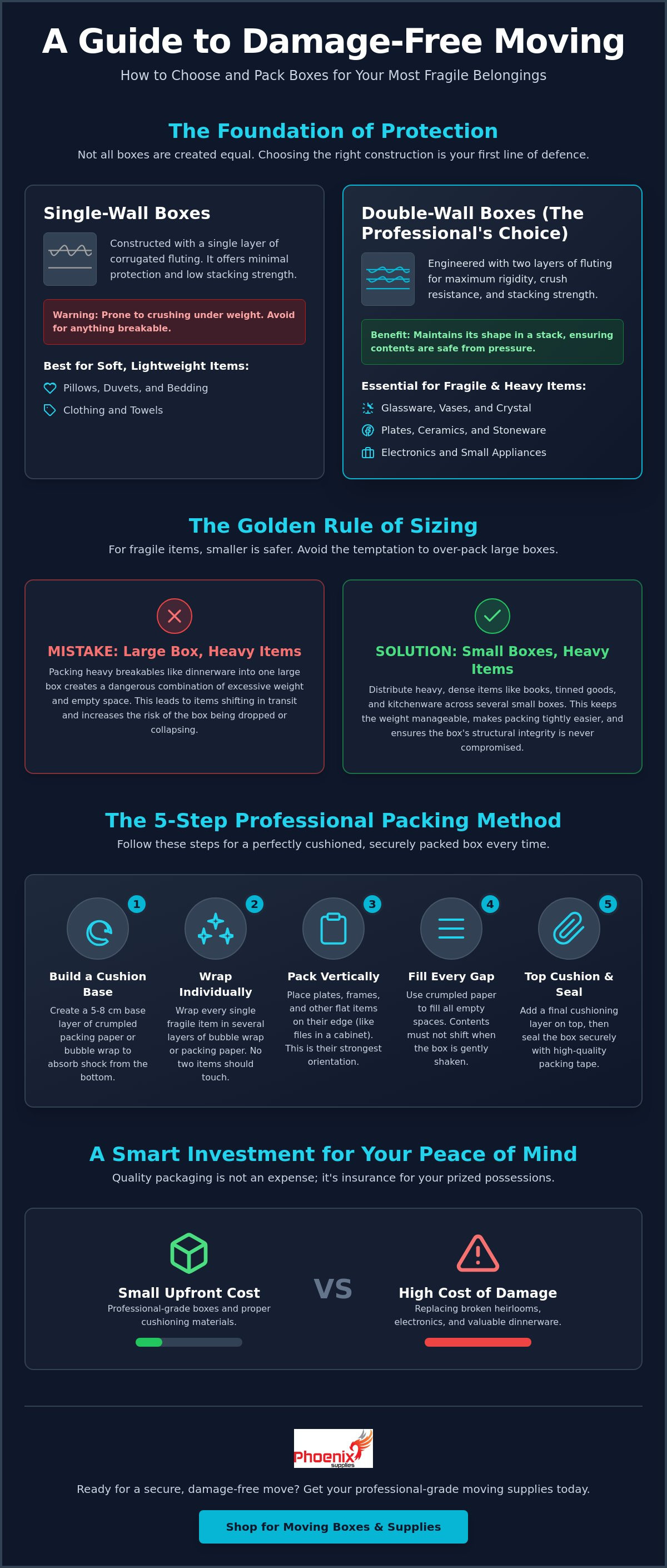
When you're preparing for a move, the foundation of your strategy begins with the physical integrity of the containers you choose. Not all cardboard is created equal. For your most precious belongings, you need to look specifically for double-wall construction. This type of cardboard is engineered with two layers of corrugated fluting sandwiched between three layers of linerboard. This design provides a robust buffer that offers maximum puncture resistance and structural rigidity.
Understanding the principles of packaging is vital here; protection isn't just about wrapping an item, but about the external shell's ability to withstand the environment of a removal van. Whilst single-wall boxes are perfectly fine for lightweight items, they lack the necessary stacking strength to protect breakables. If a single-wall box is placed at the bottom of a stack, the weight from above can cause the sides to bow, leading to a collapse that crushes the contents inside.
Choosing high-quality moving boxes for fragile items is a deliberate investment in your peace of mind. While these heavy-duty options may have a slightly higher initial cost than standard boxes, that price is negligible when compared to the replacement cost of a family heirloom or a modern television. These boxes are designed to pass rigorous crush tests, ensuring they can handle external pressure without compromising the safety of your valuables.
Single Wall vs Double Wall: Which Do You Need?
It's helpful to categorise your belongings before you start buying supplies. Single-wall boxes are ideal for soft, non-breakable goods, from pillows and duvets to your everyday wardrobe. However, for anything made of ceramic, glass, or stone, double-wall protection is mandatory. You can easily identify these boxes by looking at the corrugated edge of a flap; a double-wall box will show two distinct layers of arched fluting rather than just one.
The Science of Stacking Strength
The strength of a box comes from its vertical fluting, which acts like a series of tiny pillars supporting the weight above it. This is why salvaged supermarket boxes often fail. They've usually been weakened by moisture or previous handling, which causes those internal pillars to soften and buckle. Stacking strength is the maximum load a box can support without buckling. By using professional-grade moving boxes for fragile items, you ensure these vertical supports remain intact even when the van hits a bump in the road or the load shifts during transit.
Selecting the Correct Box Size for Fragile Belongings
Selecting the right scale for your moving boxes for fragile items is just as important as the material itself. A common mistake is assuming that a larger box is better because it holds more, but for delicate items, the opposite is usually true. The more fragile an object is, the smaller the box should be. This approach limits the amount of internal movement and ensures the box doesn't become so heavy that it's dropped or dragged, which are the leading causes of damage during a move.
Over-packing a large box with heavy, breakable items like dinnerware or stoneware creates a significant risk. Cardboard has its limits, and even the strongest double-walled material can struggle if the internal weight exceeds what a person can comfortably carry. For specific high-value items, standard sizes won't always suffice. Wardrobe boxes provide a hanging rail that keeps delicate garments from being organised and hanging freely so they aren't crushed at the bottom of a stack, whilst extra-large boxes specifically designed for flat-screen televisions offer the wide, slim profile needed to keep monitors upright and secure.
Small Moving Boxes for Heavy Breakables
Items like books, tinned goods, and heavy kitchenware belong in small moving boxes. Keeping these dense items in smaller containers ensures the box remains structurally sound and manageable for whoever is doing the lifting. When you use smaller moving boxes for fragile items, you also reduce the volume of cushioning material needed to fill the gaps, making the entire package more compact and less prone to collapsing under the weight of other boxes. It's much better to have ten small, light boxes than three large ones that are impossible to move safely.
Large and Tall Boxes for Awkward Fragiles
Larger containers are best reserved for items that are physically big but relatively light. Wardrobe boxes are a fantastic solution for more than just clothes; their height makes them ideal for tall floor lamps or garden tools that are difficult to wrap. If you're packing lampshades or large decorative ornaments, a larger box gives you the room to surround the item with plenty of protection without squeezing it.
The key to using larger boxes safely is ensuring no void space remains. Any empty pocket allows the contents to rattle, which is how most breakages occur. Following step-by-step packing instructions will help you fill those gaps with scrunched paper or bubble wrap. If you're unsure which sizes you need for your specific rooms, looking at a complete range of removal supplies can help you plan your packing strategy more effectively and with much less stress.
Essential Protective Materials for a Damage-Free Move
Securing the right moving boxes for fragile items is only half the battle. To truly safeguard your belongings, you need a multi-layered suspension system inside the box. High-quality materials act as shock absorbers, preventing the vibrations of the road from reaching your delicate glassware or electronics. Without these internal barriers, even the strongest box won't prevent items from knocking against each other during transit.
Bubble wrap serves as your primary line of defence, offering a resilient air-cushion that absorbs impact. For larger items like sideboards or televisions, removal blankets provide a secondary barrier that prevents surface scratches and dings. It's also vital to use professional-grade packing tape. Many people make the mistake of using standard stationery tape, which can't support the weight of a full box. A strong seal on the bottom prevents the "trapdoor" effect where the box opens mid-lift. Finally, don't forget mattress and furniture covers. These polythene shields are essential for keeping dust and moisture away from your upholstery whilst items are being moved through hallways or stored in the van.
Bubble Wrap: Choosing the Right Grade
Not all wrap is the same. Small bubbles are best for protecting delicate surfaces from scratches, making them ideal for small ornaments or polished silver. Large bubbles, however, are designed for heavy-duty shock absorption and should be used to fill large voids or wrap heavier ceramics. We recommend the "two-layer rule" for glass and ceramics: wrap each item individually in a layer of small bubbles, followed by a second layer of large bubbles for impact protection. You can find various Bubble Wrap Rolls to suit different needs, ensuring every piece of stemware is properly insulated.
Removal Blankets and Furniture Covers
Textile removal blankets are a staple in the removal industry for a reason. Unlike plastic wrap, which can trap moisture and damage wood finishes, thick textile blankets allow furniture to breathe whilst providing a heavy-duty shield against knocks. They are particularly useful for mirrors and framed art. For the best results, follow tips for packing specific fragile items by creating a "sandwich" of protection: wrap the mirror in a blanket, then secure it between two sheets of flat cardboard. For soft furnishings, always use polythene covers for sofas and mattresses. These maintain hygiene and protect against the inevitable grime of a removal van, ensuring your bed is clean and ready to use the moment you arrive.
How to Pack and Stack Fragile Boxes Like a Professional
Having the right supplies is a great start, but the way you arrange items inside your moving boxes for fragile items determines whether they survive the journey. Professional packing is about more than just wrapping; it is about creating a suspension system that keeps your valuables stationary. Before any item goes into a box, you must create a "buffer zone" at the base. Use scrunched-up packing paper or a thick layer of bubble wrap to create a 2 to 3-inch cushion. This layer acts as a shock absorber, protecting the contents from the vibrations of the road and the impact of being set down on hard surfaces.
Communication is the final piece of the packing puzzle. You should label every box on at least two sides. Don't just write on the top, as this is often hidden when boxes are stacked. Use a bold marker to write "Fragile" and "This Way Up" in clear, large letters. This ensures that anyone helping with the move knows exactly how to handle the container and which way it needs to sit in the van to keep the internal pressure distribution correct.
The Professional Packing Sequence
Success starts with a strong foundation. Use the "H-taping" method to secure the bottom of your box by taping across the centre seam and then across both side seams. This reinforces the edges and prevents the bottom from bowing. When filling the box, always place the heaviest items at the base and the lighter, more delicate pieces on top. For kitchenware, remember to pack plates vertically on their edges rather than stacking them flat. Plates are much stronger when standing up, similar to how an arch supports weight. Once the box is full, fill every remaining gap with void-fill material. Shake the box gently; if you hear a rattle, you need more padding.
Loading the Van for Safety
The biggest risk to your belongings often happens inside the removal van itself. To prevent damage, you must stack your boxes logically. Place your heaviest, most stable containers at the bottom to form a solid base. Your moving boxes for fragile items should always be placed in the top third of a stack, ensuring they are never crushed by heavy furniture or dense archive boxes.
To stop the load from shifting during transit, use webbing straps to tie down tall items and box stacks against the internal rails of the van. This is a step many people skip, yet it is the only way to ensure a sudden brake doesn't send your crockery flying. If you want to move with total confidence, get your professional packing supplies and webbing straps here to secure your load properly.
Why Quality Packaging is a Smart Investment for Your Move
Investing in professional supplies is often the most cost-effective decision you can make during a relocation. When you compare the price of a comprehensive kit of moving boxes for fragile items against the replacement cost of a high-definition television or a set of crystal glasses, the value becomes clear. It is about more than just pence and pounds; it is about the peace of mind that comes from knowing your belongings are secured in heavy-duty, double-walled protection. You shouldn't have to spend your first night in a new home tallying up the cost of broken memories.
High-quality boxes are also an environmentally conscious choice. Because they are built to last, professional-grade containers don't have to be thrown away after a single use. You can easily fold them flat to store for a future move, pass them on to a neighbour, or even sell them to other local movers. This longevity keeps cardboard in use for longer and reduces the demand for new materials, making your move a little bit greener.
Avoiding the "False Economy" of Free Boxes
It is tempting to collect free boxes from local supermarkets, but this often proves to be a false economy. These boxes are frequently weakened by moisture from refrigeration or previous heavy handling, which compromises their structural integrity. They also come in irregular sizes, which makes stacking them in a van difficult and slow. Professional-grade materials speed up your packing process because they are uniform in size, allowing you to build stable, predictable stacks that won't shift. Some industry professionals report that using professional-grade packaging can reduce the risk of transit damage by up to 70% compared to using second-hand, compromised materials.
The Phoenix Supplies UK Commitment
At Phoenix Supplies UK, we pride ourselves on being a family-run business that values personal connection over automated systems. We understand that moving house is one of the most stressful events in life, and our dedicated office team is here to offer straightforward, helpful advice. Whether you are an individual tackling a personal project or a commercial fleet manager with high-volume requirements, we provide the same level of dependable service and unpretentious support.
We offer national delivery across the UK to ensure you have access to professional-grade tools regardless of your location. From small moving boxes for fragile items to extra-large TV containers, our goal is to be your steady guide through the entire relocation process. By choosing reliable supplies, you aren't just buying cardboard; you are ensuring your memories arrive at your new home exactly as they left your old one.
Secure Your Belongings for a Stress-Free Move
Protecting your most cherished items doesn't have to be a source of anxiety. By choosing double-walled protection and the correct container sizes, you create a physical shield that standard boxes simply can't match. We've explored how a methodical packing sequence and the right internal cushioning ensure your valuables remain stationary and safe throughout their journey. These professional techniques turn a potentially chaotic process into a controlled, successful relocation.
Selecting high-quality moving boxes for fragile items is the best way to safeguard both your belongings and your peace of mind. As a family-run business, Phoenix Supplies UK is proud to offer personalised support and high-quality double-wall cardboard as standard. We provide national UK delivery to ensure you have the best materials at your doorstep exactly when you need them. Browse our range of heavy-duty moving boxes and protective supplies today to start your journey on the right foot. You've done the hard work of planning; now let us provide the reliable tools you need for a damage-free move.
Frequently Asked Questions
Do I really need double-wall boxes for everything?
No, you don't need double-wall strength for every item, but they are vital for anything delicate or heavy. Use single-wall boxes for lightweight goods like towels, linens, and clothing. However, for ceramics, electronics, and heavy kitchenware, the extra layer of corrugated fluting in moving boxes for fragile items provides the necessary stacking strength to prevent the box from collapsing under pressure.
How much bubble wrap do I need for a standard three-bedroom house move?
A standard three-bedroom home typically requires between 50 and 100 metres of bubble wrap to ensure adequate protection for all breakables. This estimate covers the individual wrapping of kitchenware, ornaments, and delicate electronics. If you have a large collection of glassware or high-value collectables, it is always safer to have an extra roll on hand to avoid running out mid-pack.
Can I use newspaper to wrap my fragile china and glassware?
Whilst newspaper is a cheap option, we generally advise against it for high-value china and glassware. The newsprint ink is often acidic and can permanently stain porous ceramics or leave a messy residue on glass that is difficult to remove. Professional packing paper or bubble wrap is a much cleaner and more reliable alternative for your most prized sets.
What is the best way to pack a flat-screen TV without the original box?
The safest method is to use an Extra Large TV Moving Box combined with plenty of cushioning. Wrap the screen in several layers of bubble wrap or a soft removal blanket before sliding it into the heavy-duty box. Ensure the TV remains upright at all times during the move; laying a flat-screen monitor down can lead to internal pressure damage or screen cracking.
How do I stop items from moving inside the box during the journey?
Eliminating "void space" is the most effective way to prevent items from shifting. Once your items are wrapped and placed inside, fill every remaining gap with scrunched paper or bubble wrap until the contents don't move when the box is gently shaken. This creates a solid internal structure that resists external pressure and prevents items from knocking together during transit.
What tape is best for securing heavy-duty moving boxes?
You should use a high-quality, heavy-duty packing tape that is at least 48mm wide. Standard stationery tape is too thin and brittle to support the weight of full boxes. Look for tape with a strong adhesive designed specifically to bond with cardboard, and always use the "H-taping" method on the base for maximum reinforcement of the seams.
Is it better to buy a moving pack or individual boxes?
Buying a pre-made moving pack is often the most sensible choice for a full house relocation. These kits are curated based on typical room requirements, providing a balanced mix of small, medium, and large containers along with essential tape and wrap. However, if you only have a few specific items to protect, purchasing individual moving boxes for fragile items allows for more precision in your strategy.
How do I protect large furniture items that won't fit in a box?
For items that are too large for standard containers, textile removal blankets and furniture covers are your best option. Wrap the item completely in a thick blanket and secure it with webbing straps to provide a heavy-duty shield against scratches and knocks. For upholstered items like sofas and mattresses, use specific polythene covers to keep them clean and dry whilst in the van.


