

A plastic bin can carry books, but it still needs to be small enough to lift comfortably. To learn how to pack books without breaking your back, choose a sturdy container, spread the weight across several boxes and stop before a box becomes too heavy. The same rules apply to cardboard boxes: keep each load manageable and prevent books from shifting inside.
Books are easy to underestimate, so plan for comfortable lifting as well as protection. This guide explains how to choose a suitable box or bin, arrange books to support their covers and spines, and fill gaps so they stay in place. You’ll also learn when to wrap individual books for extra protection, including valuable or sentimental volumes.
Key Takeaways
- Choose a sturdy, manageable container and reinforce its base before adding books.
- Arrange books snugly and fill gaps to limit movement while the box is carried.
- Use a plastic bin or another suitable container when it helps you keep the load easy to handle.
- Wrap delicate covers and spines with care, keeping the padding secure without bending the book.
Choosing small, sturdy boxes and reinforcing their bottoms
Choose a compact box that’s strong enough for books, then reinforce its base before packing. Handles can make a box easier to grip, while wheeled crates help on smooth routes. Free or inexpensive boxes may also be available from local bookshops, supermarkets or community groups.
-
Choose Small, Sturdy Book Boxes
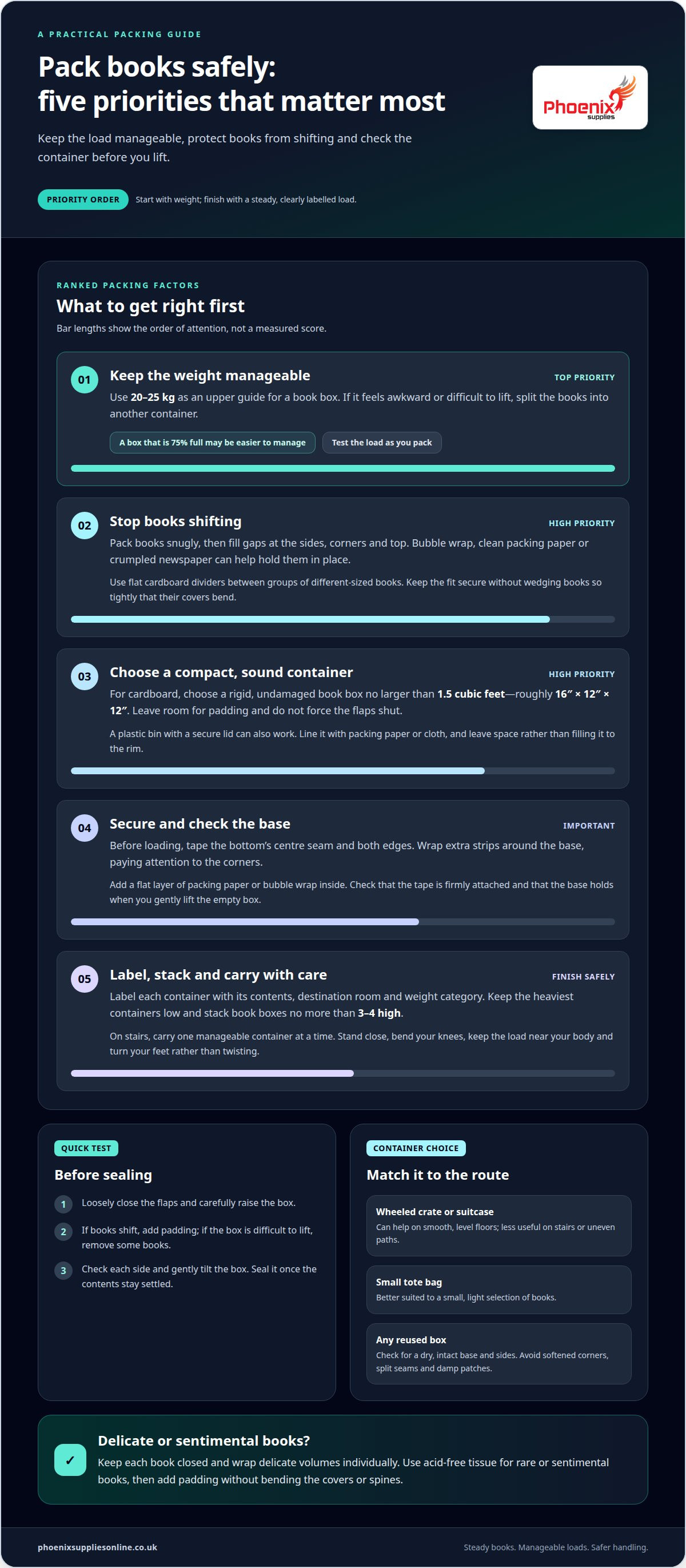
Start with a rigid, undamaged cardboard box designed for moving, rather than a flimsy box that flexes under pressure. A book box should be no larger than 1.5 cubic feet, roughly 16" x 12" x 12". Small boxes limit the weight you need to lift and are easier to carry through doorways or up stairs. Avoid boxes with softened corners, split seams or damp patches.
-
Select a Suitably Sized Box
Choose a size that fits your books with little spare room, while leaving space for packing paper or bubble wrap. Books should sit snugly without forcing the flaps shut or bulging the sides. A box of heavy hardbacks can become awkward to lift before it looks full, so test the load as you go. Handles help only if they’re properly cut and the cardboard around them stays firm. Wheeled crates can help on level floors, but are less useful on stairs or uneven paths.
For free or inexpensive boxes in the UK, ask nearby bookshops or supermarkets about spare, clean cartons, or look at local community groups. Choose boxes with dry, intact bases and sides, even if they’re second-hand.
-
Reinforce Box Bottoms
Before loading books, close the bottom flaps and tape the centre seam. Add tape along both edges, then wrap strips around the box to secure the base. This helps create a firm bottom and keeps the flaps from opening under the load. Check that the tape adheres fully, especially at the corners. Place a flat layer of packing paper or bubble wrap inside to cushion the first books, then gently lift the empty box to check that the base holds.
Filling empty space to prevent books shifting
- Pack books closely, then fill any remaining gaps. Bubble wrap or crumpled newspaper can stop books sliding when you lift or tilt the box. Tuck padding along the sides and into the corners instead of leaving one large empty space. Books shifting across the box can knock against each other, so check for movement before sealing.
Try the lift test: loosely close the flaps, carefully raise the box, then set it down. If the books shift, add padding. If the box feels difficult to lift, remove some books and use another container. A snug fit should hold the books steady without forcing them against the walls.
- Use flat cardboard dividers between groups of books when their sizes leave uneven gaps. For example, a divider can keep slim paperbacks upright beside thicker hardbacks. Add packing paper around the edges to stop the divider and books sliding together. Pack the contents closely, but don’t wedge books so tightly that their covers bend.
Check reused padding before packing. Dry, clean paper and intact cardboard work better than damp or torn material, which can collapse or mark covers. If you use clothing or linens as cushioning, make sure they’re clean and arranged so the books don’t move around inside the box.
- Control the weight as you fill the container, not after it’s sealed. A box weighing 20-25 kg is a useful upper guide for reducing lifting strain and the risk of box damage. If the load feels awkward, split the collection across another box, even when space remains. A box that is 75% full of books can be easier to manage than one packed completely and made too heavy.
Check the box from each side before sealing. Books should stay in place when the box is gently tilted, with padding filling gaps at the top and around the edges. This keeps the load stable without adding unnecessary weight. Seal the box once the books and filler stay settled when you lift it.
Can I pack books in plastic bins instead of cardboard?
Yes. Plastic bins can hold books if each load stays manageable and the books can’t slide around inside. To move books without lifting heavy boxes, use wheeled luggage on level floors, split the load or ask someone to share the carry. For a controlled lift, stand close, bend your knees, keep the load near your body and turn your feet rather than twisting.
- Choose a container to suit the route. A plastic bin with a secure lid can work well for storage or a short move. Line it with packing paper or cloth to cushion the books against the sides and help protect them from condensation. A suitcase with wheels can be useful on smooth floors, while a tote bag is better for a small, light selection. Avoid using a large wardrobe box for books, as its size can encourage an awkwardly heavy load.
- Set a weight limit before packing. Keep book boxes at or below 20-25 kg as a guide, and divide the load if it feels difficult to lift. A bin’s capacity is not a target: leave space rather than filling it to the rim. Oversized or overfilled containers are harder to carry and can strain their base, even when their sides appear sturdy.
- Label each box or bin with its contents, destination room and weight category, such as “books, study, heavy”. Mark the top so the direction stays clear during stacking and unpacking. Keep the heaviest containers low, and stack book boxes no more than 3-4 high. That makes the lower boxes easier to reach and reduces pressure on their contents.
- Before moving the load, check the bottom, lid and handles. Lift one side slightly to see whether the books shift; add padding or remove books if they do. Carry one manageable container at a time on stairs, keeping your path clear. At your new home, place each labelled box near its shelf or bookcase to make unpacking more straightforward.
Wrapping and padding individual books
The safest method is to keep books closed, wrap delicate volumes individually and cushion them inside the box. Use acid-free tissue for rare or sentimental books, then add padding without bending their covers or spines.
- Sort books by condition before wrapping. Set aside rare, sentimental or fragile volumes, such as an old family album, for extra care. Keep each book closed to help its covers and pages stay aligned during transport. A flexible plastic cover can protect the surface from friction, but it won’t stop the spine bending, so use firm support too.
- Wrap valuable books first in acid-free tissue, then add a second layer of packing paper. Keep the tissue between the covers to prevent rubbing, and secure the paper with paper tape. For added cushioning, wrap rare books in bubble wrap, adding another layer where needed. Keep the wrapping firm, but not so tight that it bends the book.
- Protect paperbacks from curling by keeping them closed and supported. Wrap each one in packing paper or bubble wrap, then place it between books or flat cardboard. A bubble-wrap envelope alone may not prevent bending if the book can flex inside it. Newspaper can fill a gap in the box, but use clean, dry sheets and avoid letting print rub directly against delicate covers.
- Place wrapped books so they can’t slide freely inside the box. Add packing paper or other padding around each side, and check that no hard edge presses against a cover. Cushion corners and spines, especially on older hardbacks. Before sealing, gently tilt the box. If a book shifts, add padding or rearrange the load.
Pair careful wrapping with a suitably sized small moving box to help keep books supported during the move.
Phoenix Supplies UK: Small Moving Boxes
Phoenix Supplies UK offers Small Moving Boxes for book collections that need dividing into manageable loads. They’re a practical choice when you want to avoid filling one large box with heavy hardbacks. For mixed belongings, Medium Moving Boxes and Large Moving Boxes offer other sizes to match the items being packed. Extra Large TV Moving Boxes are designed for a different packing need, rather than a small stack of books.
Choose a box size to suit your books and the weight you can comfortably carry. Split a large collection between smaller boxes, then add padding to limit movement in transit. This keeps each load easier to organise and helps protect books during the move. For help choosing suitable boxes, contact Phoenix Supplies UK.
Plan your next move with confidence
Think about how your books will fit into daily life at your new home. Choose where the main bookcase will go and decide which titles you’ll want close at hand during the first few days. Planning ahead gives the collection a clear destination, rather than leaving you to sort through every carton after the move. If several people share the books, agree on the room and shelf space before moving day.
A little advance planning can make the move feel more settled from the start. For advice on preparing for your move, contact Phoenix Supplies UK. You can take the next step at a pace that suits you, with a clear plan for the books and the home they’re going to.
Frequently Asked Questions
How do I move books without damaging them if I have a huge collection?
Plan how to pack books without breaking your back by recording each bookcase before you start. Note the shelf order, then label cartons with a matching sequence, such as “study bookcase, shelf A”. Keep the sequence consistent as you pack, and store the notes with your moving checklist. This makes it easier to restore a large library’s arrangement without relying on memory.
How heavy should a box of books be?
There isn’t one comfortable weight for everyone. Your strength, grip, box shape and route all affect what you can carry steadily. Weigh a sample carton once it contains the books and wrapping you plan to use. If the handles feel awkward or the box tips as you lift it, reduce the contents before packing the rest in the same way.
Should books be packed flat or upright?
Match each book’s position to its shape. Standard-sized books can stand as they do on a bookcase, while oversized volumes, such as a large-format art book, are easier to support flat. Keep stacks even rather than letting one edge overhang. This helps the covers support the pages and stops unusually sized books from being squeezed into an unsuitable row.
Why is packing books spine-up bad?
A book resting on its narrow spine edge has less support beneath it than one resting on its cover. Pressure can concentrate along the binding instead of spreading across the book’s broader surface. During a bumpy journey, that uneven support can strain the joint between the cover and pages. Position the book so its weight rests on a wider, supported face.
How heavy should a box of books be to lift safely?
Choose a load you can raise smoothly, hold securely and set down with control. Before packing the whole collection, test a representative box along the route you’ll actually take, including any doorway or landing. If you need to change your grip midway, make the next box lighter. A stable hold matters as much as the reading on the scales.
What size boxes are best for packing books?
Choose compact cartons to suit the books you’re carrying, rather than using one oversized box for every format. A box for paperbacks may leave too much unused space around large albums, so pack those formats separately. Where practical, use a consistent carton size for ordinary books. Uniform loads are easier to arrange in a vehicle and simpler to sort into bookcases later.


