
Did you know that at least one in five damage reports from home moves involves a broken television? When that screen features a premium curve, the risk of a costly crack or structural failure increases significantly. Learning how to pack a curved TV for moving is essential for protecting your investment, especially if you binned the original manufacturer's packaging years ago and find that standard boxes are simply too thin for a heavy 55-inch set.
We understand that the thought of your screen flexing or snapping during transit is incredibly stressful. This guide will show you how to master the specialist techniques and professional materials required to move a fragile display without risking damage. We will walk you through the entire process, from selecting heavy-duty TV moving boxes to the methodical way you should wrap and secure the screen to eliminate the dangerous "arc-gap." You will gain the expert knowledge needed to ensure your television arrives at your new home in perfect condition, ready for your first film night in the new place.
Key Takeaways
- Understand the specific structural risks of curved screens, such as torsional stress and point pressure, to prevent the glass from cracking during transit.
- Discover how to pack a curved TV for moving by using heavy-duty double-wall boxes that properly account for the depth of the screen's arc rather than just its width.
- Identify the essential materials needed, from non-abrasive removal blankets to large-cell bubble wrap, to fill internal voids and prevent the screen from flexing.
- Follow a methodical step-by-step process for safely removing stands and layering protective materials to create a professional-grade, cushioned package.
- Learn the safest techniques for loading your television into a van, including how to use webbing straps to lock the box securely against interior rails.
The Unique Challenges of Packing a Curved TV for Moving
Curved televisions are stunning pieces of engineering, but their physical design introduces structural vulnerabilities that flat screens simply don't face. When you are considering the unique challenges of packing a curved TV, you have to account for "torsional stress." Unlike a flat panel, which distributes pressure across a straight plane, a curved screen is under constant tension to maintain its shape. Any slight twist of the frame during a move can cause the glass to "pop" or crack. This is why learning how to pack a curved TV for moving requires a far more methodical approach than your standard household electronics.
Another significant risk is "point pressure." Because the screen arches, the apex of that curve becomes a natural target for impact. If a box is pressed against this arc, all the force concentrates on one tiny area rather than spreading out across the surface. Additionally, the centre of gravity on these models is often offset. Curved sets are notoriously prone to toppling because they don't sit as flush as flat models. It is vital to maintain an upright position at all times, as the internal glass layers aren't designed to support their own weight when laid horizontally.
Curved vs Flat: Why standard packing fails
Many people assume a standard flat-screen box will do the job, but these often create a dangerous "arc-gap." This is the empty space between the straight wall of the cardboard and the curved surface of the TV. Without specialist internal support, the TV can rattle or flex within this gap. The internal components in these sets are also tensioned differently to maintain that specific aesthetic. Whilst a flat TV might survive a bit of vibration amongst other items, a curved model needs a rigid environment to prevent the frame from warping. Simply wrapping a few blankets around the unit won't provide the structural integrity needed to stop the glass from flexing under its own weight.
Common mistakes that lead to screen failure
Avoiding these frequent errors is the first step to a successful move:
- Laying the TV flat: This is the most common cause of failure. The weight of the glass pressing down on the curved internal structure often leads to immediate hairline fractures.
- Using cheap, single-wall cardboard: Thin boxes buckle under the weight of a 55-inch or larger set. You need the rigidity of a double-wall box to ensure the packaging doesn't collapse if another item leans against it.
- Neglecting to remove the stand: A stand can act as a lever. If the box is jolted, the weight of the stand puts immense pressure on the mounting points, which can snap the screen's frame from the inside out.
Choosing the Right Flat Screen TV Packaging Box
When you're figuring out how to pack a curved TV for moving, the box you choose is the foundation of your screen's safety. Many people make the mistake of using a standard, single-wall box found at a local shop. These are designed for light items, not high-end electronics. A curved television requires a heavy-duty, puncture-resistant container that can withstand the rigours of a house move. High-quality corrugated cardboard is essential here. You want material that feels stiff to the touch and doesn't buckle when you apply pressure with your thumb.
The importance of Double Wall construction
Double wall construction is a specific type of cardboard where two layers of fluting are glued between three layers of linerboard. This creates a much thicker, more rigid wall than a standard box. It's absolutely vital for any television weighing over 20kg. These fluted layers do more than just provide strength; they act as a buffer against road vibrations. When a removal van hits a bump, those vibrations travel through the floor and into your belongings. The double-wall design absorbs that energy, preventing it from reaching the delicate, tensioned glass of your curved screen. Phoenix Supplies UK recommends heavy-duty boxes for all large electronics to ensure they don't get crushed amongst heavier furniture.
Sizing your box for the 'Curve Factor'
Measuring a curved TV is different from measuring a flat one. You can't just rely on the manufacturer's screen size. You need to calculate the "Curve Factor" to ensure a safe fit. This involves measuring the total depth of the unit. Place a straight edge across the front of the screen and measure back to the furthest point of the arc. This measurement is often much larger than people expect, and it's the most common reason why standard flat-screen boxes fail.
Once you have your dimensions, apply the 5cm rule. You need at least five centimetres of space on the front, back, top, and sides. This space isn't just for the TV; it's for the protective materials that will fill the arc-gap we mentioned earlier. Choosing from a range of Extra Large TV Moving Boxes is the best way to guarantee you have this clearance. It's always safer to have a box that's slightly too big than one that's too tight. If the box is too small, any external impact will be transmitted directly to the screen. You can browse our full range of moving supplies to find the perfect fit for your specific model.
Essential Materials for Professional-Grade Protection
Securing a sturdy double-wall box is only half the battle. You also need to focus on the internal "armour" that keeps the screen stationary during transit. Standard household items like old duvets or thin towels simply aren't up to the task. They compress too easily under the weight of a large set, which leaves the screen vulnerable to shifting inside the box. When learning how to pack a curved TV for moving, you should prioritise materials that offer both cushioning and structural support. High-quality bubble wrap and textile blankets are the industry standard for a reason, as they don't lose their shape under pressure.
You'll need a few specific items to do the job properly:
- Large-cell bubble wrap: These larger bubbles provide the necessary depth to fill the curve's void.
- Removal blankets: These thick, quilted covers offer a non-abrasive first layer of protection.
- Heavy-duty packing tape: Essential for reinforcing the base of your box so it doesn't "bottom out" during a lift.
- Foam corner protectors: These suspend the TV within the box, ensuring the edges don't touch the cardboard walls directly.
Bubble wrap: more than just a cushion
The secret to protecting a curved screen is using bubble wrap to "level" the surface before it ever enters the box. By layering bubble wrap into the arc of the screen, you turn a curved profile into a flat one. This effectively eliminates the dangerous arc-gap we discussed earlier. For a 65-inch curved TV, you'll typically need at least three to four full wraps to provide adequate protection. It's vital that you don't apply packing tape directly to the screen surface. The adhesive can leave permanent marks or damage the anti-glare coating. Always secure the wrap to itself or to a protective blanket layer instead.
The role of removal blankets and furniture covers
Using Removal Blankets as your primary layer is a smart move for any homeowner. Textile blankets are far superior to plastic sheets for the initial wrap because they're breathable and non-abrasive. They prevent the tiny scratches that can occur if dust gets trapped between the screen and a plastic cover. Once the blanket is in place, you can add a polythene furniture cover to prevent static build-up and keep moisture away during the move. This combination of a soft textile buffer and a waterproof outer layer provides the best possible environment for your television whilst it's in the removal van.
Step-by-Step: How to Pack Your Curved TV Safely
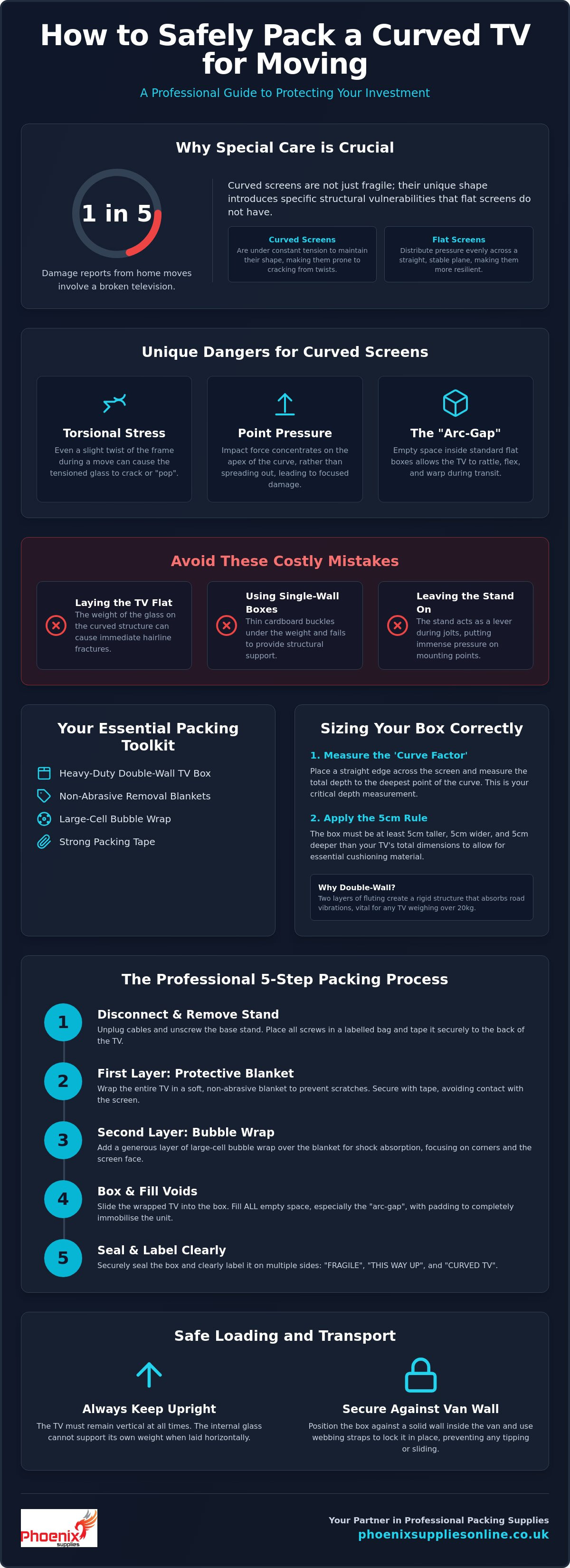
Now that you have gathered your professional-grade materials, it's time to execute the pack. Following a methodical process is the only way to ensure your screen survives the journey. When you are learning how to pack a curved TV for moving, remember that haste is your enemy. Take your time with each layer to create a professional-shield around the glass. If you rush, you risk leaving gaps that allow the unit to shift during transit.
- Step 1: Clean and dismantle. Use a microfibre cloth to remove all dust from the screen. If dust is trapped under your wrap, it can act like sandpaper against the anti-glare coating. Remove the stand or wall mount and pack these in a separate box to avoid them pressing against the frame.
- Step 2: The primary wrap. Enclose the entire unit in a soft removal blanket. Secure it with tape, but ensure the tape only touches the blanket, never the TV itself.
- Step 3: Level the profile. Use large-cell bubble wrap to fill the concave arc of the screen until the front of the package is flat. We will detail this "Pillow Technique" below.
- Step 4: Box and block. Slide the TV into your double-wall box. Place foam corner blocks on all four corners to suspend the unit away from the cardboard walls.
- Step 5: Seal and sign. Close the box and use heavy-duty tape on all seams. Use at least three layers of tape on the bottom to prevent the box from opening under the weight.
Filling the 'Arc-Gap'
The biggest risk during transit is lateral shift. If the TV can move even a centimetre inside the box, the momentum of a sudden stop can cause a crack. Professional movers use the "Pillow Technique" to solve this. This involves bunching bubble wrap into a thick, soft cushion that matches the depth of your screen's curve. Once this is taped over the blanket layer, the front of your TV package should look like a flat rectangular block. This ensures that the TV cannot shift laterally once inside the box. Before you seal the top, perform the "gentle shake" rule: if you hear anything moving inside, you need more padding.
Labeling and orientation
Orientation is everything for a curved set. Use a thick marker to draw "This Way Up" arrows on all four sides of the box. You should also clearly mark which side of the box contains the screen. When loading the van, the screen side should always face a flat, sturdy wall or a large piece of furniture like a wardrobe to prevent anything from piercing the cardboard. Don't forget to organise your cables. Coil them neatly and place them in a separate bag. Taping them to the back of the TV is a mistake, as the plugs can easily scratch the frame during the vibrations of the journey. To get started with the right equipment, you can buy your Extra Large TV Moving Boxes here to ensure a secure fit.
Loading and Transporting Your TV in the Removal Van
Once you have mastered how to pack a curved TV for moving, the final hurdle is the journey itself. Some people suggest placing the box on a car's back seat, but this is a mistake. Car seats are soft and angled, which causes the box to tilt and puts uneven pressure on the screen's arc. The safest place for your television is inside a removal van, standing perfectly upright on a flat, level floor. This ensures the internal glass layers are supported as the manufacturer intended.
Position the TV box between two heavy, stable items like a wardrobe and a chest of drawers. This creates a "sandwich" effect that prevents the box from sliding during transit. You must never stack other boxes or heavy items on top of the TV box. Even a double-wall box has its limits, and vertical pressure can cause the cardboard to bow inwards. If the cardboard touches the apex of the curved screen, even a small bump in the road can lead to a crack.
Securing the load with webbing straps
To prevent the box from toppling, you should secure it to the van's interior rails. Using Webbing Straps is the professional way to do this. Unlike bungee cords, which are far too elastic and allow for dangerous bouncing, webbing straps provide a firm, inelastic hold. This creates a "tension cage" that keeps the box stationary regardless of the road conditions.
Run the straps across the front of the box, ensuring they're tight enough to prevent movement but not so tight that they crush the cardboard. If you're driving the van yourself, take corners slowly and avoid sudden braking. Rapid deceleration is a major cause of internal shifting. Even if the box stays still, the TV inside can flex against its padding if the force is too great. A steady, methodical driving pace is just as important as the packing materials you've used.
The final check: unboxing at your new home
Your work isn't finished until the TV is safely on its stand in the new house. When you arrive, resist the urge to turn the television on immediately. If the move happened on a cold day, condensation can form inside the unit when it enters a warm room. This moisture can damage the electronics if you apply power too soon. It's best to wait at least two hours for the set to reach room temperature.
Always use a two-person lift when unboxing. Curved screens are awkward to handle, and trying to do it alone often leads to "point pressure" from your fingers on the glass. Carefully slide the TV out of the box and inspect the surface for any pressure spots before you discard your packaging. Keeping your Extra Large TV Moving Boxes for a few days is a sensible precaution just in case you notice any issues once the screen is powered up.
Secure Your Screen for a Stress-Free Move
Moving a premium curved television doesn't have to be a source of anxiety. By focusing on the structural integrity of a double-wall box and eliminating the dangerous "arc-gap" with methodical padding, you can protect your display from the most common transit risks. Mastering how to pack a curved TV for moving is simply a matter of having the right tools and following a steady, intentional process. From removing the stand to securing the final load with webbing straps, each step you take builds a layer of safety that ensures your favourite films look just as good in your new home as they did in your old one.
At Phoenix Supplies UK, we're here to help you get the job done right. As a family-run business, we take pride in offering personalised support and professional-grade materials that you can depend on. You can shop our range of heavy-duty Extra Large TV Moving Boxes at Phoenix Supplies UK, all made from double-wall corrugated cardboard for maximum strength. We even offer free national delivery on all our moving supplies, so you can focus on your move without worrying about extra costs. With the right preparation, your television will be ready for its first night in your new lounge.
Frequently Asked Questions
Can I move a curved TV without the original box?
Yes, you can safely move it by using a heavy-duty double-wall box designed for televisions. You'll need to use extra padding, such as bubble wrap and removal blankets, to create a custom fit that mirrors the original foam inserts. This method is the standard way to learn how to pack a curved TV for moving when the manufacturer's packaging is no longer available.
Is it safe to lay a curved TV flat for a short journey?
No, it's never safe to lay a curved TV flat, regardless of the distance. The internal glass layers are under tension and aren't designed to support their own weight horizontally. Laying the set flat often leads to hairline fractures or the screen "popping" out of the frame. You must keep the unit in an upright position during every stage of the move.
What size box do I need for a 55-inch curved TV?
You generally need a box that provides at least 5cm of clearance on all sides, including the extra depth created by the curve. A 55-inch television typically requires a safe packaging envelope of at least 140 x 90 x 25 cm. Using Extra Large TV Moving Boxes ensures you have enough room for the essential layers of bubble wrap and removal blankets.
How do I fill the gap behind the curve when packing?
You should fill the void using the "Pillow Technique" with large-cell bubble wrap. By bunching the wrap into a thick cushion, you can level out the profile of the set before it goes into the box. This prevents the TV from flexing or shifting laterally whilst the van is in motion, which is a critical part of how to pack a curved TV for moving safely.
Should I remove the stand before packing my curved TV?
Yes, you should always remove the stand or wall mount before you begin the packing process. Leaving a heavy stand attached creates a dangerous lever effect that can snap the internal mounting points if the box is jolted. Pack the stand and screws in a separate, clearly labelled box to keep them safely away from the delicate screen surface.
Can I use bubble wrap directly on the screen?
It's better to use a non-abrasive removal blanket as your first layer rather than applying bubble wrap directly. Plastic can sometimes trap moisture or leave patterns on anti-glare coatings if the temperature changes. Wrap the TV in a textile blanket first, then apply your bubble wrap over the top to provide the necessary impact protection and structural support.
What is the best way to secure a TV box in a moving van?
The best method is to use inelastic webbing straps to lock the box against the van's interior rails. Position the box upright between two heavy, stable items, such as wardrobes or sofas, to prevent it from sliding. Avoid using bungee cords, as their elasticity allows the box to bounce, which can lead to internal component failure or screen damage.
Does cold weather affect curved TV screens during a move?
Cold weather can cause condensation to form inside the television when it's moved back into a warm room. This moisture can damage the sensitive electronics if you turn the set on too quickly. Always allow your TV to sit at room temperature for at least two hours after a winter move before you plug it in and apply power.


